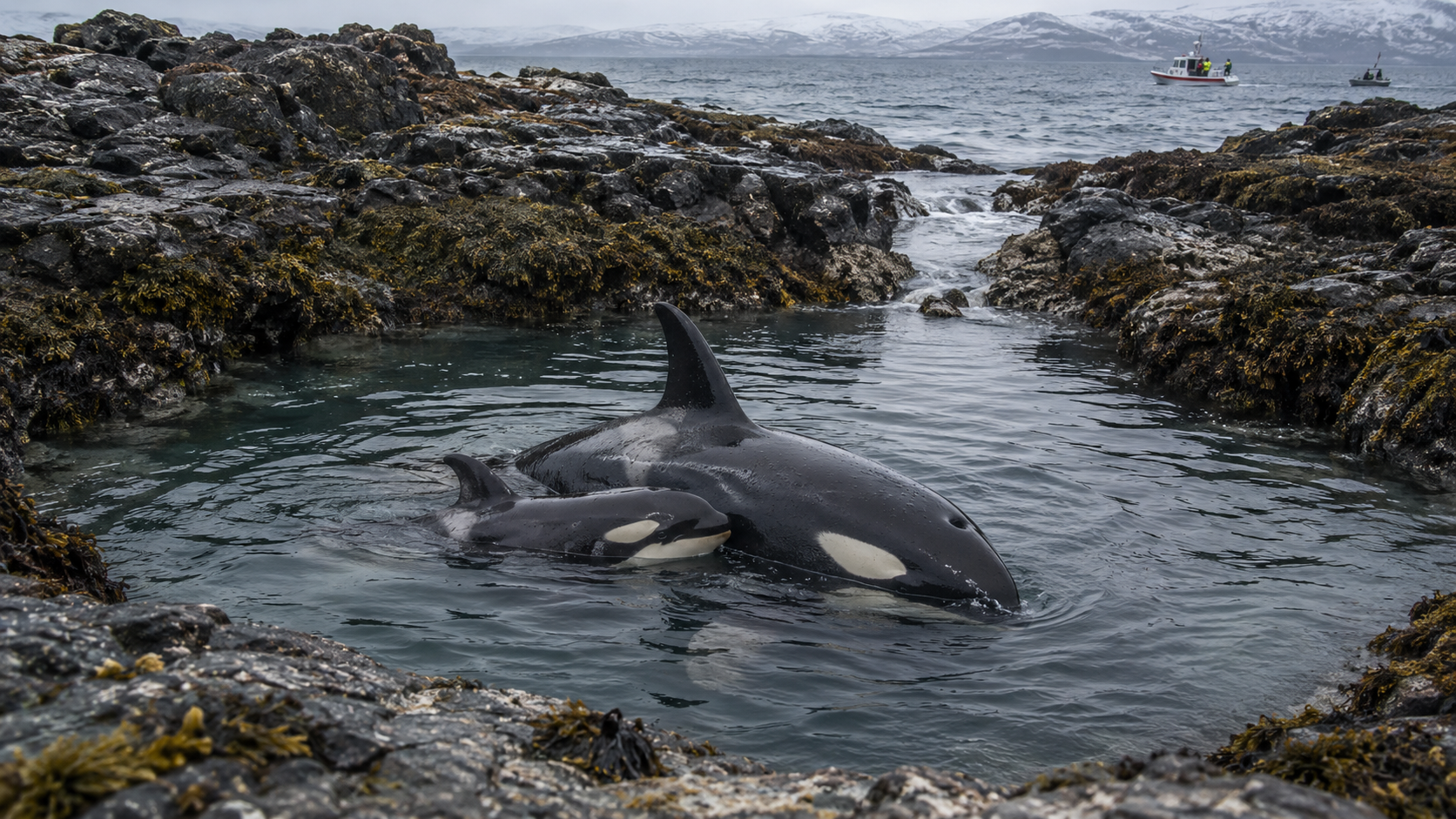
At first, there seemed to be only two whales in danger.
An adult female orca.
And the young calf staying beside her.
They were trapped inside a tiny tidal pool on the northern coast of Norway, surrounded by rocks and separated from deeper water by a difficult passage.
The calf was already getting thinner.
Food was scarce.
The tide was changing.
And each day inside the pool made the route back out more dangerous.
Then researchers sent a drone overhead.
What they saw changed the urgency of the situation.
The adult female was not simply trying to survive long enough to keep her four-year-old calf alive.
She was also late in pregnancy.
Suddenly, the rescue was no longer about only the two whales visible at the surface.
There was another calf depending entirely on what happened next.
And the exit was getting harder to use.
Two Orcas Had Entered a Place They Could Not Easily Leave
The report reached Norwegian Orca Survey in November 2019.
Two killer whales had been seen inside a small tidal pool on Vannøya, near Skjervøy in northern Norway.
One was an adult female listed in the Norwegian Orca ID catalogue as NKW-788.
The other was her approximately four-year-old calf.
Locals told researchers that the whales had already been there for days. A later scientific review recorded the entire entrapment as lasting about 10 days.
When the researchers arrived, the scene was concerning.
The pair were reportedly spending long periods almost completely still at the surface.
That kind of behavior can be one indication that killer whales are no longer simply exploring an enclosed area.
They may be conserving energy.
Or they may have become reluctant to attempt the route out.
The whales had almost certainly entered the pool by themselves.
Researchers believe they may have followed prey into the area during higher water.
Entering had been possible.
Leaving was becoming something very different.
The Pool Was Only About 50 Meters Across
The dimensions made the situation unusual.
Norwegian Orca Survey describes the tidal pool as no more than about 50 meters across and only around 8 meters deep even at high tide.
For two large marine predators, it was an extremely confined space.
Yet the greatest problem was not simply the size of the pool.
The route back to open water narrowed sharply.
The bottom also rose as the whales approached the exit.
Scientific observations of this 2019 case later documented the whales repeatedly approaching the mouth of the channel and then turning around where the passage became suddenly narrower and shallower.
That helps explain something that can seem strange from land.
The ocean was not impossibly far away.
There was no concrete wall.
There was no fishing net physically sealing the whales inside.
They had a route out.
But killer whales do not experience a shallow, rocky passage the way a human looking at a map does.
To move through it, they had to commit enormous bodies to water that became progressively tighter and shallower.
Then the tides began working against them.
Every Falling Tide Made the Exit More Difficult
Tidal water does not remain at the same depth.
That mattered enormously here.
Researchers reviewing natural killer-whale entrapments found that maximum water levels declined during the days following entry in several cases, including this one.
For NKW-788 and her calf, the falling water may have reduced both their ability and their willingness to enter the shallow exit channel.
Waiting therefore carried its own danger.
Perhaps another tide would encourage the whales to leave.
Perhaps they would eventually find the route themselves.
But perhaps they would not.
Meanwhile, they still needed food.
The scientific assessment of the case listed no prey availability among the reasons intervention became necessary. It also listed deteriorating physical condition, stranding risk, distress calls and the presence of a pregnant female.
The clock was not measured only by hours.
It was being measured by tides.
And by the condition of the younger whale.
The Calf Was Already Showing the Cost
Drone monitoring allowed researchers to look at the whales from above without continually crowding them from boats.
What they saw increased the concern.
The four-year-old calf was already described as lean.
Food inside the pool was not enough to sustain the pair indefinitely.
Young killer whales remain deeply connected to their mothers socially, even after the earliest period of dependency.
This calf stayed beside NKW-788 inside a place neither animal seemed willing to leave.
For rescuers, that meant any intervention had to consider them as a pair.
If the mother reacted badly, the calf could react with her.
If the calf became frightened or turned around, the mother might follow.
They could not simply push one animal through the exit and then deal with the other.
Their movements mattered together.
Researchers later described maintaining and monitoring group cohesion as an important part of killer-whale interventions, and drone imagery was used during this specific rescue to watch the whales’ behavior and position.
But then the drone revealed something that made the mother’s condition even more important.
The Mother Was Carrying Another Calf
NKW-788 was pregnant.
Not merely in the early stages.
Norwegian Orca Survey later described her as being late in pregnancy.
That meant her body was supporting herself while also supporting a developing fetus.
At the same time, she was spending day after day inside an enclosed pool with little or no available prey.
The 2021 scientific review specifically identified pregnancy as one of the factors that increased concern in the case.
Researchers noted that the increased metabolic demands experienced by pregnant females could make prolonged nutritional stress more serious.
From the surface, observers could still see two whales.
Biologically, however, the stakes were now different.
A mother.
Her four-year-old calf.
And an unborn calf whose survival depended on her condition.
Simply waiting indefinitely for the whales to solve the problem themselves was becoming harder to justify.
Still, intervening carried risks of its own.
Rescuers Could Not Simply Chase Them Toward the Ocean
A frightened killer whale in deep open water has room to maneuver.
These whales did not.
They were surrounded by rocks, kelp and increasingly shallow water.
Driving them too aggressively toward the wrong section could increase the risk of stranding.
Too many boats could also increase stress.
For that reason, the researchers and Norwegian fisheries authorities needed a controlled way to encourage movement without physically capturing the whales.
The solution was a technique known as a hukilau.
In this rescue, researchers described it as a long floating surface line with weighted vertical lines hanging beneath it.
The main line stretched across the water behind the whales.
As the team gradually moved it forward, the whales would naturally move away from the barrier and toward the intended exit.
For the Vannøya operation, the vertical lines extended about two meters downward and were positioned at roughly one-meter intervals along the main line.
It sounds simple.
It was not.
The whales still had to choose the narrow passage ahead.
And the tide had to be right.
The Rescue Was Timed Around One of Their Best Chances
Water depth was critical.
The scientific review says interventions in cases like this were deliberately timed so whales would reach the constricted exit close to high slack tide, when water depth would be greatest and currents less problematic.
For NKW-788 and her calf, the operation began roughly an hour and a half before high slack tide.
The recorded intervention lasted about one hour and 15 minutes.
The team did not simply pull the barrier forward as quickly as possible.
Drone imagery allowed them to monitor the whales from above.
They could watch their spacing.
Their direction.
Their reactions.
And whether mother and calf remained together.
The scientific account notes that NKW-788 and her calf showed avoidance behavior toward the hukilau and also produced loud vocalizations during the intervention.
Then came the hardest section.
The channel narrowed.
The bottom rose.
It was exactly the type of place where the whales had previously turned around.
This time, however, the barrier was behind them.
Deeper water was ahead.
And rescuers had timed their attempt around the tide.
Everything depended on what the mother did next.
NKW-788 Finally Went Through the Narrow Exit
The plan worked.
NKW-788 and her calf were guided through the difficult passage and back into open water.
Both survived the entrapment.
That ending was not inevitable.
The scientific review of natural killer-whale entrapments examined 19 cases around the world involving 116 whales.
Some whales eventually left on their own.
Others required intervention.
And some entrapments ended in deaths linked to prolonged nutritional or physiological stress.
This case had several warning signs researchers associate with greater danger:
little available food,
declining physical condition,
a young animal,
a pregnant female,
a difficult shallow exit,
and falling water levels.
The intervention had also required the whales to pass the exact geographic feature that appeared to be keeping them inside.
They made it.
Yet at the time, rescuers could not know the complete ending.
The mother had survived.
Her four-year-old calf had survived.
But there was still another life they had never seen swimming beside her.
The Most Remarkable Part Came After the Rescue
When the scientific review of the case was published in 2021, researchers noted that NKW-788 and her calf had not yet been resighted at the time that manuscript was prepared.
So immediately after the rescue, long-term survival could not simply be assumed.
Later observations provided the answer.
Norwegian Orca Survey now reports that NKW-788 survived and subsequently gave birth to her second offspring.
Even more remarkably, the organization reported that as of 2025, NKW-788 and both offspring were thriving.
That changes how the 2019 images feel in hindsight.
Inside that tiny pool, the visible story appeared to be about two stranded killer whales.
The young one was already becoming lean.
The mother had to remain beside it.
The tide was making their only route back increasingly difficult.
But the drone revealed that the mother was carrying another calf at the same time.
The rescue therefore did more than return two whales to open water.
It gave NKW-788 the chance to continue a pregnancy already placing additional demands on her body.
And years later, researchers were able to document something rescuers could only hope for that day:
the mother survived.
The young calf beside her survived.
And the calf nobody could yet see at the surface eventually joined them.
