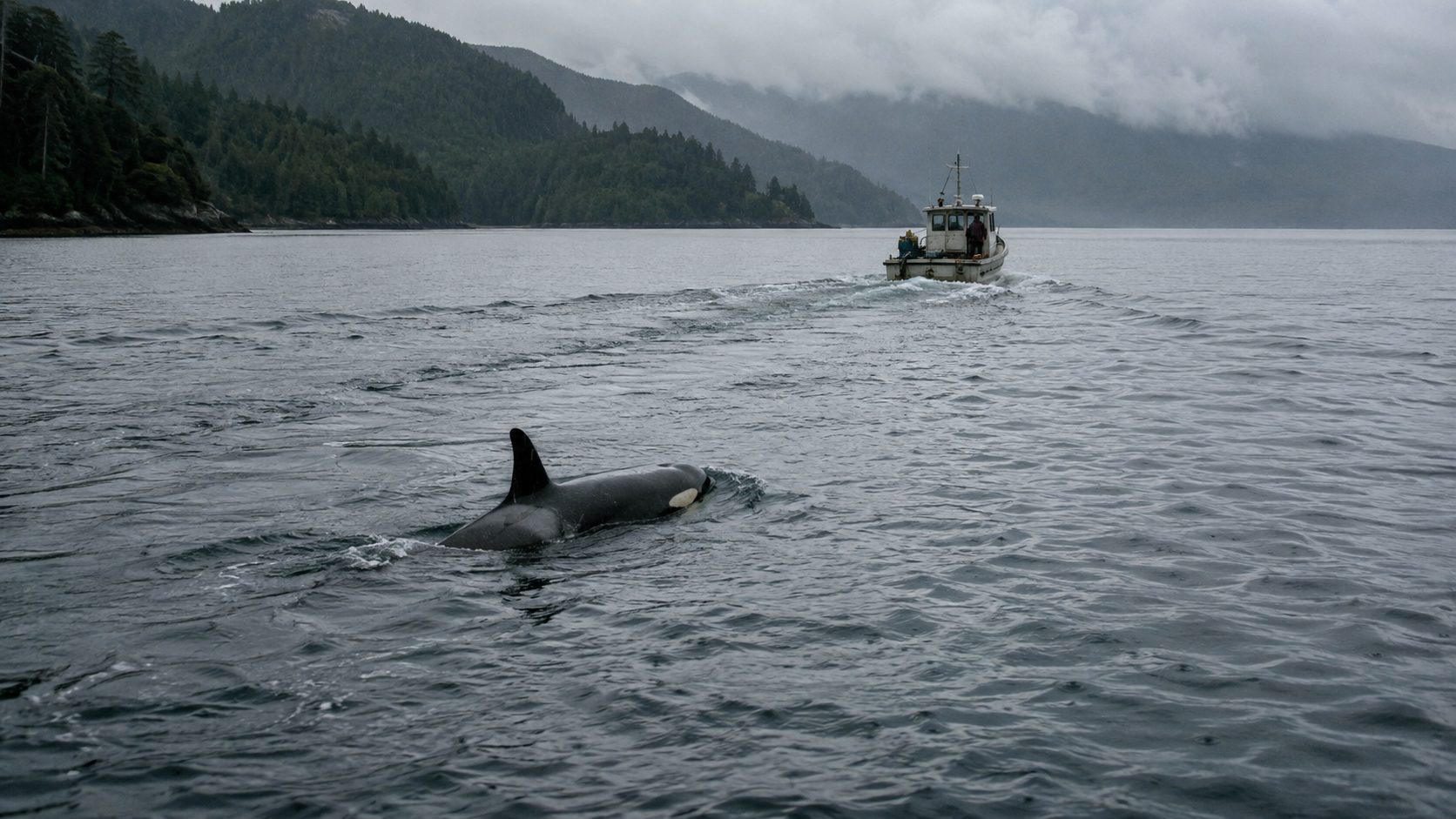
The boat was leaving.
Luna noticed.
The young orca changed direction.
Then he began following it through the cold water of Nootka Sound.
There was nothing special about that particular boat.
It carried no members of his family.
Nobody aboard could replace another killer whale.
Yet Luna followed.
And when other boats appeared, he often approached those too.
Sometimes he swam beside them.
Sometimes behind them.
Sometimes he returned again and again.
There was one detail that made the behavior much harder to watch.
Luna was alone.
He was barely two years old when he appeared by himself on the west coast of Vancouver Island.
He belonged to one of the most family-dependent populations of killer whales known to science.
His mother was still alive.
His relatives were still somewhere in the Pacific.
Yet Luna remained in Nootka Sound.
As months became years, the boats around him became increasingly difficult for him to ignore.
At first, people found that extraordinary.
Eventually, scientists became frightened by it.
Because the behavior that made Luna famous was slowly creating a danger nobody seemed able to remove.
Luna Was Barely Two Years Old
Scientists knew him as L98.
He was born into L pod, part of the Southern Resident killer whale community.
Luna was first documented as a newborn in September 1999.
By the summer of 2001, reports began emerging of a young killer whale alone in Nootka Sound.
He was not even two years old.
That was highly unusual.
Resident killer whales live in remarkably stable family groups.
Young animals normally travel with their mothers and other close relatives.
They learn where to travel.
Where to find salmon.
When to rest.
And how to move through a complicated social world built around calls and relationships that can last decades.
A young resident simply appearing hundreds of kilometers away from his normal family group was therefore difficult to explain.
In fact, scientists had initially assumed L98 was dead after he disappeared from sightings of the Southern Residents.
Then they realized the young whale living alone off Vancouver Island was him.
Luna had survived.
But that only created a much bigger question.
How had he ended up there alone?
His Mother Was Still Alive
Luna is sometimes described as an orphan.
That is not quite right.
His mother, Splash — L67 — was still alive while Luna was living alone in Nootka Sound.
By 2002 she had even produced another calf. Contemporary reports specifically contrasted Luna with Springer, the young Northern Resident orca successfully returned to her family that year: Springer had lost her mother, while Luna had not.
That makes Luna’s separation stranger.
His family had not disappeared.
His mother had not died before he arrived in Nootka Sound.
And researchers never established exactly what event separated him from L pod.
Nobody had watched it happen.
There was no rescue team present at the moment he became separated.
By the time people understood the situation, Luna had already begun building a life in a place where his family was absent.
Physically, he surprised people.
He appeared healthy.
He found food.
He grew.
He learned the geography of the inlet.
But survival was only one part of being a resident killer whale.
Luna had food.
What he did not have was his normal social world.
And eventually, something else began filling that space.
Then Luna Started Approaching Boats
Nootka Sound was not empty.
Fishing boats crossed it.
Work boats moved through it.
People used docks.
Engines started and stopped around Luna’s territory every day.
And Luna began approaching them.
At first, seeing a wild young killer whale voluntarily come near a boat felt extraordinary.
Then the encounters became more frequent.
Luna followed vessels.
He swam alongside hulls.
He rubbed against boats.
He sometimes remained around docks and people.
By 2003, concern over his interactions with humans and vessels had grown significantly.
The problem was unusual because Luna often initiated the contact himself.
People could be ordered not to approach a whale.
Nobody could explain the same rule to Luna.
A boat could try to move away.
Luna could follow.
A person could refuse to touch him.
Luna could still come beside the hull.
And the more often those encounters happened, the more normal boats appeared to become in his life.
That created an uncomfortable contradiction.
The behavior people loved most about Luna—
was exactly the behavior officials wanted to stop.
The “Friendly Whale” Was Learning Something Dangerous
Luna became famous.
People traveled to Nootka Sound hoping to see him.
For visitors, the attraction was obvious.
This was not an orca behind aquarium glass.
He was completely wild.
And yet he sometimes appeared to choose human company.
Some people went further than simply watching.
Interactions became enough of a concern that authorities repeatedly tried to discourage people from engaging with Luna.
The reason was not simply bureaucratic.
Every successful interaction could reinforce another one.
Boat means attention.
Boat means activity.
Boat means something worth approaching.
NOAA later summarized the lesson very clearly: Luna’s chronic interactions with humans conditioned him to approach people and vessels.
But that conclusion came later.
At the time, Luna was still alive.
Still growing.
Still swimming beside boats.
And still separated from his own pod.
Then officials began asking whether leaving him there was really safer than trying something much more difficult.
Could Luna be taken home?
In 2004, a Real Plan Was Made to Return Him
By 2004, Canadian authorities were preparing an intervention.
The objective was not to put Luna in an aquarium.
The goal was to move him south and create an opportunity for him to reconnect with Southern Resident killer whales.
It would be extraordinarily difficult.
Nobody could schedule the arrival of L pod.
Nobody could guarantee Luna would recognize the opportunity and remain with them.
Nobody could guarantee his relatives would appear at all.
Some researchers even spent enormous amounts of time searching for an opportunity for a natural reunion.
One search effort recorded 313 hours of sailing in May 2004 alone, looking across waters where Luna’s family might appear.
It did not happen.
L pod took a different route that spring.
Luna never got the chance to hear them.
So preparations for a more direct relocation continued.
A holding pen was constructed.
Teams prepared to guide Luna toward it.
For the first time in nearly three years, there appeared to be a concrete path toward bringing L98 closer to his family.
But Luna was not known to everyone as L98.
And not everyone believed moving him away from Nootka Sound meant taking him “home.”
To Another Community, Luna Was Tsu’xiit
The Mowachaht/Muchalaht First Nation had a very different relationship with the young whale.
They knew him as Tsu’xiit.
His arrival carried deep cultural meaning.
Chief Ambrose Maquinna had spoken before his death about returning as a killer whale.
Luna appeared in the community’s waters shortly after the chief died.
For members of the Mowachaht/Muchalaht community, Tsu’xiit therefore became connected with the late chief and with their traditional territory in a way that cannot be reduced simply to wildlife management.
Government officials saw a young Southern Resident separated from his biological pod and increasingly habituated to vessels.
Many Mowachaht/Muchalaht people saw Tsu’xiit as already belonging where he was.
Those views collided during the relocation effort.
As government teams attempted to guide Luna toward the holding pen, Mowachaht/Muchalaht paddlers went onto the water in canoes.
They paddled.
They sang.
Luna followed them.
The relocation attempt did not succeed.
Eventually, the capture operation was called off.
Luna remained in Nootka Sound.
Still free.
Still alive.
And still without L pod.
The years continued.
So did the boats.
Five Years After Arriving, Luna Was Still Following Them
Luna was no longer the tiny animal first seen in 2001.
His body grew.
His dorsal fin became larger.
He had survived season after season.
That achievement should not be overlooked.
A juvenile resident killer whale had managed to feed and survive for years without traveling beside the family group into which he had been born.
But one thing had not disappeared.
His attraction to vessels.
Authorities and local stewards continued trying to limit interactions.
People were warned not to encourage him.
Yet Luna himself could still approach.
That made eliminating the behavior extremely difficult.
By this point, approaching boats was not a strange event that had happened once.
It had become part of Luna’s life.
And boats vary enormously.
A small fishing boat is one thing.
A large commercial vessel is another.
The water around a powerful propeller can behave very differently.
A young orca cannot understand every mechanical danger hidden beneath a hull.
For years, Luna had approached vessels and survived.
Then came March 10, 2006.
One More Boat Entered Nootka Sound
The vessel was a large ocean-going tugboat.
Luna approached it.
That alone was not surprising.
It was behavior people had watched him perform for years.
But this time, the machinery beneath the water was far more dangerous.
Luna moved near the stern.
He was struck by the tugboat’s propeller.
The young killer whale died.
He was six years old.
There was no final reunion with L pod.
No moment when his mother returned beside him.
No successful journey south.
Nearly five years after appearing alone in Nootka Sound, Luna’s story ended beside a vessel.
And suddenly those early images looked completely different.
The young whale turning when an engine started.
The dorsal fin appearing beside a boat.
Luna following as a vessel moved away.
At the time, those moments could look almost beautiful.
After March 10, they looked like warnings.
Because Luna had survived years without his pod.
But the social behavior he developed around people and vessels eventually placed him beside the wrong boat.
NOAA now cites Luna’s story specifically when explaining the dangers of human habituation in killer whales, saying his repeated interactions conditioned him to approach vessels and directly contributed to his fatal collision.
But even that is not the whole reason his story stayed with people.
Luna’s Story Was Never Just About a “Friendly Orca”
There are easier ways to tell Luna’s story.
A lonely whale loved people.
A government tried to move him.
A boat killed him.
But all three descriptions leave something important out.
Luna belonged to a population in which family relationships are exceptionally persistent.
He was extremely young when he disappeared from that social structure.
He somehow survived.
Then, in the absence of his normal family group, humans and vessels became a repeated part of his environment.
Different people interpreted that relationship differently.
Scientists saw increasing habituation and risk.
Visitors saw extraordinary access to a wild animal.
The Mowachaht/Muchalaht community knew him as Tsu’xiit and understood his presence through their own cultural relationship with killer whales and their territory.
There was never one simple answer to what humans should do with Luna.
And by the time everyone understood just how dangerous his attraction to vessels had become—
there was no longer time to solve it.
That is why the simplest image may still be the most powerful.
A boat begins moving through Nootka Sound.
A young orca notices.
There are no other killer whales beside him.
The vessel gets farther away.
Luna turns.
And follows.
