There was no net.
No gate.
No wall.
No fishing line wrapped around either whale.
And open ocean was not far away.
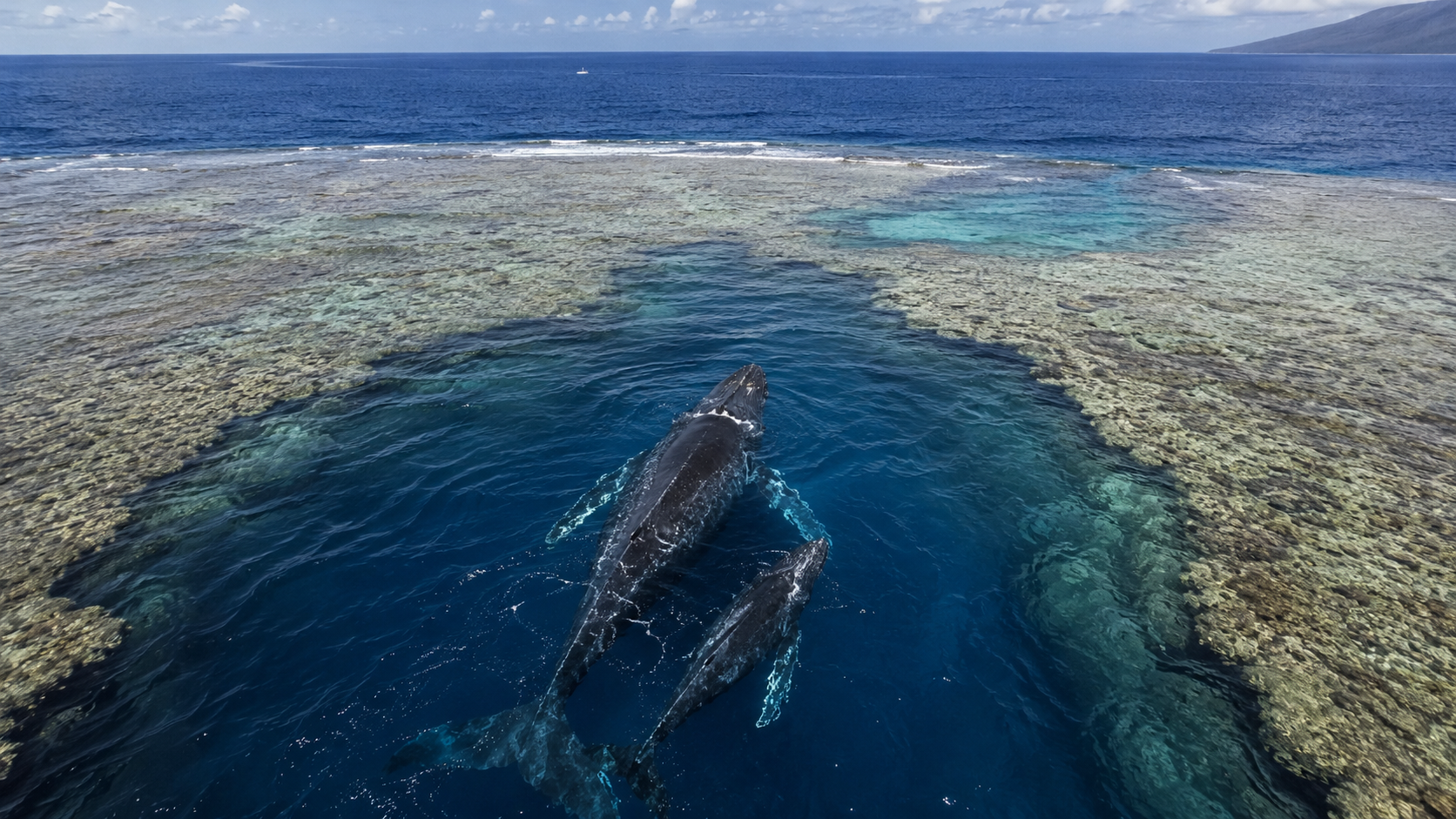
Yet a humpback mother and her calf remained inside the same deep pocket of reef off Molokaʻi, Hawaiʻi.
Day after day.
Then week after week.
From above, the situation was almost difficult to understand.
The pair could swim.
They appeared healthy when first discovered.
They could approach the shallower reef separating them from deeper water.
But the mother did not leave.
Her calf stayed with her.
Rescuers eventually spent hundreds of hours trying to change that.
They tried boats.
Sound.
Bubbles.
Water pressure.
Eventually, they even tried something far more unusual.
Still, the mother remained inside.
By the time the story ended, the pair had spent more than two months in the same reef pocket.
And the question that confused observers at the beginning became much more urgent:
Why wouldn’t she leave?
The Whales Were Not Actually Trapped
The location was west of Kaunakakai on the south shore of Molokaʻi.
Local people referred to the area as a “blue hole.”
It was not a man-made enclosure.
NOAA describes blue holes in this area as natural breaks or deeper pockets within the reef, sometimes associated with freshwater springs.
From the air, the difference in depth could be dramatic.
Dark blue water marked the deeper pocket.
Around it stretched much shallower reef.
Beyond that reef was deeper ocean.
For a mother humpback and calf, the deeper pocket offered enough room to swim comfortably.
The surrounding reef was different.
It was shallow.
But crucially, there was no physical barrier preventing the whales from leaving.
No structure closed behind them.
No net had captured them.
Nothing had to be cut away.
NOAA later stated plainly that the whales were not physically confined.
The mother simply remained unwilling to cross the relatively shallow reef.
At first, that may not have seemed like an emergency.
Both whales reportedly appeared healthy.
The calf remained beside its mother.
They surfaced.
They swam.
They moved around the deeper pocket.
But there was a problem that could not be seen from a drone photograph.
The clock was already running.
They Should Have Been Leaving Hawaiʻi
Humpback whales travel to Hawaiʻi during the winter breeding season.
The warm, shallow waters provide important habitat for mating, giving birth and nursing calves.
But Hawaiʻi is not where these whales normally spend the year feeding.
By late spring, many begin migrating back toward rich northern feeding grounds.
The Molokaʻi mother should have been making that journey too.
Instead, she stayed.
Her calf stayed with her.
Days passed.
Then more days.
And the mother was relying largely on energy stored in her body.
Every day she remained in Hawaiʻi was another day she was not replenishing those reserves in northern feeding waters.
The calf added another demand.
A young humpback still depends heavily on its mother.
That made the situation very different from simply watching two whales resting in shallow water.
The longer they stayed, the more difficult the eventual journey could become.
Local observers continued watching.
State and federal wildlife teams became involved.
Eventually, waiting was no longer enough.
They decided to try to persuade the whales to move.
The First Attempts Looked Simple
The objective sounded straightforward.
Encourage the pair toward the shallower edge.
Keep them moving.
Get them across the reef.
Then let them enter deeper open water.
But whales are not livestock.
A rescue team cannot simply point toward the ocean and expect a wild humpback to understand.
The mother had her own reasons for choosing the deeper pocket, even if humans could not know exactly what those reasons were.
So teams began experimenting with ways to influence her direction without physically capturing her.
Boats could position themselves at a distance.
Their movement could gently encourage the whales toward another area.
Water pressure could be used.
Other techniques could create an uncomfortable zone behind the whales while leaving the route toward open ocean quieter.
The hope was simple:
make one direction less attractive,
and another direction more attractive.
The mother sometimes moved.
But she did not complete the crossing.
Then she returned to the deeper water.
Again.
Nine Missions Were Not Enough
This was not one afternoon rescue attempt.
According to Hawaiʻi’s Department of Land and Natural Resources, response teams carried out nine separate on- and over-water missions during roughly six weeks.
Those operations added up to hundreds of hours.
At times, as many as seven vessels were involved.
That number changes the scale of the story.
Seven boats.
Multiple agencies.
Experts advising from different places.
Local Molokaʻi residents and cultural practitioners observing the whales almost every day.
And still the pair remained.
The rescue teams tried herding.
They experimented with acoustic playbacks.
They used bubble barriers.
NOAA also lists oikomi pipes and water pressure among the techniques attempted.
Each method had the same ultimate purpose.
Move the mother toward open water.
But nothing produced the result everyone needed.
So the teams tried sound in a different way.
They Even Played Orca Sounds
One of the most unusual details came later.
Rescuers tried playing social whale sounds outside the reef pocket.
The idea was to make the direction toward open water more attractive.
Inside the blue hole, they also used aversive sounds.
Among them were predatory orca vocalizations.
Imagine the strategy from the whale’s perspective.
One direction carried social sounds.
Behind her came sounds associated with one of the ocean’s major predators.
If sound could influence the mother’s decision, perhaps that combination would finally make her move across the shallows.
It did not.
The pair remained.
That made the situation increasingly difficult to explain from the outside.
Nothing physically blocked her.
People had tried repeatedly to guide her.
The route existed.
Open water existed.
Yet the mother continued choosing the deeper pocket.
And the weeks were accumulating.
The Mother Had a Name
Researchers later identified her through the Happywhale photo-identification catalog.
She was known as Twinning.
Her history made the situation even more striking.
Twinning had been documented off British Columbia in October 2025.
She had later made the long migration south to Hawaiʻi.
Her calf was believed to have been born sometime between late January and early February 2026.
That meant she was not an inexperienced whale that had never completed a major migration.
She had already traveled enormous distances.
She knew open ocean.
She had moved between feeding and breeding regions.
Yet in May, she and her calf settled into that deep pocket of reef west of Kaunakakai.
And by July, they were still there.
The question was no longer simply whether rescuers could convince her to move.
It was whether she still had enough energy left to make the journey if she finally did.
More Than Two Months Changed Everything
A humpback mother can lose enormous amounts of stored energy during migration, pregnancy and nursing.
Hawaiian waters are primarily breeding and calving habitat, not the northern feeding grounds where humpbacks rebuild those reserves.
NOAA said Twinning’s prolonged stay meant she was not feeding and that her energy stores were eventually exhausted.
That was the danger that had been building invisibly while the pair continued circling the blue hole.
Nothing dramatic needed to happen.
No rope had to tighten.
No ice had to close.
No predator had to attack.
Time itself was becoming the threat.
Then, on July 10, 2026, Twinning died.
The mother that rescuers had spent weeks trying to guide across the reef was gone.
State officials later collected tissue samples to help clarify the circumstances surrounding her death.
NOAA linked the prolonged stay and lack of feeding to exhaustion of her energy reserves, while DLNR noted that tissue analysis could provide further information.
But Twinning’s death created an immediate second question.
Where was her calf?
The Calf Finally Left
For more than two months, the calf had followed its mother.
Where she went, it remained close.
Then the relationship that had kept it inside the reef pocket suddenly disappeared.
After Twinning died, the calf left the area.
DLNR reported that it was no longer seen around the reef pocket.
That created an unsettling contradiction.
The pair had spent weeks remaining in a location rescuers desperately wanted them to leave.
Then, after the mother died, the calf moved on.
NOAA warned that without its mother, the young whale’s chances of survival were poor.
Its fate remained unknown.
For a young humpback, losing its mother can mean losing far more than companionship.
The calf may still depend on nursing.
It has also lost the experienced adult that would normally accompany it through migration.
And somewhere far to the north were the feeding grounds Twinning had never reached.
For a while, there was no confirmed sign of the calf.
Then something unexpected happened around another Hawaiian island.
A Lone Young Whale Appeared Off Maui
On July 28, a young humpback was reported off Kāʻanapali, Maui.
Witnesses described the whale swimming repeatedly back and forth near a jetty.
The animal appeared to be alone.
Researchers immediately wondered whether it could be the Molokaʻi calf.
Officials did not have definitive identification at the time.
That distinction matters.
A young humpback alone near Maui was not automatically Twinning’s calf.
But the timing was difficult to ignore.
The state Division of Aquatic Resources said it believed the animal could be the same whale involved in the Molokaʻi event, while researchers continued trying to determine its identity.
If it was the calf, it had moved away from the reef where it had spent more than two months beside its mother.
But that would not answer the most important question.
Could it survive alone?
As of the reports available afterward, that remained unresolved.
The Mystery Was Never Really Why the Hole Was Closed
Because the hole was never closed.
That is what makes Twinning’s story so difficult to forget.
Most whale rescue stories have an obvious obstacle.
Ice.
Rope.
A fishing net.
A beach.
A gate.
Something humans can point to and say:
That is the problem.
Here, rescuers could see open ocean.
They could see the shallow reef.
They could see Twinning move.
But they could not make the final decision for her.
Nine missions did not change it.
Hundreds of hours did not change it.
Seven vessels at once did not change it.
Bubble barriers did not change it.
Social sounds did not change it.
Even predatory orca vocalizations did not change it.
She stayed with her calf inside that deeper water until her body could no longer sustain the delay.
Scientists and responders may continue learning from what happened.
But the most haunting part of the story remains visually simple.
A mother.
A calf.
A shallow reef.
And open ocean on the other side.
Nothing physically prevented them from leaving.
Yet for more than two months—
they stayed.
Editor’s Note
This article describes a real 2026 humpback whale response off the south shore of Molokaʻi, Hawaiʻi. Official records from NOAA and the Hawaiʻi Department of Land and Natural Resources confirm that the mother and calf remained for more than two months in a naturally occurring deep reef pocket despite having no physical barrier preventing them from leaving. Response teams conducted nine missions, spent hundreds of hours on the effort and used several techniques to encourage the pair toward open water.
