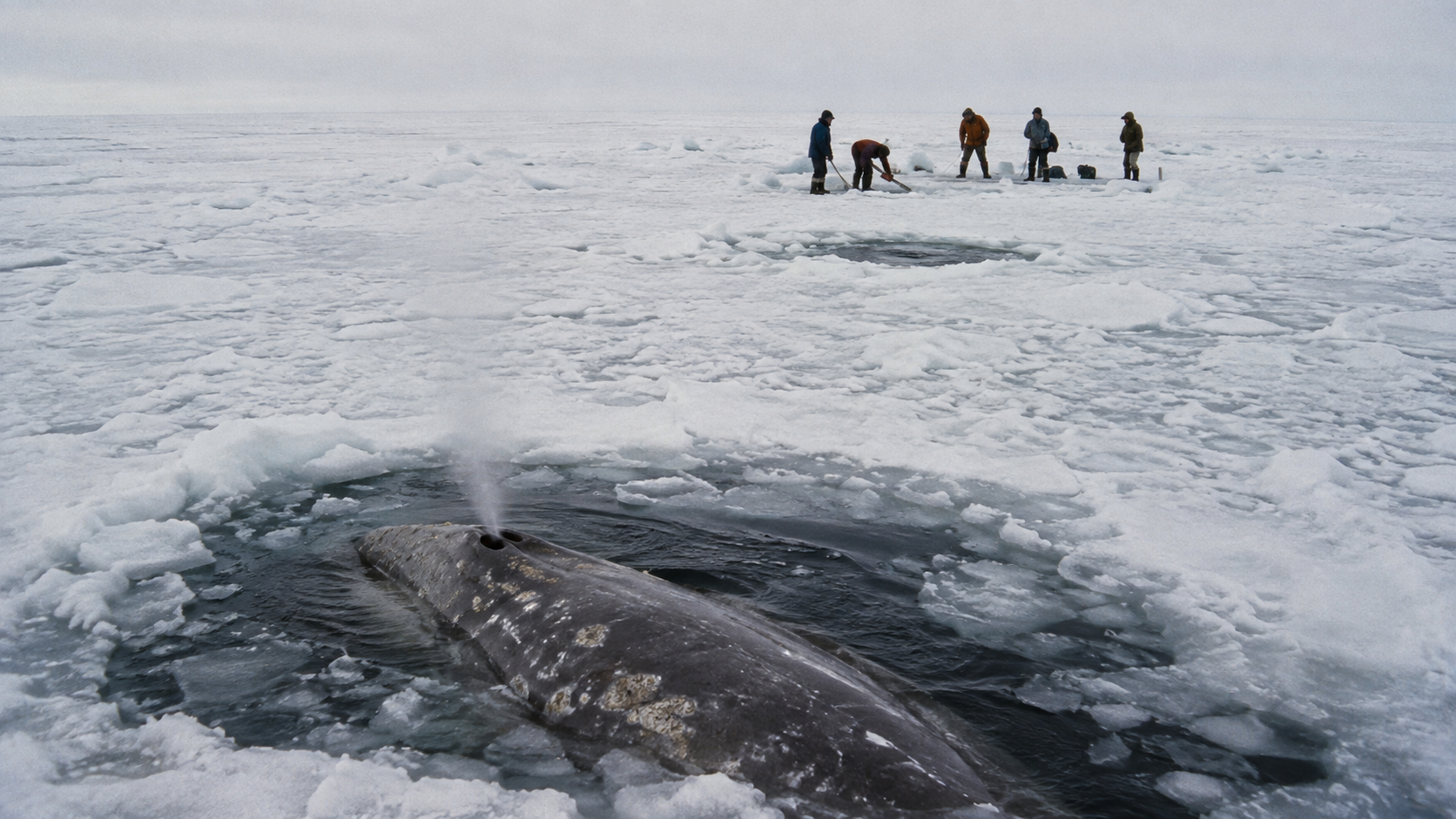
At first, there were three of them.
Three gray whales.
A sheet of Arctic ice above them.
And only a few small patches of black water where they could reach the air.
It was October 1988 near Point Barrow, Alaska.
Winter was arriving quickly.
Every day the ice grew thicker.
Every night the temperature dropped.
And every few minutes, the whales had to return to the same shrinking holes to breathe.
Open water existed somewhere beyond the ice.
But it was miles away.
Too far for a gray whale to swim beneath solid ice without surfacing.
So people on the ice began doing something extraordinary.
They picked up chainsaws.
They cut another hole.
Then another.
Then another.
Eventually, there would be 55 breathing holes stretching across the frozen sea.
But even that would not solve the problem immediately.
Because the whales still had to understand where the new path was leading.
And the Arctic was closing behind them.
At First, There Were Only Two Places to Breathe
The whales were discovered in early October in ice-covered water northeast of Barrow.
By October 14, the situation was already deteriorating.
The two main breathing holes the whales were using had once been described as roughly the size of basketball courts.
They had shrunk to approximately 15 by 30 feet.
Beyond them stretched ice.
The nearest open water was almost five miles away.
For an animal that breathes air, five miles beneath continuous ice might as well have been a wall.
Gray whales cannot simply remain underwater until they reach whatever opening lies ahead.
They need repeated access to the surface.
That meant the whales were effectively trapped around the same few patches of water.
They surfaced.
Breathed.
Dived.
Then returned again.
And every time they surfaced, the edges of the holes were freezing.
The animals were also beginning to show the physical cost of being confined.
Their skin and snouts rubbed against jagged ice.
Contemporary reports described raw, battered areas where the whales repeatedly forced their bodies against the frozen edges.
There was no obvious road out.
So rescuers decided they would try to build one.
The Whales Were Supposed to Be Far South by Then
Gray whales are famous for long seasonal migrations.
They spend feeding seasons in northern waters, then move south toward warmer breeding and calving areas.
These three had remained in the Arctic too long.
Then the freeze caught them.
By the time rescuers became involved, the whales were surrounded by ice only about 100 yards offshore, roughly 18 miles northeast of Barrow.
The world beyond their breathing holes had become almost entirely white.
The problem was not simply breaking one large hole beside them.
Even if rescuers gave the whales plenty of room to breathe where they already were, winter would continue.
The animals eventually needed to move.
South.
Away from the thickening ice.
Toward water where they could surface naturally.
That required something more ambitious.
A route.
But there was another problem.
Nobody could explain that route to a whale.
So They Built a Road Made of Air
On October 15, local Inupiat crews and rescuers began using chainsaws to enlarge the whales’ breathing holes.
Then, on October 19, workers started cutting new holes farther away.
The idea was simple in theory.
Create one opening.
Allow the whales to discover it.
Then create another farther along.
Slowly lead them toward open water.
It was essentially a trail through the ice.
Except the trail was underwater.
And the markers were patches of air.
Workers cut through thick Arctic ice with chainsaws.
They pushed slabs beneath the surrounding ice or pulled them clear.
The dark water below became visible.
Then they waited.
Would the whales leave the hole they already knew?
Would they swim beneath the ice toward another one?
The first movements mattered enormously.
Because if the animals could learn that pattern—
dive beneath one section of ice,
find another opening,
breathe,
then continue—
the rescuers might be able to guide them outward.
The whales began following some of the new openings.
That gave the operation hope.
But it also created a terrifying dependency.
Every new hole had to remain open.
The Arctic Kept Trying to Erase Their Escape Route
Cutting a hole in Arctic sea ice did not mean it stayed open.
Temperatures dropped.
Thin ice reformed.
Wind moved the pack.
Slush accumulated.
A breathing hole that existed in the afternoon could begin closing overnight.
Volunteers eventually brought water-circulation pumps to the site.
The machines churned the water and helped prevent the openings from freezing shut.
They became critical to keeping the whales’ route usable.
At night, rescuers worked beneath headlights and snowmobile lamps.
The whales continued surfacing.
Their breaths appeared briefly in the frozen air.
Then they disappeared into the dark water again.
The operation was becoming enormous.
Scientists arrived.
Local whaling crews worked the ice.
The Alaska National Guard became involved.
Special equipment was moved toward the site.
News crews arrived from around the world.
What had begun as three whales in two ice holes was becoming an international event.
But underneath all the machinery and media attention, the basic problem had not changed.
Three whales still needed air.
And the sea was still freezing.
By October 22, They Had Cut 55 Holes
The number sounds almost impossible.
Fifty-five separate openings.
By October 22, rescuers had created a string of 55 breathing holes through the ice.
The path was working.
The whales were moving.
Then they stopped.
Ahead of them was an area where the water was only around 12 feet deep.
The whales refused to cross it.
For two days, progress stalled.
The animals could move between the holes behind them.
They simply would not continue across the shallow section.
Rescuers could cut more ice.
They could run pumps.
They could bring machinery.
They could not force a wild gray whale to enter water it did not want to enter.
So the route had to change.
New holes were cut around the shallow area.
Two days later, crews connected a series of openings into a continuous channel roughly 600 yards long.
For the first time in days, the whales had enough room to roll and breathe more naturally.
It looked like progress.
But by then, there were no longer three whales.
The Smallest Whale Stopped Coming Up
One of the three had always been in worse condition.
Biologists called the smallest whale Bone because repeated contact with the ice had badly damaged its snout.
The other two were known as Bonnet and Crossbeak.
Bone struggled from early in the rescue.
It was smaller.
Weaker.
And increasingly battered.
Late on October 21, rescuers saw it for the last time.
By the following morning, only two whales were surfacing.
Bone was presumed dead.
The rescue continued.
But everything had changed.
There were now two whales following the chain of holes.
And somewhere ahead of them stood an obstacle that chainsaws alone could not solve.
A massive pressure ridge had formed where ice masses collided.
Contemporary reports described parts of it as roughly 30 to 35 feet high.
Beyond it lay the route toward freer water.
The rescuers on the ice could not simply cut through that.
A much larger force was needed.
Then the Cold War produced one of the strangest turns in the entire story.
Two Soviet Ships Were Asked to Help
This was 1988.
The United States and Soviet Union were still global rivals.
Yet somewhere off the northern edge of Alaska, two gray whales were trapped behind a wall of Arctic ice.
On October 21, U.S. officials learned that Soviet icebreakers were operating in the region.
With help from the State Department, assistance was requested.
The Soviet Union agreed.
Two vessels were diverted:
the Admiral Makarov, approximately 443 feet long,
and the Vladimir Arseniev, approximately 518 feet long.
Their job was completely different from the work being done by the chainsaw crews.
The Inupiat rescuers were creating a path outward from the whales.
The Soviet ships would attack the enormous ice barrier from the opposite direction.
Eventually, the two efforts were supposed to meet.
On October 25, the icebreakers began working against the pressure ridge.
Huge ships repeatedly pushed into the ice.
Blocks broke apart.
Water appeared between them.
By nightfall, one vessel had moved remarkably close to the trapped whales.
The next day, the Arseniev came within roughly 200 yards.
After nearly three weeks, the last major barrier was breaking.
But freedom still did not come cleanly.
They Reached the New Channel—Then the Ice Began Closing Again
On October 26, Bonnet and Crossbeak finally left part of the hand-cut breathing-hole route and entered water opened by the Soviet vessels.
For a moment, rescuers believed the problem was solved.
The whales were moving toward freedom.
Then the Arctic changed the situation again.
The icebreakers had shattered enormous amounts of ice.
Their channel contained slush and jagged fragments.
Cold temperatures quickly began freezing sections behind them.
The whales slowed.
At one point, they were again caught in a small opening surrounded by newly forming ice.
Rescuers returned to chainsaws.
More breathing holes were cut.
The animals were moved farther outward.
On October 27, the whales were reportedly only about 1,000 feet from open water.
The Soviet icebreakers made their final passes.
Then rescuers did something that might sound strange after weeks of constant intervention.
They switched things off.
Lights.
Pumps.
Other stimuli around the whales.
The hope was that nothing near the rescue site would encourage the animals to remain there.
After weeks of creating places for them to breathe—
the humans now needed the whales to leave those places behind.
At 8:45 the Next Morning, They Surfaced One Last Time
Friday, October 28.
Rescuers were still watching.
At approximately 8:45 a.m., Bonnet and Crossbeak surfaced at one of the breathing areas.
Then they headed toward open water.
It was the last confirmed time rescuers at the site saw them.
Aircraft later searched the area.
They found openings in thin ice extending away from the rescue site.
Some looked like tracks created by whales breaking through to breathe.
The two animals appeared to have continued outward.
After nearly three weeks beneath the Arctic ice, the remaining whales were gone.
The rescue was declared a success.
But there was one final uncertainty.
No radio transmitters had been attached to Bonnet or Crossbeak.
Officials worried that tagging the already stressed animals could create additional problems.
So once they disappeared—
they truly disappeared.
Nobody could follow their entire migration south.
Nobody could confirm with certainty that either whale survived the journey that followed.
Operation Breakthrough had successfully opened the prison.
Whether the two whales ultimately survived the ocean beyond it remains unknown.
The 55 Holes Were Only the Beginning
Looking back, it is tempting to remember Operation Breakthrough as a story about giant ships smashing through Arctic ice.
But the rescue began much smaller.
With chainsaws.
Local knowledge.
A few dark patches of water.
And an unusual realization:
If humans could not physically carry the whales to safety, perhaps they could give them enough places to breathe that the whales could move themselves.
One hole became another.
Then another.
Eventually there were 55.
Then a 600-yard channel.
Then machinery.
Then aircraft.
Then two Soviet icebreakers working from the opposite direction.
All because three whales had surfaced in the wrong place as winter closed around them.
One did not make it.
Two disappeared toward open water.
And decades later, the image that remains most powerful may still be the simplest one.
A frozen white sea.
A small black hole.
A gray whale rising through it for air.
And somewhere farther across the ice—
another hole waiting.
Editor’s Note
Operation Breakthrough was a real rescue effort carried out near Point Barrow, Alaska, in October 1988. NOAA records confirm that three gray whales were initially trapped, that rescuers created a chain of 55 breathing holes, that one whale was presumed dead, and that two Soviet icebreakers later participated in the effort. The two remaining whales were last seen heading toward open water on October 28. Their long-term survival was never confirmed because they were not radio-tagged.
