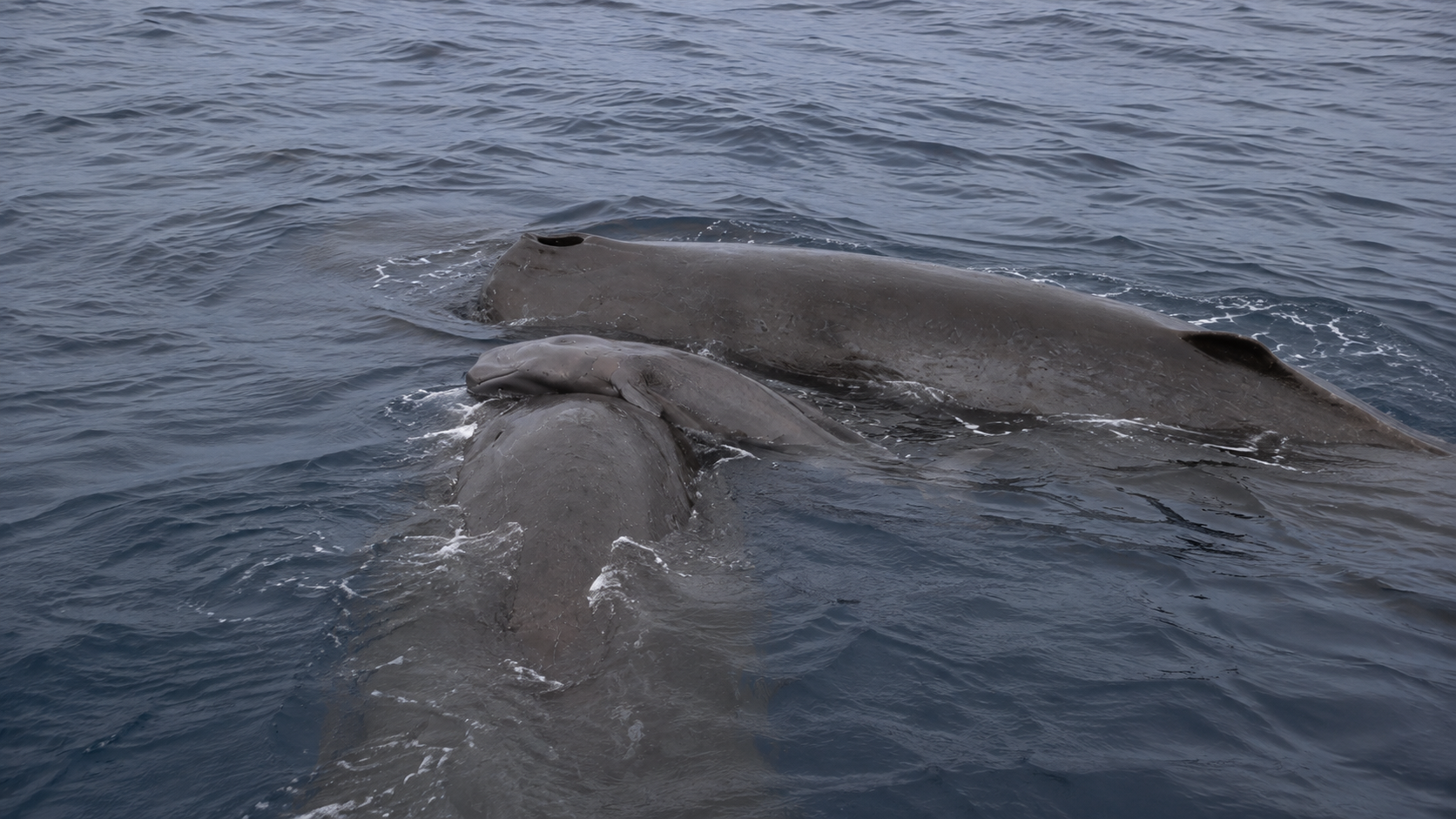
The newborn had been alive for only minutes.
Yet one of the first things it had to do was something every whale must eventually do alone.
Reach the surface.
Breathe.
Off the coast of Dominica in the eastern Caribbean, researchers were watching a group of sperm whales when an already unusual encounter suddenly became extraordinary.
A female known as Rounder had just given birth.
Her calf was tiny beside the enormous adults surrounding it.
Its body was soft.
Its movements were weak.
And its tail was not yet functioning normally.
For a newborn whale, that created an immediate problem.
The calf needed air.
But remaining at the surface was proving difficult.
Rounder stayed close.
Then another massive body appeared underneath the newborn.
And it was not the only whale moving toward it.
What researchers recorded over the next several hours would eventually give scientists one of their most detailed looks ever at what happens inside a sperm whale society during a birth.
But first, the newborn had to keep breathing.
The Researchers Had Not Gone Out Looking for a Birth
July 8, 2023 began as a research day.
Project CETI scientists were working off the western coast of Dominica, an island where sperm whale families have been studied for decades.
Their goal was not to film a birth.
The team studies sperm whale behavior and communication, using tools that include hydrophones, photography and aerial recording.
That morning they encountered a familiar social group known as Unit A.
There were 11 known members present.
Eight were adults.
Three were calves.
At first, the whales simply seemed unusually social.
They remained close.
Their behavior was different from what researchers typically saw.
Then the reason began to become clear.
Rounder was giving birth.
Wild whale births are extraordinarily difficult to observe.
A scientific review cited by the researchers found that births in the wild had been recorded in fewer than 10 percent of cetacean species.
Even when researchers know a pregnant whale, nobody can simply schedule the moment she will deliver.
It may happen far offshore.
It may happen underwater.
It may happen at night.
Or the animals may simply disappear from researchers for days.
This time, however, scientists were already there.
And their equipment was running.
For 34 Minutes, the Entire Group Stayed Close
The first visible sign came when the tips of the unborn calf’s tail flukes appeared.
That happened at approximately 11:12 a.m.
The delivery was not immediate.
Rounder continued moving while the other sperm whales gathered around her.
Adult females repeatedly approached.
Some moved beneath Rounder.
Others stayed oriented toward her as the birth progressed.
Approximately 34 minutes passed between the first appearance of the calf’s flukes and the completion of delivery at 11:45:45 a.m. local time.
Then the newborn was free.
For humans, birth might sound like the end of the dangerous part.
For an animal that must breathe air while living entirely in the ocean, it was only the beginning.
A newborn sperm whale does not have unlimited time to learn what to do.
Its first breath has to come at the surface.
And this calf did not immediately have the swimming ability of the whales surrounding it.
Its Tail Was Still Folded
The researchers noticed something important almost immediately.
The calf’s flukes were still folded.
Its body also lacked the rigidity and control of an older calf.
Those details matter.
A sperm whale moves through the water by driving its tail flukes vertically.
For this newborn, strong, controlled propulsion was not yet available.
The adults did not simply swim away and wait for the calf to figure it out.
They moved closer.
Much closer.
Researchers recorded adults touching the newborn with their heads and positioning their bodies around it.
At times the calf was squeezed gently between enormous whales.
At others, adults moved underneath it.
Then something especially striking began happening.
They started lifting it.
Not out of the ocean like an object.
Not in a dramatic leap.
They used their own massive bodies as support.
And when the newborn slipped lower, another whale could move underneath.
Something Huge Moved Beneath the Calf
From the surface, the movement could initially look confusing.
A small grey calf.
An enormous dark shape below it.
Then the larger animal rising.
The adult’s head or back came underneath the newborn.
As the adult moved upward, the calf rose with it.
Water still carried most of the calf’s weight.
The whale underneath provided the additional support it could not yet reliably create for itself.
Then another adult could take a position nearby.
And another.
The behavior was not limited to Rounder.
The entire social group became involved.
Project CETI later described the whales as collaboratively keeping the newborn afloat while its tail was still furled and it was learning to swim properly.
That makes the quiet moment in the water much more significant.
The giant beneath the calf was not simply surfacing in the same place.
It was part of something organized.
But researchers still needed to answer an even more basic question.
Had the newborn managed to breathe?
Scientists Waited for One Tiny Sign
The newborn disappeared among the adults repeatedly.
Bodies rolled.
Whales changed position.
Water broke around them.
From a research vessel, identifying a single breath inside that activity was not easy.
Then, about one minute and 15 seconds after the birth was completed, researchers clearly observed the calf surface beside Rounder’s head.
Its blowhole reached the air.
The newborn had taken a breath.
That did not mean it was suddenly independent.
Scientists did not clearly observe the calf attempting to swim until about three minutes after delivery.
Even then, the surrounding adults continued helping.
The researchers noted that lifting, pushing and supporting behavior was so extensive immediately after the birth that the calf may have breathed or propelled itself earlier without those moments being clearly visible.
But one thing was unmistakable.
The adults were not leaving the newborn alone to solve the problem.
The Help Continued Long After the First Breath
A single lift would already have been remarkable.
That was not what happened.
For roughly the first 20 minutes, the entire unit remained in an extremely tight cluster.
The newborn stayed near the surface.
Sometimes it rested against the bodies of adults.
Sometimes adults pushed or redirected it with their heads.
Sometimes it was carried partly across their backs and heads.
The whales were so tightly grouped that nearly all of them were in physical contact during parts of the event.
Project CETI reported that the group continued helping keep the newborn afloat for several hours, until its fluke unfolded and it could swim properly.
That changes the meaning of the behavior.
This was not one accidental contact.
It was sustained assistance.
The calf needed time.
The adults gave it that time.
But when scientists later analyzed which whales had been helping, the story became even stranger.
They Were Not All Close Relatives
Sperm whale society is strongly social.
Females and young animals can remain within long-lasting social units.
But Unit A was not one single simple family line.
It contained two matrilines.
In other words, there were different maternal family branches within the group.
Researchers later used high-resolution drone footage, computer vision and network analysis to examine which whales interacted with the newborn.
The results were published in Science in March 2026.
The analysis indicated that assistance crossed those family boundaries.
A female relative appeared to play a leading role around the birth.
But after delivery, individuals across the unit oriented toward the calf and participated in lifting it.
Whales that were not close kin also helped.
That finding mattered because the researchers were not simply documenting a mother caring for her own offspring.
They were seeing cooperation across different family lines.
The calf belonged to Rounder.
The work of keeping it near the surface became a group problem.
Even the Whales’ Voices Changed
The cameras were not the only instruments recording the event.
Hydrophones were listening beneath the surface.
Sperm whales communicate using patterns of clicks known as codas.
During the birth, researchers recorded extensive vocal activity.
Later analysis found significant shifts in coda style associated with key moments in the event.
The whales were not silent while all of this was happening.
Scientists are careful about assigning human meanings to whale sounds.
A change in vocal pattern does not automatically tell us what an animal “said.”
But the timing gives researchers another window into the social event.
The whales were changing how they interacted physically.
They were changing how they were positioned.
And their vocal behavior was changing too.
Then the gathering attracted outsiders.
Short-finned pilot whales approached.
Later, Fraser’s dolphins were also observed nearby.
At times pilot whales came extremely close to the sperm whales and newborn, and adult sperm whales positioned themselves around the calf.
For the newborn, its first hours had become the center of an enormous amount of activity.
Then the Group Slowly Began to Change
Eventually, the frantic closeness eased.
About 44 minutes after delivery, the large cluster began splitting into smaller groups.
Nearly two hours after the birth, adult sperm whales started returning to normal foraging behavior.
The newborn remained near Rounder and other younger members of the unit.
By then, something important had changed.
The calf that initially needed bodies beneath it was beginning to function on its own.
Its tail had unfolded.
Its movements were becoming more controlled.
The adults no longer had to keep performing the same constant lifting behavior.
The first crisis had passed.
For researchers, however, there was still a question they could not answer that day.
They had watched the calf survive its first minutes.
They had watched the group support it.
But newborn survival in whales is never guaranteed.
And after July 8, Unit A disappeared from their observations.
The Real Answer Came More Than a Year Later
The researchers did not see Unit A again for more than a year.
That absence was not necessarily alarming.
Sperm whale social units range across large areas, and researchers cannot continuously follow individual families.
Still, the calf’s longer-term fate remained unknown.
Then, on July 25, 2024, Unit A appeared again off Dominica.
The newborn was no longer a newborn.
The calf was approximately one year old.
And it was alive.
Researchers observed the young whale with other known members of its unit, including Accra and Aurora.
That sighting transformed the strange scene recorded one year earlier.
The tiny animal that had entered the ocean with folded flukes—
the calf that adults had lifted toward the surface—
the newborn surrounded by an entire social unit—
had made it through its first year.
And scientists now possessed hours of data showing exactly how its life had begun.
What Those First Minutes Revealed
The most remarkable part of the story may not be that one whale helped another.
It is the scale of the cooperation.
All 11 known members of Unit A were present during the event.
Researchers documented adults and younger animals becoming intensely involved after delivery.
Later quantitative analysis showed that support crossed kinship lines.
The 2026 Science study described the event as evidence of coordinated birth assistance in a non-primate species.
That does not mean sperm whales experience birth exactly as humans do.
It does mean their social relationships may influence one of the most vulnerable moments in a whale’s life in ways scientists are only beginning to quantify.
For decades, researchers knew sperm whales formed complicated societies.
They knew individuals could maintain relationships over many years.
They knew calves depended heavily on social groups while adults made deep foraging dives.
But a birth offered something different.
A moment when a completely helpless new member entered that society.
And instead of seeing only a mother and calf—
researchers saw the group move in.
One whale beneath the newborn.
Then another.
Bodies keeping it close to the air.
Until the little whale could finally do it itself.
