The water was pitch black, freezing, and deceptively silent.
Thousands of feet below the icy surface of the Southern Ocean, a specialized naval research unit was executing a classified mapping mission.
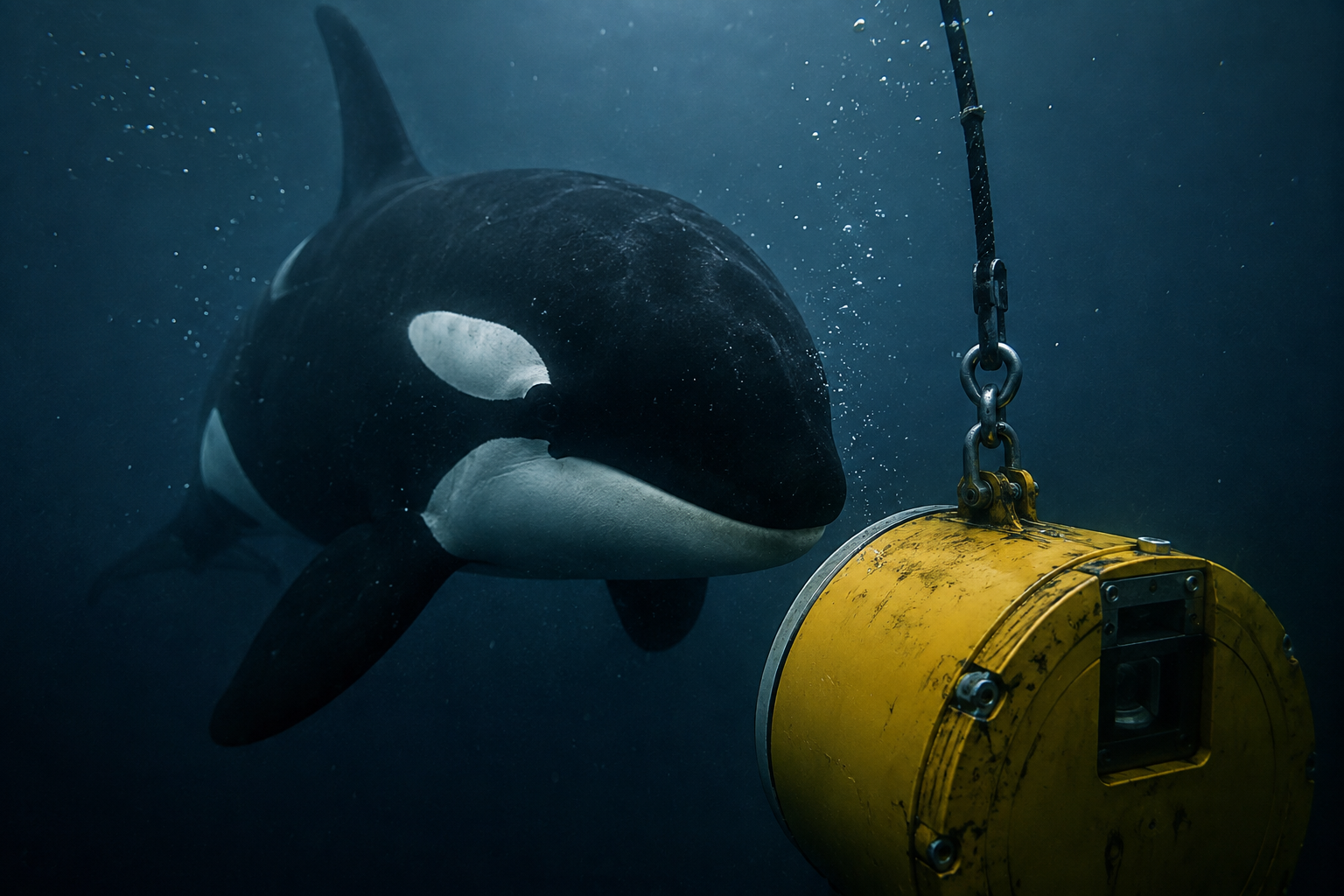
Hanging from a thick, reinforced steel cable was a massive yellow cylinder.
It was a military-grade, low-frequency active sonar system.
On the surface, engineers and marine acoustics specialists inside the research vessel were monitoring the live video feed from the submersible camera.
The screen displayed nothing but dark blue abyss and drifting glacial ice particles.
And then, without any warning from the surface radar, a massive shadow emerged from the gloom.
A Shadow in the Southern Ocean
It was a full-grown male killer whale.
An apex predator measuring nearly thirty feet in length, weighing over six tons, and possessing one of the most advanced brains in the animal kingdom.
The whale did not rush forward in an aggressive attack.
It did not strike the strange metallic object with brute force.
Instead, it slowed its movement dramatically as it closed the distance.
It glided through the freezing water with eerie precision, turning its massive body sideways.
The crew on the surface watched in utter disbelief as the giant creature brought its snout within inches of the yellow sonar casing.
And then, it gently made contact.
The Sound Humans Could Not Hear
To the engineers sitting in the climate-controlled control room on the ship, the sonar was just data on a screen.
To human ears underwater, low-frequency sonar sounds like a faint, rhythmic pulse.
To an orca, however, that sound is a completely different reality.
Killer whales do not experience the ocean through sight alone.
They live in a world made almost entirely of sound.
Using sophisticated echolocation, orcas construct an intricate, three-dimensional mental map of their environment.
They can sense the heartbeat of a fish, locate prey miles away in total darkness, and communicate with pod members across vast distances.
When a high-powered military sonar device operates nearby, it doesn’t just make a noise.
It floods the aquatic environment with intense, agonizing acoustic energy.
To a creature whose brain is built around hearing, these low-frequency pulses can cause severe disorientation, physical pain, and overwhelming distress.
The orca approaching the cable was not acting out of casual curiosity.
It was responding to an invisible force that was shattering the silence of its home.
An Act of Deliberate Intelligence
The timestamp on the surveillance camera read 03:14 AM when the interaction began.
What happened over the next several minutes stunned the marine acoustic experts on board.
The orca did not attempt to bite the heavy metal structure.
It did not try to sever the thick steel cable.
Instead, the whale began using its powerful head to repeatedly push the sonar unit back and forth.
It was deliberately rocking the device, forcing it to tilt at extreme angles.
By physically swaying the heavy cylinder, the whale was altering the direction and propagation of the acoustic waves being emitted into the water.
It was trying to disrupt the source of the noise.
Marine biologists who later reviewed the declassified footage identified this as a clear example of complex problem-solving.
The animal recognized that the yellow object was the origin of the disturbance.
And it was actively attempting to disable or redirect it using its own physical strength.
The Hidden Cost of Ocean Noise
For decades, scientists have warned about the impact of artificial noise in the deep ocean.
Commercial shipping lanes, oil exploration blasts, and military sonar operations have transformed once-quiet marine habitats into chaotic acoustic environments.
For baleen whales and echolocating hunters like orcas, noise pollution is an invisible wall.
It separates mothers from their calves.
It disrupts hunting strategies that have been refined over millions of years.
In extreme cases, high-power naval sonar has been linked to mass strandings and severe tissue damage in deep-diving cetaceans.
What this single camera captured in the remote Antarctic waters was a rare, undeniable glimpse into how marine life attempts to cope with human interference.
The whale was not simply reacting to a physical object.
It was attempting to defend its acoustic space.
Why This Footage Captured Global Attention
Stories like this resonate deeply because they challenge our understanding of animal consciousness.
We often categorize wild animals through simple lenses—predator, prey, instinct, survival.
But moments captured on deep-sea surveillance reveal something far richer.
Inside those icy depths lives a high level of awareness.
A creature that encounters sophisticated human military technology, identifies it as a threat or a nuisance, and formulates a strategy to deal with it.
Following the encounter, the surface crew ultimately decided to halt the sonar operation.
The heavy cable was winched back up into the ship’s bay, and the research vessel repositioned to prevent further stress to the local pod.
The operation was temporarily suspended, but the camera feed had already recorded history.
A World We Are Only Beginning to Understand
In the vast, freezing waters of the Antarctic, humanity remains an outsider.
Our technology can penetrate the depths, map the sea floor, and broadcast live feeds from thousands of feet below.
But the ocean does not belong to our machines.
It belongs to the giants who have navigated its dark currents for millennia.
And as this extraordinary footage proved, when we drop our technology into their world, they are not just passive observers.
They are watching.
They are assessing.
And sometimes, they push back.
