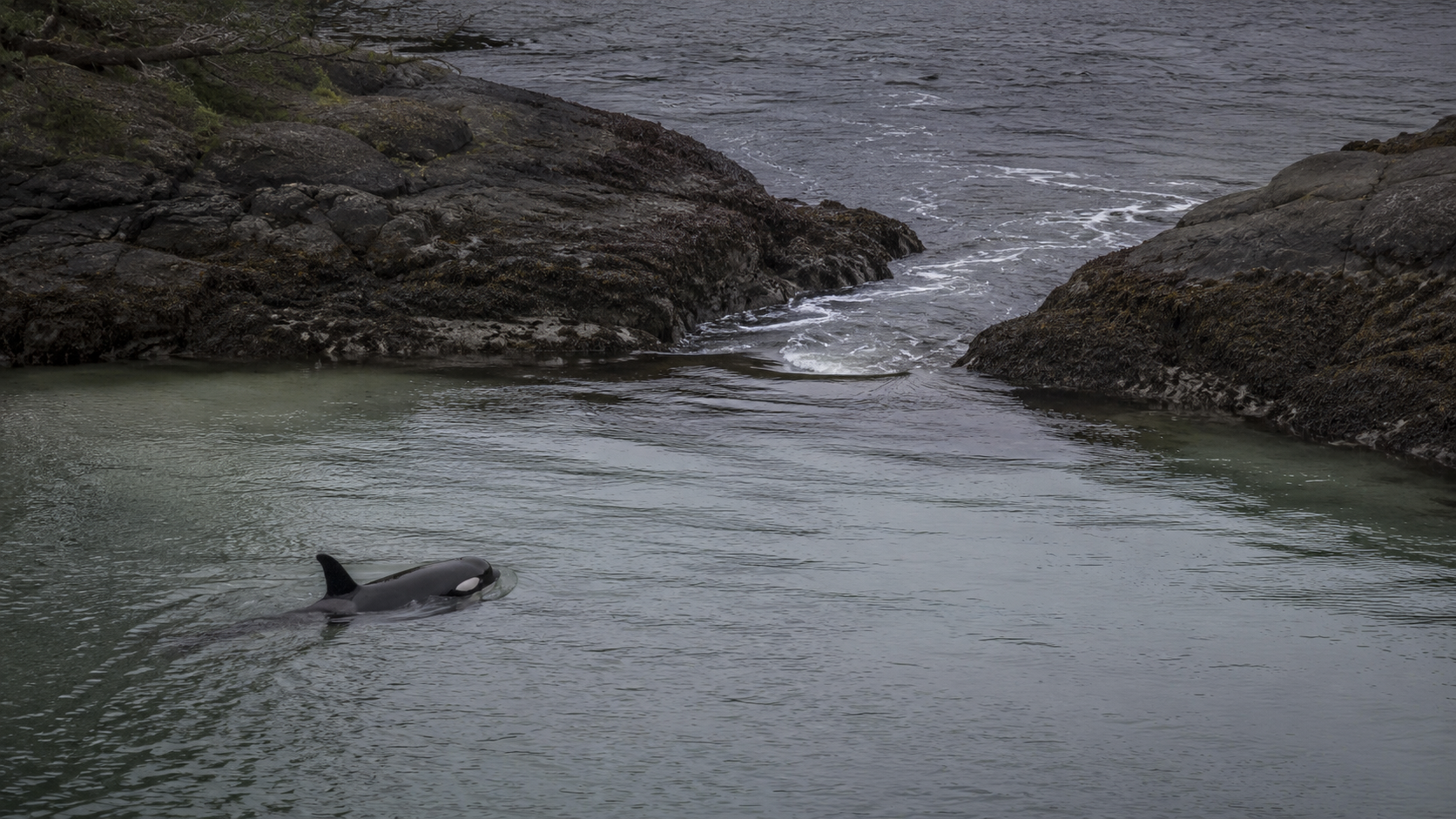
The young orca could see the way out.
Beyond a narrow rocky channel, darker water opened toward the inlet and, eventually, the Pacific Ocean.
She could swim. She could breathe. She could still find food.
Yet every time the small whale approached the passage, something changed.
She slowed.
Sometimes she came close enough that people watching from shore believed she was finally going to cross.
Then she turned back into the lagoon.
Day after day, the same narrow stretch of water remained between the young orca and freedom.
But the story had begun with something far more painful than a difficult tide.
Her mother had died beside that same passage.
The accompanying Reel is a modern visual reconstruction inspired by this documented event. It is not original footage and does not reproduce every movement exactly as it happened.
She Had Entered the Lagoon With Her Mother
The extraordinary story began on Vancouver Island, British Columbia, in March 2024.
The young Bigg’s killer whale entered a tidal lagoon near Zeballos with her mother.
At first, the pair could move through the area together.
Then the tide dropped.
On March 23, the adult female became stranded on rocks in shallow water. People nearby attempted to help, but the receding tide left too little water beneath her enormous body.
An orca can dominate the ocean.
On exposed rocks without enough buoyancy, even an animal that powerful becomes almost helpless.
The mother did not survive.
Her young calf remained in the lagoon.
Suddenly, the smaller whale faced the surrounding water alone.
The Exit Was Still There
The young orca was not trapped behind a concrete wall or inside a net.
That made the situation especially difficult to understand from shore.
A natural tidal channel still connected the lagoon with the surrounding inlet.
At high tide, water moved through the passage.
Beyond it waited deeper water.
The calf simply had to swim through.
At least, that was how it looked to humans.
The reality was much more complicated.
Water moved rapidly through the narrow channel as tides changed. Rocks made the passage more difficult at lower water levels. The animal also had to pass near the location where her mother had become stranded.
Nobody could know exactly what the calf remembered or understood about that place.
Researchers could only watch what she did.
Again and again, she remained inside.
She Began Calling From the Lagoon
The young orca’s isolation was not silent.
Hydrophones recorded vocalizations while she moved through the enclosed water.
Orcas use calls to maintain contact with family members. Their social lives depend heavily on communication, and young whales learn much of what they need from relatives.
No one could translate the calf’s calls into a human sentence.
Still, hearing a young animal vocalizing after losing its mother added another painful dimension to the rescue.
The whale was not simply an animal in the wrong body of water.
She was a young orca without the adult who had guided her there.
Rescuers hoped sound might help guide her out.
They experimented with recorded orca calls and other noises that might attract her toward the passage.
The calf listened.
She moved.
She still did not leave.
Somehow, She Kept Herself Alive
One thing worked in the calf’s favor.
The lagoon contained food.
She began catching prey and continued feeding herself while rescuers worked on different plans.
That ability probably bought everyone valuable time.
It also removed one of the strongest reasons she might have had to leave immediately.
Inside the lagoon, she had food.
She knew the water.
The narrow passage remained the uncertain part.
What looked like a prison to humans may also have felt temporarily safer than the route beyond it.
The situation created an unusual rescue problem.
The whale needed help.
Yet she remained healthy enough to repeatedly avoid the people trying to provide it.
They Called Her Brave Little Hunter
Members of the Ehattesaht First Nation gave the young whale the name kʷiisaḥiʔis, commonly translated as Brave Little Hunter.
The name quickly spread far beyond Vancouver Island.
It suited her.
She was alone, but she was not passive.
The young orca continued swimming through the lagoon, finding food and reacting quickly whenever boats or rescue equipment approached.
Every day she survived gave rescuers another opportunity.
Every day also extended her separation from other orcas.
What began as an emergency lasting hours slowly became a problem measured in weeks.
Rescuers Tried to Guide Her Out
At first, the goal seemed straightforward.
Rather than physically capture the young whale, teams hoped they could encourage her to swim through the channel herself.
They used boats and sound.
At different stages, rescuers also experimented with lines of floats designed to reduce the amount of open space behind her and gently encourage movement toward the exit.
The concept relied on pressure without direct contact.
Move closer behind the calf.
Keep the passage open.
Allow her to choose the safest route.
Brave Little Hunter repeatedly found another option.
She changed direction.
She avoided the boats.
At times, she moved around or beneath the equipment intended to guide her.
The animal that rescuers were trying to save kept defeating their plans.
Every High Tide Created Another Chance
Tides became central to the operation.
At lower water, the rocky passage offered less depth and stronger physical barriers.
High tide created a larger window.
More water covered the rocks.
The route became safer.
Observers began waiting for those periods, hoping one would finally give the calf enough confidence to leave.
She sometimes approached.
Then she retreated again.
Imagine watching from shore.
The dorsal fin moves toward the gap.
The distance shrinks.
The calf reaches the point where one more decision could take her toward open water.
Then the black fin turns.
Back into the lagoon.
For people following the rescue, every attempt began to feel like the one that might finally work.
None of them did.
The Rescue Became Much More Serious
Weeks passed.
Eventually, teams began preparing for an option they had hoped to avoid.
If Brave Little Hunter would not leave voluntarily, they would try to move her.
The operation required extensive planning.
A young orca may be smaller than an adult, but she remains an extremely powerful marine predator. Capturing one safely demands experienced personnel, specialized equipment and careful coordination.
The plan involved securing the calf, supporting her body in a specially designed sling and transporting her into open water.
This could not become a simple chase.
Too much pressure might exhaust or injure her.
Poor positioning could endanger the whale or the rescuers.
Everything needed to happen slowly enough to protect her but quickly enough to prevent prolonged stress.
Eventually, dozens of people gathered for the attempt.
About 50 People Tried to Catch One Young Orca
The rescue operation involved roughly 50 people, along with boats, divers and specialist equipment.
Teams entered the lagoon and worked to gradually restrict the calf’s movement.
If they could guide her into the right area, they hoped to secure her safely.
Brave Little Hunter had another plan.
She avoided them.
Again and again, the young orca found room to move away from the boats and equipment.
Hours of preparation could not overcome one simple fact:
She was still a wild killer whale.
The operation ended without capturing her.
To people watching from outside, that could look like failure.
Yet the calf had demonstrated something encouraging.
She remained fast.
She remained alert.
And she still had enough strength to outmaneuver a rescue operation built specifically around her.
The question was no longer whether she could swim.
Everyone knew she could.
The question was whether she would ever choose the channel.
More Than a Month Had Passed
By late April, Brave Little Hunter had spent more than a month inside the lagoon.
Her mother was gone.
The rescue teams had tried sounds.
They had tried guiding her.
They had tried barriers.
They had prepared an enormous capture operation.
Still, the calf remained on the same side of the passage.
The story began attracting attention far beyond British Columbia because the solution appeared simultaneously simple and impossible.
Freedom sat only a short swim away.
Yet humans could not make a wild orca choose it.
Another high tide was approaching.
Rescuers continued preparing for what they might try next.
Then, before another major intervention could decide her future, Brave Little Hunter made a decision of her own.
In the Early Morning, She Approached the Passage Again
On April 26, the tide rose.
Water deepened through the narrow channel.
The young orca moved toward the exit.
Nothing physically dramatic happened.
No rescue boat surrounded her.
No sling appeared beneath her body.
Nobody pulled her through.
Brave Little Hunter simply kept swimming.
This time, she did not turn back.
The calf entered the narrow passage under her own power.
She moved past the rocky area.
Then she passed beneath the bridge.
For more than a month, people had watched her approach that route and retreat.
Now the small dorsal fin continued forward.
She had finally left the lagoon.
She Passed the Place Where Her Mother Died
The route carried an emotional detail that people following the story could not ignore.
To escape, Brave Little Hunter had to pass near the area where her mother had become stranded.
It is tempting to explain her earlier hesitation through grief or memory.
Science requires more caution.
Nobody can prove that the calf avoided the passage because she associated it with her mother’s death.
Tidal conditions alone could have influenced many of her earlier decisions.
Fear of shallow rocks may also have played a role.
The truth may involve several factors that humans cannot fully observe.
But the physical sequence remains powerful enough without interpretation.
Her mother’s journey ended there.
Weeks later, the calf crossed the same area and kept going.
Rescuers Suddenly Had to Stop Rescuing Her
Once Brave Little Hunter entered deeper water, the role of the rescue team changed immediately.
For weeks, people had tried to influence where she went.
Now she needed space.
Boats and observers followed from a careful distance as the young orca moved farther from the lagoon.
Nobody wanted to frighten her back toward the passage or interfere with whatever decision she made next.
The animal was finally doing what rescuers had wanted from the beginning.
She was navigating on her own.
Freedom, however, created another enormous question.
Where would she go?
Could She Find Other Orcas?
Losing the lagoon did not replace losing her mother.
Bigg’s killer whales travel over large stretches of coastal water in family groups.
By the time Brave Little Hunter escaped, more than a month had passed since the death of her mother.
Relatives were not necessarily waiting outside.
Researchers hoped she could eventually encounter familiar animals or other orcas that might allow her to travel with them.
For a young whale, social connection could become just as important as finding food.
The lagoon had kept her geographically trapped.
Leaving it restored possibility.
No one could promise what she would find beyond the inlet.
But for the first time since March, the young whale could search.
Why Humans Could Not Simply Solve the Problem
The story of Brave Little Hunter demonstrates something unusual about wildlife rescue.
Humans had resources.
They had boats.
They had specialists.
They had technology, planning and dozens of people prepared to help.
The calf still controlled the most important decision.
A rescue team could create opportunities.
It could remove immediate dangers.
It could prepare to intervene if her health declined.
What it could not safely do was turn a wild orca into a passive passenger.
The young whale repeatedly resisted human plans.
In the end, the successful escape required something rescuers could not manufacture.
The right tide.
The right moment.
And the calf’s willingness to keep swimming.
Why Our Reel Ends Before She Crosses
The visual reconstruction stops at the most powerful point for understanding the story.
The calf approaches the narrow passage.
Water moves faster around her.
Open water sits beyond the rocks.
She begins to enter.
Then the video ends.
That cliffhanger reflects the real uncertainty that lasted for weeks.
People watching Brave Little Hunter had seen similar approaches before.
They could never know whether the next one would end differently.
The full story gives that moment its weight.
She did not hesitate for 15 seconds.
She remained inside for more than a month.
The Rescue Nobody Planned
Rescuers had prepared increasingly complicated methods to help the calf.
The final escape required none of them.
No person carried Brave Little Hunter back to the ocean.
She did it herself.
That does not make the rescue effort meaningless.
People monitored her health, developed backup plans and remained ready if the situation became more dangerous.
Their restraint mattered too.
Knowing when not to force an animal can become part of a successful wildlife rescue.
Eventually, nature changed the conditions.
The tide rose.
Brave Little Hunter approached the narrow passage one more time.
And this time, she kept going.
For weeks, the ocean had waited just beyond the rocks.
On April 26, the young orca finally chose it.
