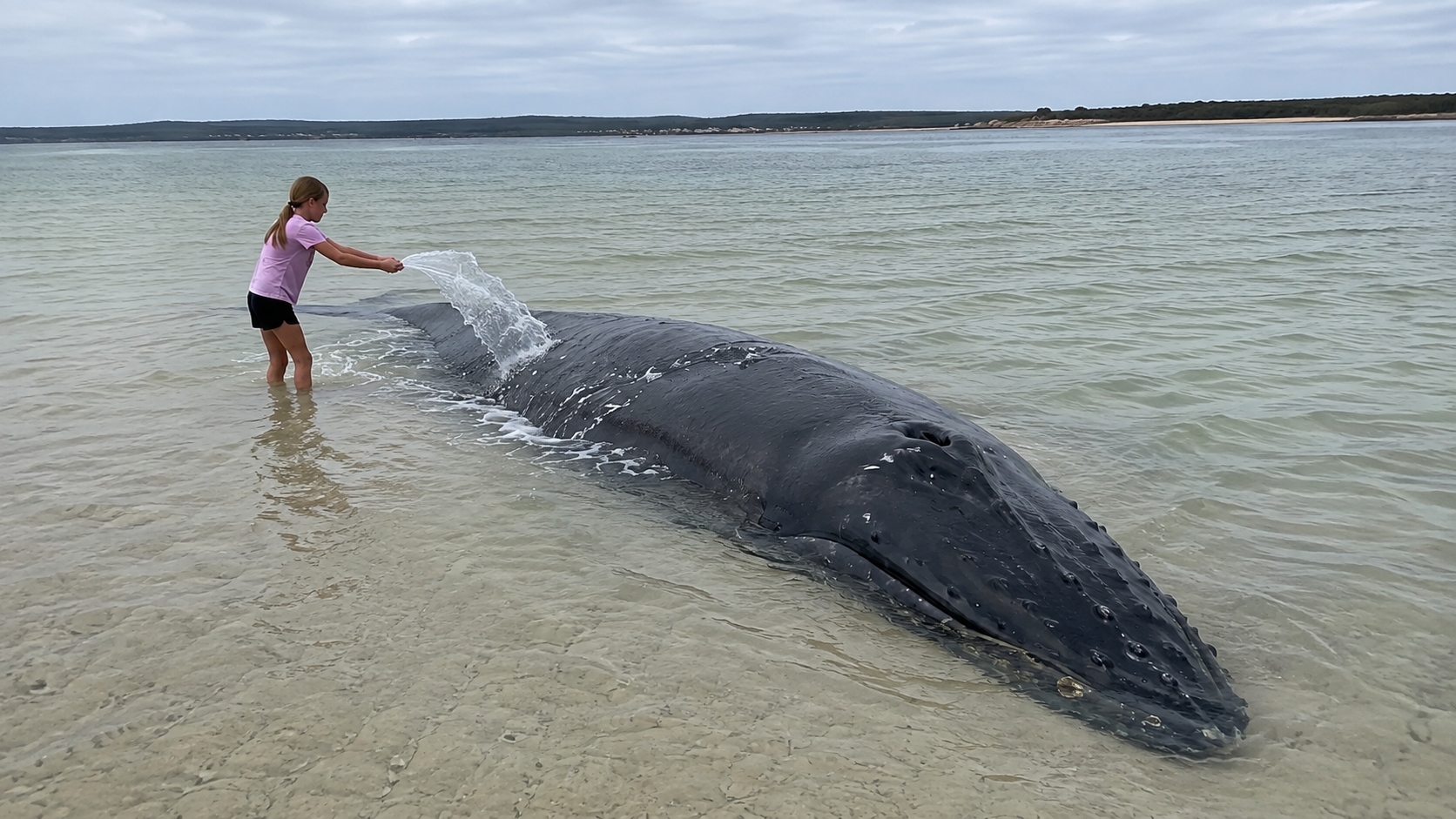
The young humpback lay almost motionless in water that was far too shallow for it to swim.
A thin layer of seawater covered part of its enormous body, but sections of its dark back remained exposed to the air. Beneath it, pale sand offered almost no depth and nowhere for the whale to go.
The ocean had not disappeared.
It was simply too far away.
Nearby, a 10-year-old girl stepped into the shallow water.
She could not lift the whale. She could not push an animal that outweighed her many times over. No rope, boat or rescue team stood beside her.
So she began doing the one thing available to her.
She scooped seawater into her hands and threw it across the whale’s exposed skin.
Then she did it again.
And again.
The tide would not return immediately.
No one yet knew whether the whale could remain there long enough to wait for it.
The accompanying Reel is a modern visual reconstruction inspired by the documented rescue. It is not original footage and does not reproduce every movement exactly as it occurred.
A Morning Ride Turned Into an Emergency
The real encounter happened on August 9, 2026, near Wathumba Creek on the western side of K’gari, Queensland.
Chantelle Smith was riding a jet ski with her 10-year-old daughter, Scarlett, when they encountered the stranded young humpback.
The calf had become stuck in the shallow coastal water near the creek. Scarlett immediately wanted to help. She entered the shallows and began splashing seawater over the whale while her mother worked out what they could safely do and whether authorities had already received a report.
From a distance, splashing water onto a whale may look almost insignificant.
For a stranded animal, however, remaining wet matters.
A whale’s body evolved to spend almost all of its life supported by seawater. Once it loses that buoyancy, its own weight becomes part of the problem.
The exposed skin can also begin drying under the air and sun.
Scarlett could not solve the stranding herself.
She could only help buy the whale time.
The Whale Was Still Alive—and Still Responding
The young humpback had not simply washed ashore lifeless.
Witnesses could see that it was alive.
According to 7NEWS, the whale remained highly vocal during the ordeal while Scarlett continued throwing water over it. The article described the young animal as exhausted in shallow water while the girl worked to keep it wet.
That detail made the scene even harder to leave.
Each breath confirmed that the whale was still fighting.
At the same time, every minute in the shallows increased the pressure to find a solution.
Trying to force the whale toward deep water would have created its own dangers.
People standing beside a stranded whale may underestimate the power of its tail and pectoral fins. A sudden movement from an animal of that size can seriously injure someone nearby.
The safest response requires trained authorities, distance and careful assessment.
But waiting can feel unbearable when the animal remains directly in front of you.
More People Arrived
Scarlett and her mother were not the only people who became involved.
Volunteer Kim Ralph later reached the area with her husband, teenage son and family friends. Other people joined them until roughly 11 volunteers were helping around the stranded calf.
For at least four hours, the group repeatedly splashed water over the whale from a safer distance while they waited for wildlife authorities and the incoming tide.
The number of volunteers changed the scale of the effort.
One small girl throwing water had become a rotating group trying to keep the whale as comfortable as possible.
Yet none of them could manufacture the thing the calf needed most.
Depth.
The ocean had to come back to the whale.
Why They Could Not Simply Push It Out
A young humpback is smaller than a fully grown adult, but “small” becomes relative when discussing whales.
Even a calf carries enormous mass.
Moving that weight across sand risks injuring the animal and the people around it. Dragging or pulling without specialist equipment can damage skin, fins or internal tissues.
The whale also needs enough water beneath its body to regain buoyancy.
A few centimetres of additional water may not be enough.
As the tide rises, however, more of the whale’s weight transfers from the sand back into the surrounding water. Eventually, the animal may reach a point where its own tail can generate useful forward movement again.
That creates a difficult waiting game.
Too little water, and the whale remains pinned.
Enough water, and one strong movement may suddenly change everything.
The volunteers could keep splashing.
Only the tide could change the depth.
Hours Passed
The group remained with the calf through the late morning and into the afternoon.
ABC reported that volunteers worked for at least four hours to keep the young whale comfortable.
Imagine what that means in practical terms.
Scoop water.
Throw it over the exposed body.
Move carefully.
Watch the tail.
Check the whale.
Repeat.
The action itself was simple.
The uncertainty was not.
No one standing there could guarantee that the calf would still have enough strength when the water finally returned.
Strandings can happen for different reasons. A whale may enter shallow water accidentally, become separated from family, experience illness or follow changing coastal conditions into an area it cannot easily leave.
At that moment, the volunteers did not need to solve the entire mystery.
They needed the animal to survive until the environment changed.
Somewhere Nearby, Its Mother Was Missing
One detail made the situation especially serious.
The stranded animal was a calf.
Young humpbacks remain dependent on their mothers. They need milk, protection and guidance during migration.
Marine scientist Wally Franklin told ABC that separation from the mother can become extremely dangerous for a calf. If the pair cannot reconnect, the young whale’s survival prospects drop dramatically.
The volunteers could help the whale remain wet.
They could not replace its mother.
That created another unanswered question beyond the tide.
Even if the calf managed to leave the sand, would it find her again?
The answer was somewhere beyond the shallow water.
Then the Water Began to Change
As afternoon approached, the tide finally began returning.
The difference did not arrive as one enormous wave.
Water gradually reclaimed the sand around the whale.
More of the body became supported.
The calf now had something it had lacked for hours: increasing buoyancy.
Around 2 p.m., according to Queensland’s Department of Environment, the young humpback managed to dislodge itself on the incoming tide.
After hours of waiting, splashing and watching, the central question suddenly had an answer.
The whale was moving.
It had not required people to drag it across the sand.
The rising water finally gave the calf enough depth to use its own body again.
But one enormous question remained.
Where was its mother?
The Rescue Was Not Over Yet
Escaping the sandbank solved the immediate physical danger.
For a calf, reaching deeper water alone still would not guarantee survival.
A young whale can move through the ocean, but independence comes much later.
The volunteers therefore watched what happened next.
Then came the moment that transformed the story from a successful refloating into something far more emotional.
According to Ralph, the calf found its mother again.
The two whales reunited and swam away together.
The mother had not disappeared permanently.
Somewhere beyond the shallow bank, she remained close enough for the pair to reconnect after the calf regained open water.
The volunteers had spent hours trying to keep one young whale alive.
The tide completed the physical rescue.
The reunion completed the story.
Why Authorities Still Warn People to Keep Their Distance
The outcome was positive, but wildlife officials do not want the event interpreted as permission for everyone to enter the water beside a stranded whale.
Queensland’s Department of Environment advises people to keep their distance and report stranded whales so rangers can assess the animal and monitor the situation.
Franklin also warned that large whale tails and pectoral fins can cause severe injuries. Another concern involves disease transmission between humans and marine mammals.
There may also be dangers that people cannot see.
Sharks can approach a distressed or stranded marine animal. Water depth can change suddenly. A whale that has appeared quiet for hours may make a powerful movement once a wave gives it more buoyancy.
The correct first step is therefore simple:
Report the animal.
Give authorities an accurate location.
Remain at a safe distance unless trained responders provide other instructions.
Scarlett’s story became remarkable because she encountered an extraordinary situation.
It should not encourage people to deliberately create close contact with stranded whales.
K’gari Sits Beside a Major Whale Migration Route
The location also helps explain why whale encounters around K’gari receive so much attention.
Humpbacks migrate along Australia’s east coast in large numbers each year.
K’gari lies beside that movement corridor.
As populations recovered from the devastating effects of commercial whaling, more humpbacks returned to Australian waters. Franklin told ABC that the population has made a major recovery over recent decades, which also means more whales moving through coastal environments where strandings can occur.
ABC reported 13 whale strandings in the region during 2026 by the time of the K’gari rescue.
More whales represent a conservation success.
More whales can also mean more encounters with sandbanks, changing tides, boats, nets and other coastal hazards.
Every migration contains thousands of individual journeys.
Some go wrong within metres of shore.
Why This Rescue Looked So Different
Most dramatic wildlife rescues involve visible equipment.
Boats surround the animal.
Ropes enter the water.
Teams cut netting or use specialized gear.
This event looked almost painfully simple.
A whale lay in shallow water.
People stood around it.
A child repeatedly threw seawater over its body.
For hours, nothing visually spectacular happened.
That simplicity is exactly what makes the story powerful.
The volunteers could not overpower the problem.
They could only protect the calf from some of the immediate effects of stranding while nature slowly created another opportunity.
The rescue depended on patience.
Four Hours for One Change in the Water
A 15-second video compresses the scene dramatically.
The real waiting lasted hours.
During that time, the whale continued breathing while volunteers repeatedly returned water to its exposed skin.
Scarlett eventually had to leave after confirming that the incident had been reported. Other volunteers remained and continued the effort.
No one person carried the entire rescue.
Scarlett became the emotional beginning of the story because of the contrast visible in the footage: one small child beside an enormous stranded whale.
The larger truth involved a community response.
One person found the animal.
Others remained.
Authorities monitored the situation.
The tide returned.
Finally, the whale did the part that only the whale could do.
It swam.
The Moment the Reel Does Not Show
Our reconstruction ends before that happens.
The water begins rising around the calf.
Its tail appears to gain slightly more freedom.
Then the video stops.
That is where the real story becomes worth reading.
The young whale did not remain trapped.
At around 2 p.m., the incoming tide finally provided enough water for it to free itself.
And after escaping the shallows, it found the one animal the volunteers could never replace.
Its mother.
Together, they disappeared back into deeper water.
For hours, the people on K’gari had been trying to keep one stranded whale alive until the ocean returned.
In the end, that was enough.
A 10-year-old girl could not move a humpback whale.
She could not control the tide.
She could only keep throwing water.
And for those hours, that was exactly what the whale needed.
