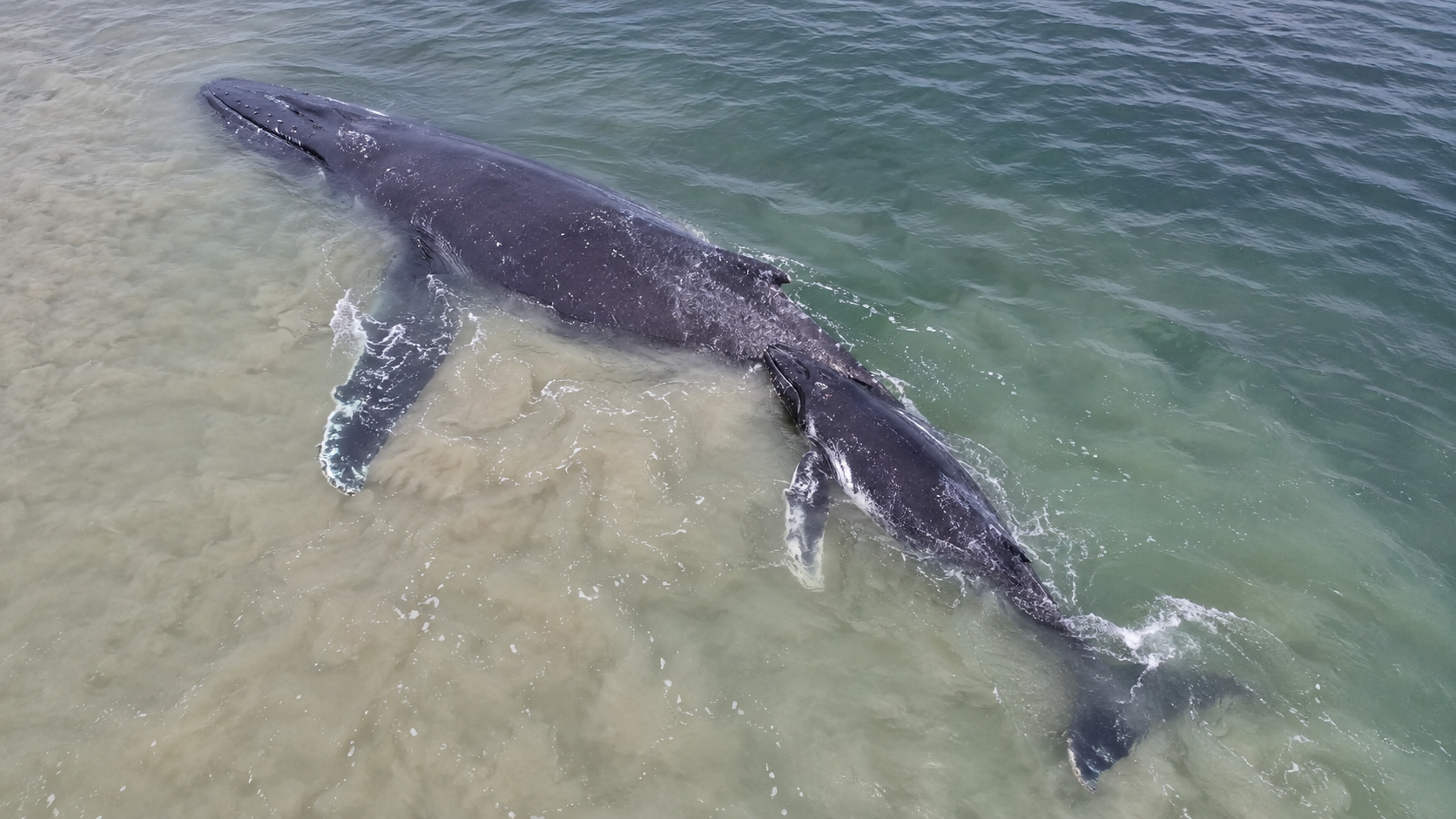
The mother tried to move again.
Her massive body shifted against the shallow water, stirring pale sand beneath her. A short sweep of the tail sent ripples across the bank, but she barely changed position.
A few metres away, her calf was still free.
Nothing physically prevented the younger whale from following the deeper channel and continuing toward open water.
Instead, it turned back.
The calf approached the mother’s side, pressed its small head against her enormous body and began pushing.
At first, nothing seemed to happen.
The adult humpback outweighed the calf many times over. Sand and shallow water supported too little of her body for normal swimming. Each attempt produced turbulence, foam and another cloud of disturbed sediment beneath her.
Still, the calf remained beside her.
It backed away, repositioned itself and pushed again.
The extraordinary encounter happened near North Stradbroke Island in Queensland, Australia, in October 2016. Aerial footage captured the calf repeatedly nudging its stranded mother while she struggled to escape a sandbank.
What the cameras could not answer immediately was the question that made the scene so difficult to stop watching:
Could such a small whale actually help move its mother?
The accompanying Reel is a modern visual reconstruction inspired by this documented event. It recreates the central behavior rather than reproducing the original footage frame by frame.
The Mother Had Entered Water That Was Too Shallow
Humpback whales migrate along Australia’s coastline each year, and eastern Australian whales regularly travel through coastal waters during their journeys between tropical breeding areas and Antarctic feeding grounds. Australian government guidance notes that humpbacks commonly use coastal waters and rank among the whales most frequently seen around the country.
Shallow water itself does not automatically create danger.
Mothers with calves can travel relatively close to shore, and protected coastal areas may offer calmer conditions than exposed ocean.
A sandbank, however, can change depth dramatically over a short distance.
A whale may still be surrounded by water while the seabed beneath it becomes too shallow to support normal swimming.
That appears to have happened near North Stradbroke Island.
Reports from the incident said the mother became stuck at around 7:30 in the morning. Her body rested over the shallow bank while her calf remained mobile around her.
The adult did not simply lie still.
Footage showed her moving her tail and struggling to regain deeper water while the calf stayed close and repeatedly nudged her side.
From above, the imbalance was obvious.
The calf could move.
The mother could not.
The Calf Had a Choice the Mother Did Not
A humpback calf depends heavily on its mother.
During the first stage of its life, the adult provides milk, protection and the experience needed to navigate a long migration.
The calf follows her movements because survival depends on remaining together.
In this case, the relationship suddenly reversed.
The mother needed to move.
Her calf appeared to respond.
No scientist standing beside the animals could ask what the young whale intended. Words such as “rescue” or “save” therefore require some caution. Observers can document the behavior—approaching, nudging and remaining beside the mother—but they cannot prove exactly what the calf understood.
Yet the physical action was difficult to miss.
Instead of moving away from the stranded adult, the calf repeatedly returned and pressed against her.
That behavior gave the scene its emotional force.
A young whale that normally depended on its mother now seemed to be directing its own effort toward her.
Pushing a Humpback Whale Is Not Simple
The difference in size between a humpback mother and her calf makes the scene appear almost hopeless.
An adult female humpback carries enormous mass. Even with water supporting much of that weight, shallow conditions can prevent the whale from generating the forward momentum that normal swimming requires.
The calf faced a mechanical problem.
It could push against the mother, but its own body offered only a fraction of her mass and strength.
More importantly, the mother did not need to move vertically. She needed to slide enough of her body toward deeper water for buoyancy to begin helping again.
A few centimetres might accomplish almost nothing.
A larger shift at exactly the right moment could change everything.
That made the surrounding water crucial.
The Water Was Part of the Rescue
The calf was not working alone.
Every small wave that crossed the bank temporarily increased the water beneath and around the mother. A little additional buoyancy could reduce the pressure holding her against the sand.
At the same moment, the adult could use her own tail.
If the calf pushed while a small surge lifted part of the mother’s body and the adult generated forward force, those separate movements could combine.
The video reconstruction emphasizes that possibility by showing disturbed sand and changing water around the pair.
It creates the central visual question without immediately answering it:
Was the calf strong enough—or did it simply keep trying until the water finally gave the mother the opportunity she needed?
The First Attempts Did Not End the Crisis
The real encounter did not resolve after one dramatic push.
Reports described the calf repeatedly nudging the stranded whale while she continued struggling in the shallow water.
That repetition matters.
A single contact could happen accidentally. A calf swimming close to its mother may bump into her without attempting anything specific.
Repeatedly returning to her side creates a different picture.
The younger whale remained engaged with the adult while the mother tried to free herself.
Meanwhile, people onshore had already recognized that the situation could require intervention.
Queensland Parks and Wildlife personnel were reportedly on their way as the whales continued struggling.
The clock mattered.
A stranded whale can face mounting physical stress, and changing tides may either improve the situation or make it worse.
For the mother, remaining trapped was not a position she could maintain indefinitely.
About 40 Minutes Passed
The mother reportedly remained stuck for roughly 40 minutes.
During that period, the calf continued swimming close and nudging her while the adult worked her tail against the shallow water.
Forty minutes changes the meaning of the scene.
This was not one brief moment captured at exactly the right second.
The pair remained in the same problem long enough for observers to watch the calf return again and again.
For a person viewing a 15-second Reel, the pushes happen quickly.
For the animals, the real event unfolded over a much longer period.
Every failed movement left the mother in the same place.
Every return from the calf happened while the adult still had not escaped.
Then the balance finally began to change.
The Mother Started to Move
Eventually, the adult gained enough movement to shift away from the shallowest section.
The exact contribution of each force cannot be measured from the footage alone.
Her own tail movements mattered.
Water depth mattered.
Changing conditions around the sandbank mattered.
And the calf was still there, repeatedly pushing and nudging her side.
Reports described the mother finally freeing herself at around 8:15 that morning, before the approaching wildlife team needed to carry out a physical rescue.
After roughly 40 minutes of being trapped, the huge body moved away from the bank.
The mother reached deeper water.
Then came the part that confirmed the separation had ended.
The calf went with her.
They Swam Away Together
Once the mother reached enough depth to support normal movement again, the pair left the shallow area together.
Aerial footage showed them swimming away from the sandbank after the adult regained her freedom.
No ropes pulled her.
No crane lifted her.
Rescuers did not need to surround the whale or tow her into open water.
The mother ultimately moved herself back into deeper water while her calf remained beside her throughout the struggle.
That distinction matters when describing the story.
It would be easy to reduce the event to a dramatic sentence:
“The baby whale saved its mother.”
The truth is more interesting.
The calf clearly nudged and pushed the stranded adult. The mother simultaneously fought to move herself, and the changing water around the sandbank likely helped restore enough buoyancy for her to escape.
Nobody can calculate how much of the final movement came from the calf.
But nobody watching the footage could miss the young whale’s persistence.
Did the Calf Understand What It Was Doing?
That question remains much harder than describing the physical events.
Animal behavior often tempts humans to assign familiar motivations.
A calf pushes its mother, so we call it a rescue.
A whale stays beside a dead relative, so we call it grief.
An orca leaves prey beside a boat, so we call it a gift.
Sometimes those words may capture part of what is happening.
Science still needs to separate observation from interpretation.
In the North Stradbroke incident, observers could confidently say that the calf repeatedly remained close to the stranded mother and nudged her while she struggled.
Determining whether the calf understood the mechanical problem—“my mother is stuck, and pushing her may free her”—requires a much stronger claim.
The calf may instead have reacted to its mother’s distress, attempted to maintain physical contact or followed an instinctive drive to stay close.
Those possibilities do not make the behavior less remarkable.
A young whale faced with an unusual situation repeatedly chose proximity rather than departure.
Mother and Calf Bonds Make Separation Dangerous
For a young humpback, losing contact with its mother can become a survival emergency.
The mother provides nutrition and protection during a period when the calf lacks the independence required for long-distance migration.
Remaining nearby therefore makes biological sense.
Yet staying close to a stranded whale can also expose a calf to shallow water and other hazards.
The 2016 footage captured that tension perfectly.
Deeper water remained accessible to the calf.
Safety lay away from the sandbank.
The animal nevertheless remained near its mother.
What looked emotionally like loyalty may also reflect one of the strongest survival relationships in the calf’s life.
Leaving her could have created a completely different danger.
Why Sandbanks Can Become Traps
The incident also demonstrates why an ocean surface can be misleading.
From above, a whale may appear completely surrounded by water.
Underneath, only a small difference in depth can determine whether the animal swims normally or rests part of its weight against the seabed.
Sandbanks constantly interact with currents, tides and waves.
For an animal as large as a humpback, losing only part of the water column beneath the body can sharply restrict movement.
The whale may still breathe normally because the head remains at the surface.
That does not mean it can escape easily.
Once enough of the body contacts the bottom, normal tail propulsion becomes less effective. The animal must wait for deeper water, find a workable angle or generate enough movement to slide toward the channel.
That appears to be the struggle captured in the 2016 footage.
Why We Stop the Reel Before the Escape
The generated Reel ends while the mother has begun to move but before she reaches deeper water.
That choice differs from the complete real story.
It is deliberate.
The original incident gives the audience a genuine unanswered question during the video:
Did the calf’s pushing eventually make any difference?
The article provides the payoff.
Yes—the mother eventually moved free, and the pair swam away together.
However, the real significance lies in everything that happened before that final movement.
For roughly 40 minutes, the calf could leave.
It did not.
The mother struggled.
The calf returned.
Sand stirred beneath the enormous body as both whales continued trying.
Then the water gave them another chance.
One Small Body Beside a Much Larger One
The most memorable image from the incident does not show the moment of freedom.
It shows the size difference.
One enormous adult lies restricted by shallow water.
Beside her, a much smaller calf pushes against a body it could never realistically overpower through strength alone.
That is why the footage still works years later.
The calf did not need to perform a perfect rescue.
Its persistence created the story.
Each return carried the same simple message through movement rather than words:
The mother had stopped.
The calf had not.
Eventually, the sand released its hold, the mother reached deeper water and the two whales resumed their journey together.
Whether the calf understood exactly what its pushing accomplished remains impossible to know.
What the cameras captured is enough.
It had open water.
Its mother did not.
And instead of swimming away, the calf turned back.
