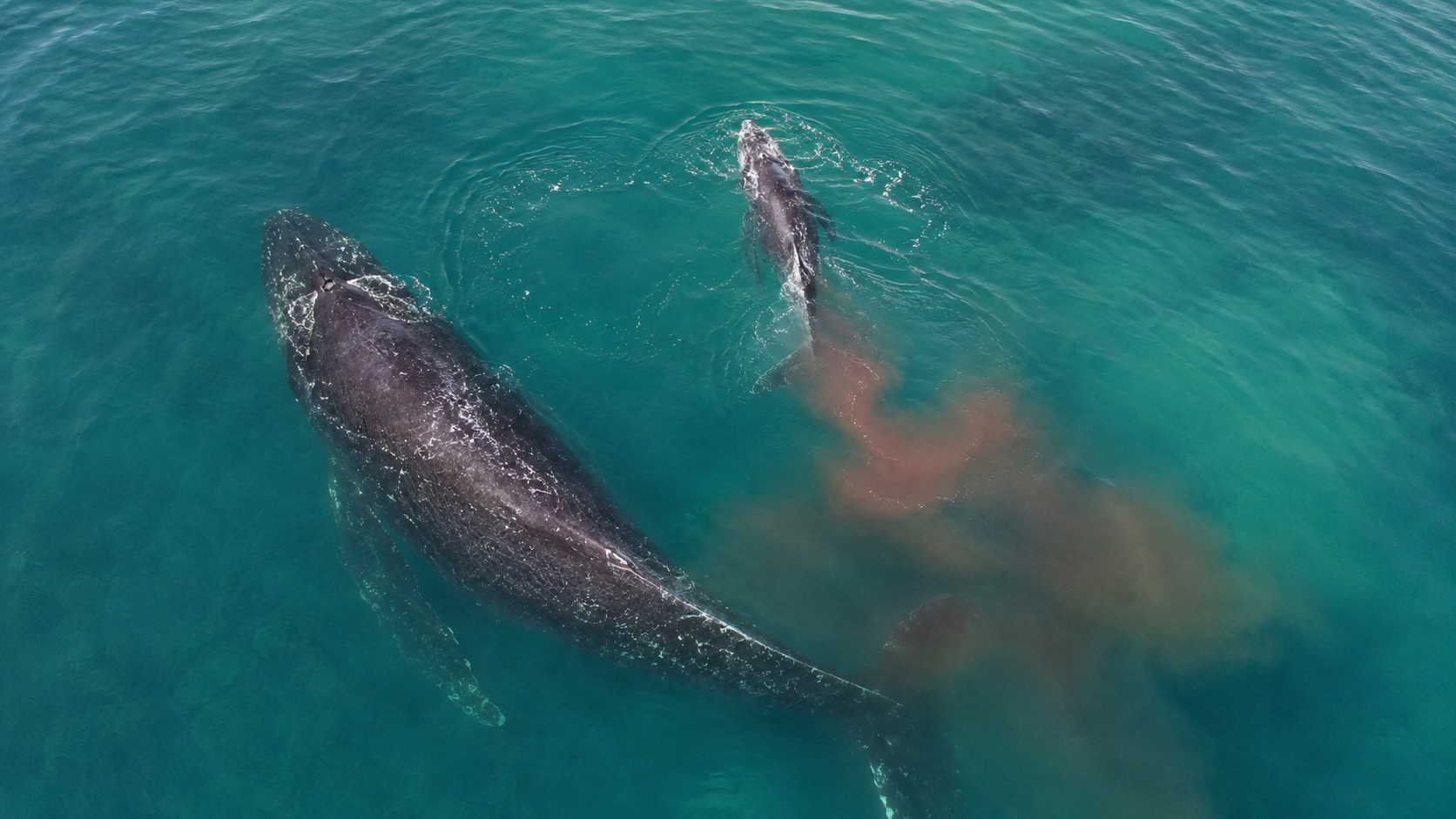
From high above the coast of New South Wales, the humpback whale looked as though she had simply fallen behind.
Other migrating whales continued north through the blue-green water. However, this female moved at a pace that immediately caught the attention of drone operator Alexander Forrest.
She was not completely still.
She was not sleeping.
Yet something about her movement felt different.
Forrest began recording as the whale slowly travelled near Kingscliff on Australia’s east coast. Then the water beneath her suddenly changed.
A reddish plume spread behind the enormous animal.
For one frightening moment, Forrest wondered whether he had just witnessed an attack.
Then a tiny pale body began rising through the water.
The whale had not been attacked.
She had just given birth.
The accompanying video is a visual reconstruction of this documented event. The original observation and footage were recorded by the Organisation for the Rescue and Research of Cetaceans in Australia.
One Whale Was Moving Differently
The extraordinary encounter happened on the afternoon of July 28, 2026, near Kingscliff on the northern coast of New South Wales.
Forrest, a volunteer drone operator with the Organisation for the Rescue and Research of Cetaceans in Australia, better known as ORRCA, was observing humpback whales during their annual migration.
Most of the whales continued travelling normally. One adult female, however, remained behind the group and moved unusually slowly.
At first, Forrest thought she might be resting.
He had already spent thousands of hours observing humpbacks from above, yet he had never seen one travel so slowly and consistently.
The female was approximately 700 metres from shore. ORRCA also reported that Forrest kept the drone more than 100 metres away, following the wildlife-distance requirements in New South Wales.
Because of that elevated perspective, the camera could see what no observer at water level would have seen as clearly.
Something was happening beneath the whale.
Then the Water Turned Red
The female rose closer to the surface.
Almost immediately, a reddish plume appeared behind her body and began spreading through the blue water.
Forrest did not initially understand what he was seeing. He briefly feared that a predator had attacked the humpback or that another violent interaction had happened below the surface.
Then a small white-grey shape appeared inside the plume.
It separated from the mother and began travelling upward.
Only when the tiny animal approached the surface did Forrest understand that he was watching a newborn humpback calf enter the ocean.
The entire meaning of the scene changed within seconds.
The red cloud was no longer evidence of an attack.
The pale shape was not another predator.
It was a baby whale beginning the first and most urgent movement of its life.
The Calf Had Never Breathed Before
A humpback calf is already enormous by human standards. Newborn humpbacks typically measure roughly four to five metres long.
Yet beside its mother, the calf in the drone footage looked extraordinarily small.
It emerged underwater.
Therefore, before it could begin following its mother, learning her movements or nursing, it first had to reach the air.
The newborn began rising almost immediately.
Marine scientist Vanessa Pirotta explained that the calf appeared to know instinctively what it needed to do: move toward the surface. The drone captured the baby reaching the air and taking its first breath.
No one had to guide it toward the sky.
No one could pause the moment.
From the instant it entered the water, the newborn’s survival depended on an instinct it had never used before.
The Mother Remained Still
Immediately after the birth, the adult female remained almost motionless for several seconds.
Then she turned back.
The calf had risen through the water, but the separation between mother and newborn lasted only briefly. As the baby reached the surface, the female repositioned herself and moved toward it.
Forrest later described their reunion as one of the most remarkable wildlife moments he had ever witnessed.
The drone team continued observing the pair for several hours. During that period, they recorded maternal behaviour, the calf’s first movements and brief interactions involving other whales.
The calf had completed its first breath.
Now it had to begin learning how to remain beside a mother travelling through an enormous ocean.
Why This Birth Was So Rare
Humpback whales migrate through waters watched by researchers, tourists, coastal residents and whale-watching crews every year.
Even so, scientists almost never witness the exact moment of birth.
The event usually happens far from people, often at night or beneath water that hides the most important details. Observers may encounter a mother with a newborn calf, but by then the birth has already happened.
According to ORRCA’s preliminary assessment, only three other complete humpback whale births had previously been documented on film.
The Kingscliff encounter appeared to become the fourth—and the first complete humpback birth recorded from an aerial drone perspective.
That difference matters.
A camera at water level may record a blow, a dorsal surface or a calf suddenly appearing beside its mother. However, the top-down drone view revealed the positions of both bodies below the surface.
It recorded the mother’s slow movement before the birth.
It captured the plume as the calf emerged.
It followed the newborn’s rise toward the air.
Finally, it showed how the mother turned back and reunited with it.
The Birth Happened During Migration
Every year, eastern Australian humpback whales leave their Antarctic feeding grounds and travel north along the New South Wales coast.
They move toward warmer waters off New South Wales and Queensland, where mating and calving occur. The complete return journey can cover approximately 10,000 kilometres. In 2026, the New South Wales government estimated that roughly 40,000 humpbacks would participate in the migration.
For years, scientists often associated humpback births most strongly with tropical or subtropical breeding grounds.
However, this mother gave birth while still travelling near Kingscliff.
She was close to the coastline and appeared to be travelling without an escort.
That location raises important questions about how strictly humpbacks follow the birthing patterns humans have assigned to them.
A researcher interviewed by ABC explained that the sighting may require scientists to reconsider the simplified idea that the whales must reach tropical waters before giving birth.
Perhaps the calf arrived earlier than expected.
Perhaps some females regularly give birth while still migrating, but few people ever witness it.
Alternatively, the growing number of whales and the increasing use of drones may simply allow researchers to see behaviour that has always occurred beyond human view.
She Appeared to Be Alone
Another detail made this birth different from several previously documented encounters.
The female appeared to be travelling alone when labour began.
Researchers have sometimes recorded other whales near mothers during birth events. Those nearby animals may remain close before, during or after the calf arrives.
In this case, however, the mother did not appear to have an escort beside her at the crucial moment.
She gave birth alone in open coastal water.
Only after the newborn reached the surface did the first visible bond begin: the mother turned back, the calf moved toward her, and the pair started travelling together.
That sequence may help researchers compare solitary births with those involving additional whales.
It could also reveal whether the presence of escorts changes the mother’s movement, the calf’s ascent or the behaviour immediately after birth.
The Drone Recorded More Than a Spectacle
The footage quickly spread because of its emotional power.
Nevertheless, ORRCA believes its greatest value may come later.
The organisation plans to examine the recording in detail and expects researchers to submit the observation for peer review and publication. Scientists can compare the mother’s movement, the calf’s position and the timing of the first breath with the few other complete births already documented.
The video may help answer questions that remain difficult to study:
How does a humpback mother position herself immediately before delivery?
How quickly does the newborn begin rising?
Does the mother assist directly, or does the calf reach the surface largely through its own movement and buoyancy?
How long does the mother remain still before returning?
What happens during the calf’s first hours?
One recording cannot answer every question.
However, when only a few complete observations exist, every second of clear footage becomes valuable.
Technology Found a Moment Humans Rarely See
The birth did not happen because a research vessel surrounded the whale.
No diver entered the water.
Instead, a drone recorded the scene from a regulated distance while the mother continued behaving naturally.
That perspective allowed observers to see through the surface without approaching the pair closely.
Researchers also believe the recovery of eastern Australia’s humpback population has increased the chance of witnessing rare events. Commercial whaling once reduced the population to only a small fraction of its former size. Protection allowed the number of migrating whales to grow dramatically over subsequent decades.
More whales now travel along the coastline.
More observers watch them.
Meanwhile, better cameras and aerial technology can reveal behaviour that once remained hidden beneath the surface.
The Kingscliff birth may therefore represent two remarkable stories at once.
It documented the beginning of one calf’s life.
At the same time, it showed what becomes possible when a recovering population meets a new way of observing the ocean.
What Happened After the First Breath?
The calf successfully reached the surface and reunited with its mother.
Over the following hours, the drone team continued documenting the pair as they swam together. The mother displayed nurturing behaviour, while the newborn began adapting to movement beside her. Brief interactions with other humpbacks also occurred during the observation period.
Those hours were only the beginning.
The calf still faced a long migration, changing ocean conditions and the many dangers that confront young whales.
However, the recording confirmed the first essential outcome.
The tiny body that rose through the reddish water reached the air.
It took its first breath.
Then it found its mother.
A Few Seconds That Changed Everything
At first, Forrest saw only a whale moving unusually slowly.
Then the sea changed colour.
A pale shape appeared behind the enormous female and began rising toward a world it had never seen.
For the mother, the moment ended months of pregnancy and began the demanding work of protecting a newborn.
For the calf, everything depended on reaching the surface.
For scientists, the drone opened a rare window into one of the least observed moments in the life of the world’s most watched whale.
The footage lasted only moments.
Yet within those moments, a new humpback entered the ocean, found the air and joined its mother for the first time.
The water beneath the whale had changed.
And then, something tiny began to breathe.
SEO për WordPress
Focus keyphrase: humpback whale birth caught by drone
SEO title: Humpback Whale Birth Caught by Drone: First Breath
Slug: humpback-whale-birth-caught-by-drone
Meta description:
A drone operator saw a humpback moving strangely off Australia. Then a newborn calf rose through the water for its first breath.
