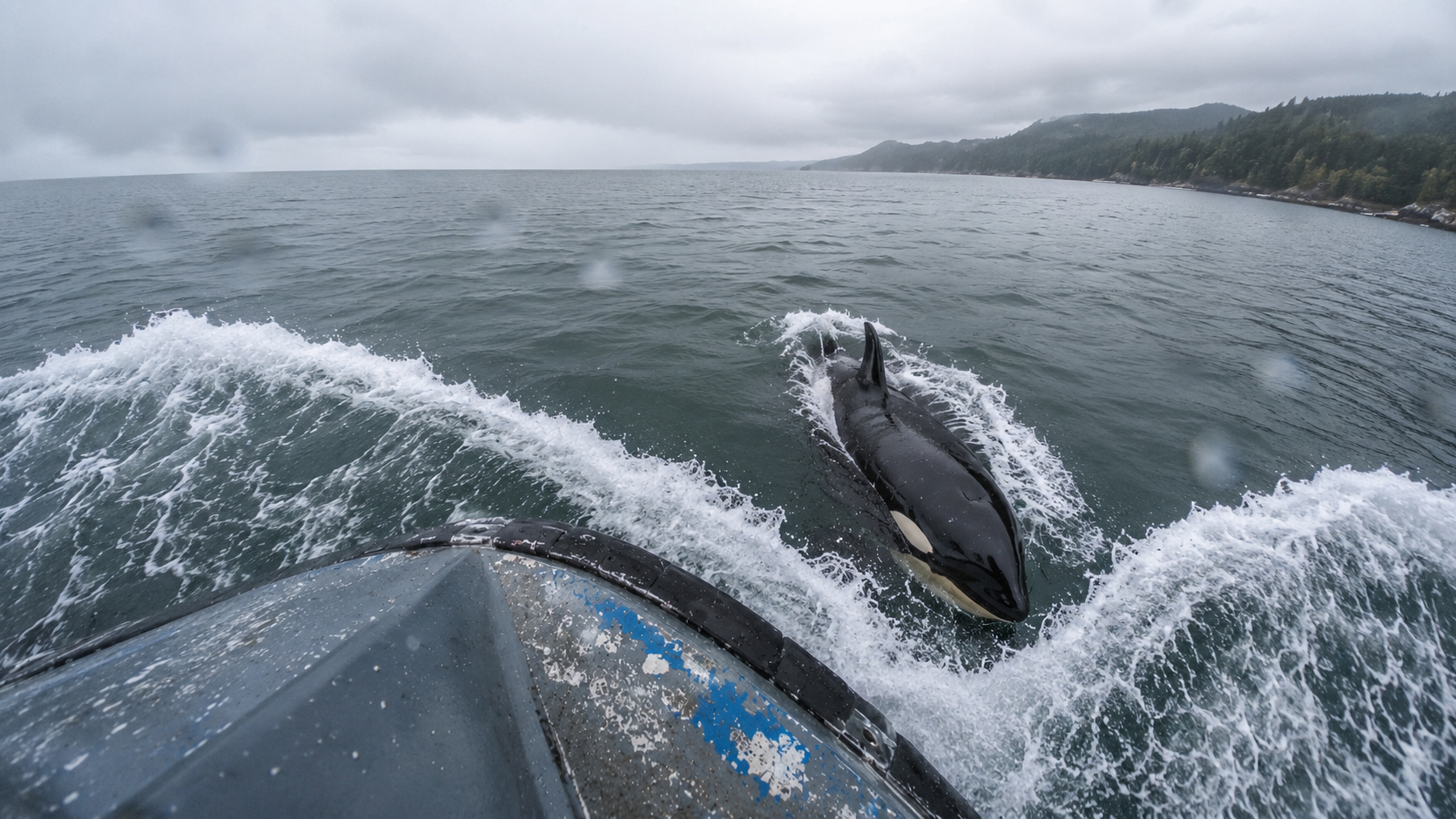
He is there again in the morning, before anyone on deck has finished their coffee.
The first time, the crew thought it was a coincidence. A young killer whale, maybe four metres, riding the pressure wave off the bow the way dolphins sometimes do. It lasted twenty minutes and then he was gone.
The second time was three days later, in a different part of the channel.
By the end of the month nobody was calling it a coincidence anymore.
What it looks like from the deck
He comes in from the left, always the left, and settles into the water just inside the bow wave where the hull pushes a wall of water outward. It is the easiest place in the ocean to travel. He does not have to work. He just holds position and the ship does the rest.
From above you can see the whole length of him under the surface, dark green in the cold water, the white eye patch bright against the black. His dorsal fin is short and rounded at the tip. He is young. He surfaces every few minutes, blows once, and stays.
He does not beg. There is no food involved. Nobody feeds him and nobody has ever tried.
He does not play, either — not the way people expect. He does not breach, does not roll, does not slap the water. He simply travels, matching the ship’s speed, staying close enough that the disturbed water washes over his back.
He does this for as long as the ship is moving in a straight line.
The part the crew learned to hate
The channel turns.
Every route through these waters bends eventually, around a point or a headland, and the ship has to turn with it. The wheel goes over, the hull leans, the wake swings out behind.
And he keeps going straight.
Not immediately, not dramatically. There is no moment of confusion, no head turning, no attempt to follow. He simply continues on the line he was already on, at exactly the speed he was already travelling, while the ship peels away to starboard.
The gap opens fast. Within a few seconds the wake is spreading out between them, white and churning, and he is on the far side of it. Within twenty seconds he is a dark shape in open grey water with nothing around him.
He does not look back. He does not speed up. He does not stop.
He just gets smaller until you cannot pick him out from the chop anymore.
Why this is not a nice story
Everybody’s first instinct is that he likes the boat. That he has made friends with it. That there is something charming about a wild animal choosing human company.
Marine biologists have a different reaction, and it is closer to dread.
Killer whales do not travel alone. In resident populations — the fish-eating communities of the North Pacific — offspring stay with their mothers for their entire lives. Not until adolescence. Not until they find a mate. For life. Sons stay. Daughters stay. Daughters have calves of their own and those calves stay too, and the whole matriline moves together as one unit for decades.
A young orca alone is not an independent young adult who has struck out on his own. That concept does not exist in their world.
A young orca alone means something has gone wrong.
Usually it means the mother is dead. Sometimes it means separation during a period of confusion — bad weather, a busy shipping lane, an unfamiliar stretch of coast. Occasionally nobody ever works out what happened.
What matters is what comes next. An orca who has lost its family loses more than company. It loses the thing that teaches it where to hunt, when to move, which channels hold fish in which month, and — critically — how to be an orca at all. Resident orcas learn their entire culture from their relatives, including their vocal dialect. Alone, all of that stops.
And they are intensely, structurally social animals. Being alone is not a lifestyle they can adapt to. It is a state of deprivation, and they will look for something to fill it.
Which is where the ships come in.
Object attachment
The technical description of what he is doing is not friendship. It is object attachment.
An animal built for constant social contact, deprived of it, will begin to direct social behaviour toward whatever is available. For a lone orca in coastal waters, the available things are boats. Large, mobile, noisy, present every day, moving through the water in ways that produce something almost like the feeling of travelling with a group.
Documented behaviours in lone, sociable orcas and dolphins include riding bow waves for hours, pressing against hulls, rubbing along the side of vessels, following ferries on their regular routes, positioning themselves near rudders and propellers, mouthing ropes and moorings, and approaching people at the waterline in marinas.
None of it is aggression. All of it is substitution.
And every single one of those behaviours puts the animal within reach of a propeller.
What usually happens
This is the part people do not want to hear.
The outcome for a lone sociable orca that has attached itself to boat traffic is usually bad, and the reason is mechanical rather than mysterious. The animal is spending its days in the exact places where vessels operate. Propeller strikes, collisions, and injuries from close contact with hulls are the recurring pattern.
There is a specific case that ended the debate on this, and it is worth knowing about.
In 2001 a young male orca named Luna became separated from his family and ended up alone in Nootka Sound, on the west coast of Vancouver Island. He did exactly what is described above. He approached boats. He rubbed against hulls. He pushed small vessels around. He sought out human contact relentlessly, for years, because there was nothing else.
People loved him. That was part of the problem. There were arguments about whether to intervene, arguments about whether to leave him alone, arguments about jurisdiction, and while the arguments went on he kept swimming up to boats.
In 2006 he was killed by a tugboat propeller.
He was six years old.
The one that went the other way
At almost exactly the same time, on the other side of the same island, there was a second orphan.
She was found in Puget Sound in the winter of 2001 to 2002 — a young female, roughly two years old, alone about 500 kilometres from where her family lived. She was underweight. Her skin was in poor condition. And she had started doing the same thing Luna did: rubbing herself on hulls, hanging around ferry traffic, responding to people at the waterline.
Nobody could work out who she was. Photo-identification failed. One researcher identified her as the wrong whale.
What identified her was her voice.
Resident orca families each have their own vocal dialect — a set of calls learned from the mother and passed down within the matriline, distinct enough that researchers can match a whale to a specific family group by sound alone. They recorded her calls, compared them against the catalogue, and found the match.
She was A73, a Northern Resident, and her family lived hundreds of kilometres to the north.
What followed took months of argument and several institutions. She was captured, held in a sea pen, treated, and fed live salmon to make sure she could still hunt. Then she was moved north by boat and placed in a holding pen in a bay her family used.
The plan was to keep her there for a while and observe.
Her family came through the next afternoon. She heard them before the people on the walkway did, and the decision got made on the spot. The net came down at 2:45 that afternoon and she swam out.
Within a day, two adult females from her extended family had taken her in tow. Within three weeks she had been recorded travelling with 21 of the 34 family groups in her community.
Twenty years later she was photographed in the same waters with two calves of her own.
It is the first and, so far, the only successful reunion of an orphaned orca with its family.
Why the difference matters
Two orphans. Same year. Same species. Same behaviour toward boats. Opposite outcomes.
The difference was not luck and it was not personality. It was that in one case people were able to identify the family, locate them, and physically get the animal back to them — and in the other case, that never happened.
Which is why the sight of a young orca riding a bow wave is not the heartwarming image it appears to be. It is an animal doing the only thing available to it, in the most dangerous possible place, while a clock runs.
The ship turns eventually. It always turns.
And he does not turn with it, because he was never actually going anywhere. He was just, for a little while, not alone.
Frequently asked questions
Is it dangerous for orcas to follow boats? Yes. The primary risk is propeller strikes and collisions. Animals that habitually approach vessels spend their time in the exact locations where those injuries occur.
Should you interact with a lone whale that approaches your boat? Wildlife authorities in most jurisdictions advise against it. Encouraging contact reinforces the behaviour that puts the animal at risk, and in many areas it is also illegal. If a lone whale is behaving this way, the appropriate response is to report it to the relevant marine mammal authority.
Why don’t orcas just join another pod? Resident orca societies are built around matrilines — mothers, offspring, and their offspring, travelling together permanently. Individuals do not transfer between family groups the way some other social mammals do. An orphan has no obvious group to join.
How do researchers identify individual orcas? Three main features: the shape of the dorsal fin, notches along its trailing edge, and the pattern of the grey saddle patch behind it. These are individually distinctive and stable across a whale’s life. Vocal dialect can identify the family group.
How common is this? Genuinely lone, boat-sociable orcas are rare — rare enough that the well-documented cases are known individually by name. That rarity is exactly why each one attracts so much attention and so much argument.
