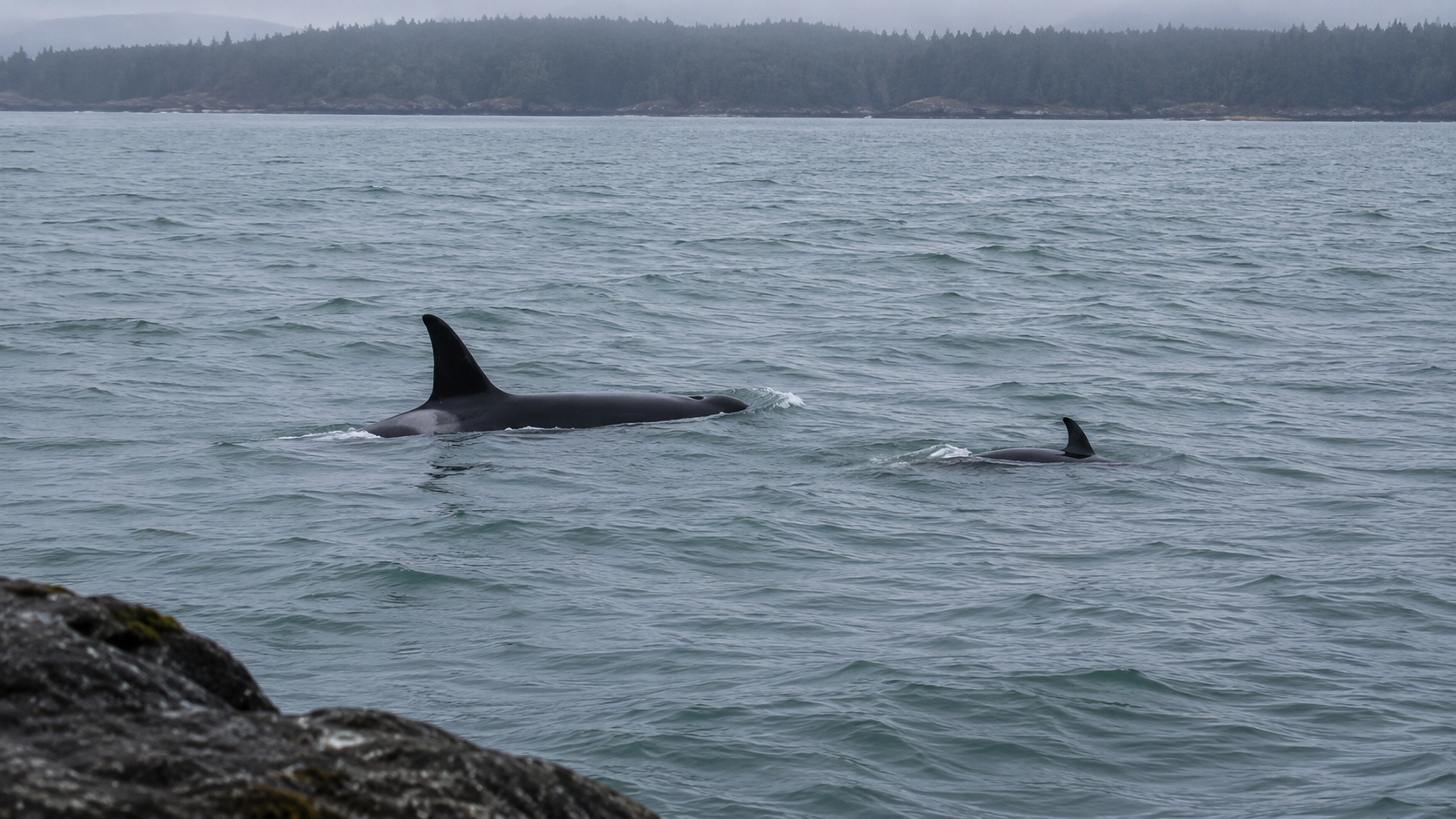
The small dorsal fin kept appearing behind the larger whale.
At first, the two orcas looked like any closely travelling pair. One surfaced ahead, while the smaller animal followed through the calmer water beside her wake.
However, the calf was no longer swimming normally.
His body sat too low in the sea. Each breath required more effort, and every time he slipped beneath the surface, the young female beside him stayed close.
She was not his mother.
She was his older sister.
Their mother had already disappeared, leaving the calf without the one thing his sister could never provide.
Still, she refused to abandon him.
The Family Had Once Travelled as Three
The mother was J28, an endangered Southern Resident killer whale better known as Polaris.
Researchers had followed Polaris since she was a calf. A small tear in the trailing edge of her dorsal fin later made her easy to identify, even when she travelled among many other members of J-Pod. In November 2009, Polaris gave birth to her first known surviving calf, a daughter designated J46 and later named Star.
Star remained unusually close to her mother as she grew.
Then, in December 2015, Polaris gave birth again.
The new calf was a male called J54, or Dipper. Star now had a baby brother, and the three whales formed a tight family group. Observers rarely saw them far apart.
Dipper depended completely on Polaris.
Although young orcas can begin experimenting with solid food, a calf of his age still relies heavily on its mother’s rich milk. Without it, even fish may not supply enough energy for survival.
For several months, nothing in their formation suggested how quickly the family would collapse.
Then researchers noticed that Polaris was becoming thinner.
Something Was Happening to Polaris
The Center for Whale Research reported that Polaris began losing body condition in early 2016. By July, she looked clearly emaciated. Observers could see a depression behind her head—a severe sign of lost body mass sometimes called “peanut head.”
Dipper was also small and thin.
Even so, Polaris continued travelling with her pod. At times she moved slowly, rested at the surface or drifted, but she kept trying to stay with her family. Her condition briefly appeared to improve, giving researchers hope that she might recover.
The improvement did not last.
As the weeks passed, Star began taking on a larger role.
She stayed with Dipper while their mother rested. She also caught salmon and shared food with her family rather than eating every fish herself.
Star was only about seven years old.
She was not a fully grown adult female. She had never raised a calf, and she could not produce milk.
Nevertheless, she was trying to help feed three whales: herself, her sick mother and her dependent baby brother.
The Older Sister Began Acting Like a Caregiver
Orcas often live in close family groups led by older females. Calves remain with their mothers, while siblings, aunts and grandmothers may travel and forage nearby.
However, Star’s situation went far beyond ordinary companionship.
As Polaris weakened, Star spent increasing amounts of time beside Dipper. Observers described her babysitting him, catching salmon and remaining close while their mother struggled to continue.
A salmon could help an adult whale.
It could also provide some food to an older juvenile.
Yet Dipper was still a nursing calf. His body had developed around a constant supply of calorie-rich milk from his mother.
Star could catch fish.
She could share them.
But she could not replace what Polaris’s body provided.
Meanwhile, Polaris continued to decline.
Researchers watched the family travel through the Salish Sea while knowing that every new encounter might become their last.
Then the Mother Disappeared
Researchers last confirmed Polaris with her family in October 2016.
The Center for Whale Research estimated that she died somewhere in the Strait of Juan de Fuca between October 16 and 18. Her first confirmed absence came on October 19. No one recovered her body, so scientists could not perform a necropsy or determine a final cause of death.
Her disappearance left Dipper orphaned at only about ten months old.
Star remained.
Other relatives also travelled within J-Pod, including Dipper’s grandmother and aunts. However, no lactating female adopted him. His grandmother was already caring for another young calf and could not take over his nursing needs.
For Dipper, the difference between having family nearby and having a mother became brutally clear.
He still had whales around him.
He still had a sister who would not leave.
But he no longer had milk.
Star Did More Than Stay Beside Him
After Polaris disappeared, Dipper’s condition deteriorated quickly.
He began struggling to swim and maintain his position near the surface. Instead of leaving the weakening calf behind, Star tried to physically support him.
Observers reported that she pushed or cradled Dipper upward so he could breathe. The Center for Whale Research later documented rake marks on the calf’s skin and explained that Star had caused them while trying to help bring him to the surface when he could no longer swim normally.
The marks did not represent an attack.
They showed the difficulty of what Star was attempting.
Orcas cannot hold another whale with hands. To lift a sinking calf, Star had to use her rostrum, head, body or teeth while both animals moved through the water.
She had to place herself beneath or beside him.
Then she had to push a body that was losing the ability to remain at the surface.
Every breath became a rescue.
Food Could Not Solve the Real Problem
Star had already spent months catching and offering salmon to her mother and little brother.
However, the Center for Whale Research concluded that one young female could not provide enough nutrition for all three whales, regardless of how hard she tried.
That difference matters.
Star did not fail because she stopped trying.
She failed because the task exceeded what another young orca could physically do.
Dipper needed far more than an occasional fish. He needed his mother’s milk, regular nursing, protection and enough strength to digest and use the food available to him.
By then, he had already endured months of inadequate nutrition while Polaris herself struggled to survive.
Once she disappeared, the calf lost the last support keeping him alive.
Even so, Star continued beside him.
The Moment Hope Began to Disappear
Some observers briefly wondered whether Dipper might survive with help from Star and the extended family.
Southern Resident orcas form exceptionally close social bonds. Other pod members sometimes help watch calves, share food and remain with struggling relatives.
However, Dipper was still too young.
Orca Behavior Institute states that Star tried to support her brother after their mother’s loss, but his nursing age made her efforts unsuccessful.
The final observations became increasingly difficult.
Dipper could no longer travel normally. Star still tried to keep him at the surface, although she could not make his weakening body recover.
Researchers eventually stopped seeing him.
By October 28, 2016, the Center for Whale Research counted both Polaris and Dipper among the population’s losses. The Southern Resident count had fallen to an estimated 80 whales.
Dipper had survived his mother by only a short time.
Star survived both of them.
Why Was Polaris So Thin?
Without Polaris’s body, researchers could not confirm what first caused her decline.
The Center for Whale Research suggested that complications surrounding reproduction or an infection may have contributed. However, the organization could not verify a specific cause without a necropsy.
Her family’s nutritional crisis also reflected a much larger threat.
Southern Resident killer whales depend heavily on salmon, particularly large Chinook. NOAA identifies lack of prey as one of the main threats to their recovery, together with vessel disturbance and chemical contamination. When whales struggle to find enough food, their health, reproduction and survival can all decline.
Polaris had to feed herself while producing milk for a growing calf.
At the same time, she needed enough energy to travel, hunt and remain with her pod.
As her body weakened, Dipper also received less nutrition.
Star tried to fill that growing gap one salmon at a time.
It was never going to be enough.
A Seven-Year-Old Orca Faced an Impossible Choice
Star could have continued travelling normally with other members of J-Pod.
Instead, she stayed involved while her mother weakened and while her brother lost the strength to swim.
First, she helped gather food.
Then she watched her mother disappear.
Finally, she tried to hold her younger brother near the surface.
People often describe such behaviour using human words: love, grief, loyalty or sacrifice.
Scientists cannot know exactly how Star understood the deaths around her.
However, no emotional interpretation is required to recognize her actions.
She shared food.
She stayed close.
She pushed a sinking calf upward so he could breathe.
And she kept trying after the mother who had cared for both of them was gone.
What Star Could Never Become
The tragedy was not that Star did nothing.
It was that she attempted almost everything available to her.
She could guide Dipper through the water.
She could remain beside him.
She could catch salmon.
She could place her body beneath his and force him back toward the air.
But she could not become a nursing mother.
Dipper did not simply need another whale nearby.
He needed Polaris.
When she disappeared, Star inherited a responsibility that biology would not allow her to fulfil.
The Two Fins in the Water
From a distance, someone watching the pair might have seen only two dorsal fins travelling through grey water.
The larger fin surfaced first.
The smaller one appeared behind it.
Again and again, the calf followed the same path as his sister, using the calmer water beside her and trying not to fall farther behind.
Yet beneath that simple formation, an entire family had already broken apart.
Their mother was gone.
The calf was running out of strength.
And the young female in front had become the only thing still keeping him near the surface.
Star could not save Dipper.
But until the end, she did not leave him to face the water alone.
