The young orca had survived the crisis that brought her into human care. As her weight returned and her strength became visible, another question grew harder to ignore: what would happen when she was ready to leave the rehabilitation pool?
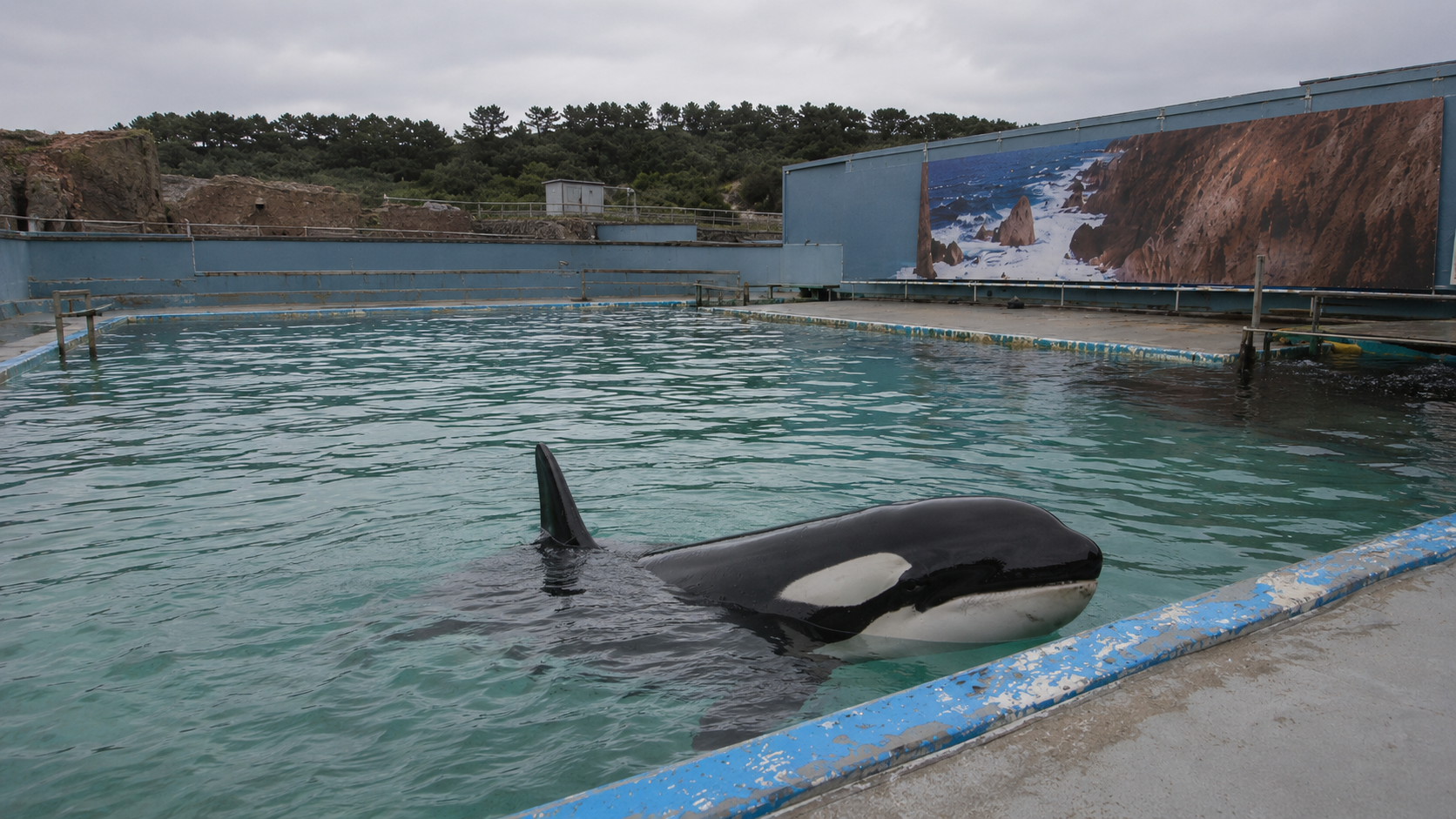
Morgan moved slowly beside the worn blue edge of the pool.
Her black back broke the turquoise surface. Water rolled away from her head as she breathed, turned and followed the concrete boundary toward the far side of the enclosure.
She no longer looked like the severely weakened animal discovered alone in the Wadden Sea.
Her body had filled out. Her movements appeared controlled and powerful. At times, she could rise through the surface with the energy expected from a young killer whale.
To someone seeing only those moments, the next step might have seemed obvious.
Treat her. Restore her health. Open the way back to the ocean.
But the gate never led Morgan home.
Instead, after approximately 17 months at Dolfinarium Harderwijk in the Netherlands, she was lifted from the pool, placed into a transport container and flown to Loro Parque in Tenerife.
The decision remains one of the most disputed chapters in the modern history of captive killer whales.
The Young Orca Found Alone
Morgan was discovered in June 2010 in shallow waters of the Dutch Wadden Sea. Sightings of killer whales in that area were rare, and the young female was alone, underweight and visibly in poor condition.
The Dutch coast guard contacted Dolfinarium Harderwijk, whose team organized her removal from the sea and transfer to its marine-mammal facility.
Morgan weighed approximately 430 kilograms when she entered care. Based on her length and physical development, she was initially estimated to be roughly one to two years old.
Although she had skin abrasions and inflammation, the most immediate problem was severe malnutrition. Her condition suggested that she had been unable to obtain enough food for some time.
The first objective was therefore straightforward: keep her alive.
Staff provided food, veterinary treatment and constant observation. Morgan responded quickly. Within approximately three months, her weight had risen to nearly 700 kilograms, much closer to what experts considered appropriate for her length.
The physical rescue appeared to be working.
The far more difficult question was what should happen afterward.
Recovery Was Not the Same as Releasability
A whale can recover its weight without recovering everything required for survival in the wild.
A released orca must find and capture suitable prey, navigate large areas, avoid vessels and other dangers, communicate effectively and, crucially, reconnect with an appropriate social group.
Killer whales do not live as interchangeable individuals. Their social relationships, feeding strategies and calls can differ between populations and family groups.
Studies of Norwegian killer whales have documented stable social units, cooperative feeding, communal care of young and group-specific vocal patterns. Those relationships made Morgan’s unknown origin especially important.
Researchers attempted to identify where she had come from through photographs, genetics and recordings of her calls.
The broad evidence pointed toward the Northeast Atlantic, particularly Norwegian killer whales associated with herring. But identifying a population was not the same as locating Morgan’s exact maternal family.
Without that family, officials feared that releasing a young orca into the range of unfamiliar whales could leave her socially isolated again.
They also questioned whether she had learned enough hunting behavior before becoming separated to feed herself reliably.
The Experts Did Not All Reach the Same Answer
Dolfinarium Harderwijk assembled advice from seven specialists. According to the facility and Loro Parque, those advisers concluded that Morgan was not a suitable candidate for release.
Their concerns included the failure to locate her exact family, uncertainty about her ability to hunt independently and the strict social organization of killer whales. Dutch authorities ultimately accepted the view that returning her directly to the sea presented an unacceptable risk.
But that was not the only scientific position presented.
The Free Morgan Foundation and supporting experts argued that she should enter a staged rehabilitation and release program rather than permanent captivity. Their proposed approach involved placing Morgan in a sea pen in Norwegian waters, continuing to develop her ability to catch live fish and attempting to locate or establish contact with related wild orcas.
Acoustic researchers working with the campaign reported strong similarities between Morgan’s calls and recordings attributed to a Norwegian group known as Group P. They argued that the matches narrowed the search and made a carefully managed return more plausible.
The two sides therefore disagreed not about whether release carried danger, but about what level of uncertainty was acceptable.
One side saw the unknowns as reasons not to release her.
The other saw them as problems that a staged sea-pen program should attempt to solve.
Why the Pool Became So Important
Morgan’s temporary pool at Harderwijk became the visual center of that debate.
When she arrived, the enclosure represented emergency care. It allowed veterinarians to stabilize an animal that might otherwise have died.
But as Morgan regained weight and remained there month after month, the meaning of the same concrete walls changed.
Supporters of permanent managed care saw a young whale whose life had been saved and whose future required the company of other captive orcas.
Release advocates saw a rehabilitation animal becoming increasingly accustomed to an artificial environment while the window for returning her to the wild was closing.
The question was no longer whether the rescue had been justified.
It was whether rescue had silently become permanent captivity.
The images of Morgan moving strongly through that pool intensified the dispute. Physical recovery was visible. The less visible abilities—hunting competence, social readiness, navigation and acoustic function—remained uncertain.
The Proposed Destination Was Not the Ocean
In July 2011, Dutch authorities issued the certificate required to transfer Morgan from Harderwijk to Loro Parque in Tenerife.
Loro Parque already housed a group of captive killer whales and presented the move as an opportunity for Morgan to live socially with members of her species.
Opponents argued that transferring her to another marine park would eliminate the realistic possibility of rehabilitation and release.
The dispute moved through the Dutch legal system.
In 2014, the Netherlands Council of State upheld the authorization. The court concluded that the proposed release plan did not constitute a sufficiently realistic alternative under the circumstances. It emphasized that Morgan’s family had not been located, that killer whales possess strict social structures and that her ability to provide for herself remained uncertain.
Later legal attempts to invalidate the transfer certificate also failed. In 2019, the Council of State again left the certificate in force.
The legal decisions established that the transfer was lawful.
They did not end the moral or scientific disagreement over whether another outcome might have been possible.
The Day Morgan Left Harderwijk
On November 29, 2011, preparations began early.
Morgan was lifted from the pool in a specially designed sling and placed in a transport container. She was taken by truck to Amsterdam’s Schiphol Airport and loaded aboard an aircraft bound for Tenerife.
Veterinary staff and caregivers accompanied her, keeping her wet and monitoring her condition throughout the journey. Contemporary reporting placed her weight at approximately 1,100 kilograms by the time of transport, far above the 430 kilograms recorded when she entered rehabilitation.
That increase demonstrated how completely her immediate nutritional crisis had changed.
Yet her destination was not a Norwegian sea pen, an open coastal enclosure or a monitored release site.
It was another captive facility.
The pool at Harderwijk had saved Morgan’s life. The transport ended the possibility that it would serve as the first stage of her return to the sea.
[EMBED YOUR VIDEO HERE]
The Hearing Test That Changed the Debate
After Morgan arrived at Loro Parque, researchers investigated suspicions that she might have difficulty hearing.
Scientists recorded auditory brainstem responses while presenting short broadband clicks to Morgan and five other killer whales. The other animals produced measurable responses. Morgan did not produce the expected response, even at the highest test level the equipment could project.
The researchers concluded that she had a hearing impairment. The test did not reconstruct precisely what Morgan could or could not hear in every real-world situation, but it provided significant evidence of a serious auditory deficit.
For those supporting her continued captivity, the finding strengthened the argument that release would have been dangerous. Hearing is central to killer-whale communication, orientation and coordinated feeding.
Critics responded that the impairment was confirmed only after the decision to send her to Tenerife and could not retroactively prove that every staged rehabilitation option considered earlier was impossible.
It also raised another unanswered question:
Had hearing loss contributed to Morgan becoming separated from her group in the first place?
No evidence has established a definitive explanation for how she ended up alone in Dutch waters.
What Happened to Morgan After the Transfer?
According to Loro Parque, Morgan was gradually introduced to its other killer whales and was considered fully integrated into the captive group by March 2012. The park describes her as healthy and involved in its research and educational activities.
Her life there has continued to generate controversy.
Loro Parque argues that the transfer gave Morgan the social care and veterinary support she required after experts determined that release was too risky.
The Free Morgan Foundation continues to dispute the decisions that led to permanent captivity and has challenged how the terms of her transfer were interpreted and applied.
Both narratives begin with the same fact:
Morgan was alive because people intervened.
They divide sharply over what people owed her once she recovered.
In March 2025, Morgan gave birth to a male calf named Teno. Loro Parque reported that mother and calf were healthy following the birth, and in April 2026 the park marked Teno’s first birthday. Those updates reflect the park’s account of Morgan’s present life under human care.
They do not resolve the original question of whether her future should have been decided in a pool or tested in a controlled return to the ocean.
Could Morgan Really Have Been Released?
There is no honest way to answer with complete certainty.
A successful release was never guaranteed.
Her exact family had not been conclusively located. She had arrived severely malnourished. Her ability to hunt independently remained uncertain. Later testing provided evidence of substantial hearing impairment.
Any release attempt could have failed, possibly fatally.
But permanent captivity was not a neutral decision either.
Moving Morgan to Tenerife meant that the central questions behind a staged release—whether she could hunt consistently, whether related whales could be located and whether she could adapt to a coastal sea pen—would never be fully tested.
That is why Morgan’s case still produces such strong reactions.
It sits at the uncomfortable boundary between rescue and possession.
Saving an animal’s life gives people responsibility for its future. It does not automatically reveal which future is right.
Why the Image of the Closed Pool Still Matters
The young orca in the Harderwijk pool looked very different from the animal first brought ashore.
She was heavier.
She was active.
She could move through the water with visible strength.
Those facts made the rescue successful.
They also made the next decision more difficult.
The public could see the body that had recovered. It could not see the missing family, the uncertain hunting skills or the possible hearing impairment.
It could only see an ocean animal moving around a concrete boundary while officials, courts, researchers and campaigners debated where she belonged.
Morgan survived the Wadden Sea.
She survived the initial crisis that brought her into human care.
But the moment she became strong again did not open a gate back to the Atlantic.
It opened the path to another facility, another set of walls and a life whose direction had already been decided for her.
