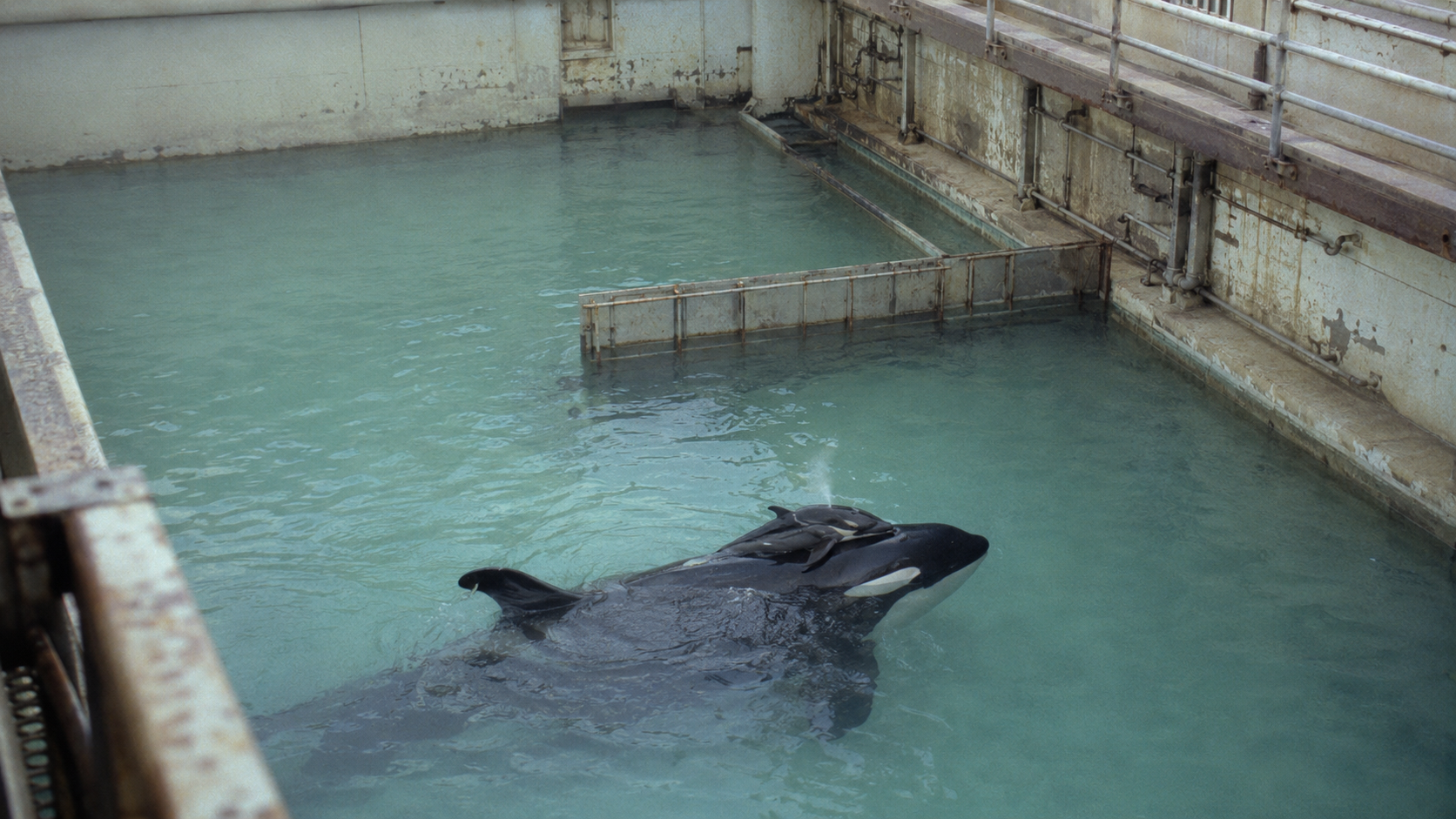
For a brief moment, the small body beside Corky represented something no marine park had achieved before.
The newborn was alive.
He had survived the birth, reached the surface and entered a concrete tank as the first live orca conceived and born in captivity.
But almost immediately, something appeared wrong.
The calf was not nursing.
For a newborn orca, milk is not merely food. It is the energy required to breathe, swim, remain beside the mother and survive the first dangerous days of life.
As the hours passed, the calf continued to weaken.
Corky remained inside the tank while the people around her tried to solve a problem nobody at the facility had faced before.
The newborn was losing weight.
Eventually, the pool was drained so staff could intervene and feed him directly.
The attempt continued day after day.
It was not enough.
After surviving for just over two weeks, Corky’s first calf died from pneumonia.
The tank became quiet again.
But Corky’s story as a mother had only begun.
Corky Had Already Lost One Family
Long before her first pregnancy, Corky had belonged to a family that moved through the coastal waters of British Columbia.
She was born into the Northern Resident orca community and was a member of the A5 pod. In December 1969, when Corky was estimated to be about four years old, people surrounded part of her family with fishing nets in Pender Harbour. Corky was among the young orcas selected for captivity.
After being separated from the pod, she was placed in a sling, lifted by crane and transported by road, ferry, aircraft and truck to Marineland of the Pacific in California.
The change was absolute.
The distances, currents, prey and acoustic landscape of the Pacific were replaced by concrete walls, filtration machinery and water contained within fixed boundaries.
Resident orcas do not normally leave their families when they reach adulthood. Their fundamental social unit is the matriline: a mother, her offspring and the descendants of her daughters. Government researchers describe these family associations as lifelong.
Corky would never again swim freely with the family into which she had been born.
Years later, when she produced a calf of her own, the newborn became the beginning of a new family inside the tank.
That possibility lasted only days.
The First Birth Changed Captivity History
Corky delivered her first male calf on February 28, 1977.
The birth was historically significant because it produced the first live orca conceived and born under human care. OrcaLab’s historical account states that the adult male Orky helped the newborn reach the surface after the difficult delivery.
But the calf did not begin nursing normally.
Staff attempted to save him by draining the pool and feeding him manually several times each day. Despite those efforts, he continued losing weight and later died from pneumonia.
The loss could have remained a singular tragedy: the painful result of an unprecedented birth during an era when comparatively little was understood about maintaining newborn orcas in captivity.
But Corky became pregnant again soon afterward.
A second calf was coming.
Hope Returned to the Same Tank
On October 31, 1978, Corky delivered another male.
Once again, the birth created hope that the outcome might be different.
Once again, the newborn failed to nurse successfully.
Staff returned to direct intervention and attempted to provide formula. The calf survived for only 11 days. OrcaLab reports pneumonia and colitis associated with bacterial contamination of the formula as the causes of death.
Two births had now followed a similar pattern:
A living newborn.
A failure to nurse.
An urgent human effort to compensate.
Then another empty space beside Corky.
It is impossible to reconstruct precisely how Corky understood those losses. Human observers can document her movements and vocalizations, but they cannot translate her private experience into human language.
What science does establish is that resident orcas form unusually stable family bonds. Sons and daughters may remain associated with their mothers throughout their lives, and several generations can travel together in the same matriline.
Corky’s calves were not reaching the stage when such a family could form.
The next pregnancy did not produce a living calf at all.
The Third Pregnancy Ended Before the Calf Had a Chance
In April 1980, Corky delivered an approximately eight-week-premature stillborn calf.
There was no period of uncertain nursing this time.
No sequence of days in which the newborn’s condition might improve.
The pregnancy ended with another loss.
By then, Corky had experienced three pregnancies in little more than three years.
Yet another calf would arrive in 1982.
This newborn would remain alive longer than any of the others.
For several weeks, it may have appeared that the pattern had finally been broken.
The Calf Who Survived the Longest
On June 18, 1982, Corky gave birth to a female calf.
The newborn survived the first days.
Then the first week.
Then several more.
But the central difficulty returned: historical accounts state that the calf also failed to nurse successfully.
She lived for 46 days.
That made her Corky’s longest-surviving baby, but she still did not reach two months of age.
The difference between 11 days and 46 days may appear substantial on paper.
For Corky, it meant more time swimming beside the calf.
More time responding to her movements.
More time in which the small animal became part of the daily structure of the tank.
And then the calf was gone too.
Four pregnancies had ended without a young orca surviving infancy.
The full number was still growing.
Staff Tried to Teach Corky With a Model Calf
According to OrcaLab’s historical account, Marineland personnel constructed a dummy calf and used it during training sessions to encourage Corky to place herself in a position that would make nursing easier.
The same account says Corky responded during those sessions, but the desired nursing behavior did not succeed after her living calves were born.
That detail makes the history more complicated than a simple story about a mother “refusing” her calves.
The records establish that the newborns failed to nurse.
They do not provide a single, proven explanation for why the problem happened repeatedly.
Captive conditions, maternal experience, calf health, positioning and other medical or behavioral factors may all be discussed as possibilities, but the available sources do not justify identifying one definitive cause.
What is certain is the result.
Every attempt ended before Corky could raise a calf.
Another Female Was Born
Corky became pregnant again and delivered another female calf in July 1985.
That calf also survived beyond the first days but died during infancy.
By this point, the pattern had extended across most of a decade.
The newborns were not all lost in exactly the same way. Some were born alive and failed to survive. One had been stillborn. Later pregnancies would end before another living calf could begin swimming beside Corky.
But every path led to the same outcome:
No son or daughter grew up with her.
No calf reached the age when it could begin learning the social traditions, calls and behaviors normally passed through an orca family.
And Corky’s reproductive history was still not finished.
The Number Finally Reached Seven
Between 1977 and 1987, Corky became pregnant seven times.
Conservation organizations that have compiled her history report that all seven pregnancies ended through miscarriage, stillbirth or the premature death of a calf. None of the offspring survived beyond infancy.
The documented sequence included four living calves who died young, a premature stillbirth and later pregnancy losses. The final miscarriage occurred after Corky had been transferred to SeaWorld San Diego.
Seven pregnancies.
No surviving offspring.
The figure changes the meaning of the first birth.
The weak newborn in 1977 was not simply Corky’s first loss.
He was the beginning of a cycle that would continue for approximately ten years.
She Was Moved Before the Final Loss
In January 1987, Corky and Orky were moved from Marineland of the Pacific to SeaWorld San Diego.
Her last documented pregnancy ended in miscarriage later that year. She never produced another calf.
Orky died in 1988.
Corky remained.
SeaWorld’s current website lists her at its San Diego facility and describes her as the oldest whale and largest female in its orca group. The park presents her as energetic and says she continues to inspire visitors.
Groups campaigning against orca captivity tell a very different version of the same life.
Whale and Dolphin Conservation emphasizes the deaths of Corky’s offspring and her separation from the Northern Resident family that remains in British Columbia. OrcaLab supports moving Corky to a managed ocean sanctuary in her historic home waters, though it acknowledges that her age and long dependence on human care would prevent a simple release into the wild.
The two perspectives disagree profoundly about what Corky’s present and future should look like.
They do not disagree about the central fact of her reproductive history.
None of her calves survived.
The Family Corky Never Had Beside Her
In the wild, a female resident orca may remain surrounded by children, adult sons, daughters and eventually grandchildren.
The family does not dissolve when the calves grow larger.
It expands.
Resident killer whale matrilines can include as many as four related generations traveling together.
Corky’s life followed the opposite pattern.
She was removed from her mother when she was young.
She later produced calves inside captivity.
Every one disappeared before reaching adulthood.
Her relatives continued living in the Northern Resident community off British Columbia, while Corky remained hundreds of miles away in California. OrcaLab says members of her wider family still return to waters around Hanson Island.
No one can know exactly what Corky remembers from 1969.
No one can state with certainty how she internally experienced each failed pregnancy or each newborn’s death.
But the timeline does not require speculation to be painful.
Seven pregnancies occurred.
Not one calf survived to grow beside her.
Why the First Calf Still Matters
The archival-looking scene of a mother supporting a fragile newborn carries enormous emotional weight.
But it is important to separate a dramatic visual reconstruction from the details established by historical records.
The documented first calf struggled to nurse.
Staff intervened.
He lost weight.
He developed pneumonia.
And after only a short life, he disappeared from Corky’s tank.
What makes that first loss devastating today is the knowledge the people watching in 1977 did not yet possess.
Another calf would be born.
Then another pregnancy would end.
Then hope would return again.
The longest any of Corky’s babies survived was measured in weeks, not years.
The newborn beside her never became an adult.
There was never a grown son swimming at Corky’s side.
There was never a daughter who produced a calf of her own.
There were no grandchildren.
Only a sequence of beginnings that repeatedly ended inside artificial pools.
The Tank Kept Corky—but Not Her Family
Corky has survived captivity longer than any other orca taken during the Pacific Northwest capture era, according to organizations that have tracked her history.
That survival makes her extraordinary.
It also means she has lived long enough to outlast every one of her offspring, her captive companion Orky and the marine park where she spent the first 17 years after her capture.
The first newborn entered the world as a milestone.
He left it as the first chapter in a much larger tragedy.
The painful question is not simply why that calf could not survive.
It is why the same hope returned so many times without Corky ever being allowed to experience what defines the lives of her wild relatives:
A family that remains.
