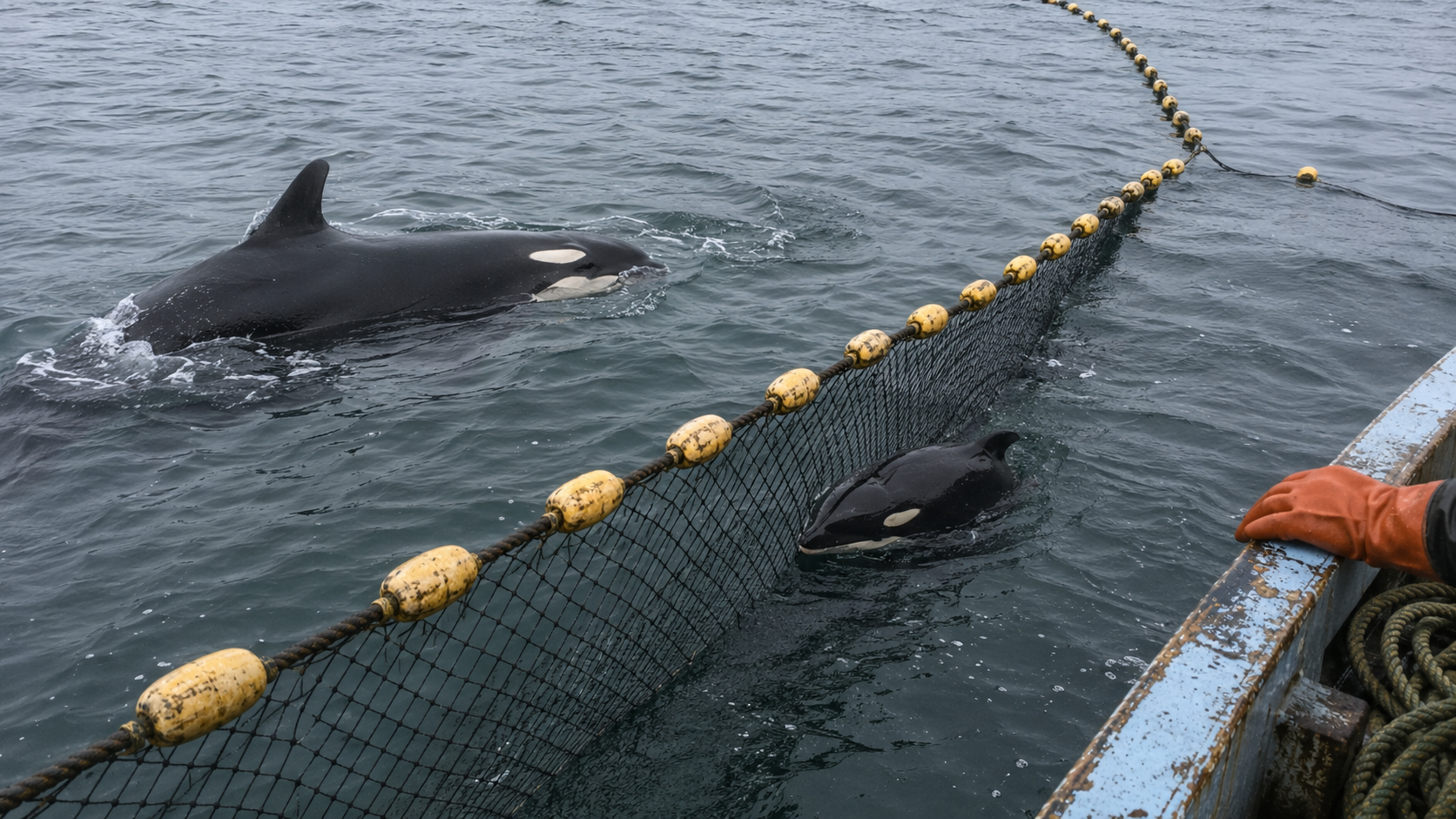
The crew first noticed the smaller black fin after the net had already begun to close.
It surfaced inside the enclosure for less than a second, disappeared beneath a line of yellow floats and then appeared again beside a dense patch of silver fish.
At first, nobody understood what they were looking at.
The vessel had been working the same cold stretch of water since early morning. The seine net curved away from the boat in a broad semicircle, surrounding the fish before the crew slowly reduced the open space.
Everything had appeared normal.
Then one deckhand saw the white patch beneath the water.
It was not another fish.
It was a young orca.
The calf had entered the enclosure while following the tightly packed school. Now the opening behind it was narrowing, and the heavy mesh extended deeper than the calf appeared to understand.
The crew stopped hauling.
No one moved for several seconds.
The calf surfaced again, breathed quickly and turned toward the outside of the net.
That was when a much larger dorsal fin appeared on the opposite side.
Its mother had found it.
The Net Was Between Them
The adult female approached slowly.
She did not strike the boat or accelerate toward the crew. She moved along the outer edge of the net with her head angled toward the calf.
Inside the enclosure, the calf changed direction immediately.
The two animals surfaced on opposite sides of the mesh, close enough that their black-and-white bodies could be seen through the moving water.
For a moment, their rostrums appeared almost to meet.
Only the net separated them.
The calf pushed toward the barrier, but the mesh gave slightly and then held. It turned, surfaced again and returned to the same place.
The mother remained outside.
Everyone aboard expected her to hit the net.
An adult orca had enough power to create serious danger around a small working vessel. Even an accidental collision with the hull or the equipment could injure the animal, damage the boat or tighten the net around the calf.
But the mother did not charge.
She touched the float line gently with the front of her head.
Then she moved away.
The Crew Thought She Was Leaving
The adult female traveled parallel to the net, following its curve away from the boat.
The calf tried to follow from inside.
Each time the mother passed a float, the smaller animal matched her direction on the other side of the mesh. Their bodies moved together for several metres, separated by a barrier neither animal could cross.
Then the mother reached a distant section of the enclosure and slowed.
She remained there briefly.
From the boat, nothing about that location appeared important. It looked like another section of black mesh, heavy rope and aging floats.
The mother submerged.
The calf stayed near the surface, circling inside the enclosure.
When the adult did not immediately reappear, some of the crew believed she had abandoned the net and moved into deeper water.
But less than a minute later, the tall curved dorsal fin returned.
The mother swam back to the calf.
She surfaced beside it through the mesh, remained there for several breaths and then repeated the same route.
Once again, she traveled toward the distant section of the net.
Once again, the calf followed from inside.
And once again, the mother stopped at exactly the same place.
She Repeated the Route
The behavior continued.
The mother returned to the calf.
She waited until the smaller animal moved close to the barrier.
Then she turned and followed the net toward the far side of the enclosure.
She was not swimming randomly.
Her path was almost identical each time.
The calf attempted to remain beside her, but it frequently became distracted by the fish inside the net. When the school changed direction, the young orca sometimes turned with it before rushing back toward its mother.
The crew watched the pattern repeat.
Each time, the adult female led the calf toward the same location.
Each time, she slowed and waited.
At first, the people aboard interpreted the behavior as distress. Perhaps she was searching for a weak point in the net. Perhaps she was trying to remain close enough to reassure the calf.
Then one deckhand noticed something unusual near the float line.
One of the floats was sitting lower than the others.
One Section of the Net Was Different
The damaged float had taken on water.
Its buoyancy had weakened, allowing a short section of the upper rope to sag closer to the surface.
The difference was not dramatic.
From the deck, the line still appeared continuous. The mesh remained below it, and the opening was not large enough for the calf simply to swim through.
But compared with the surrounding barrier, that section was lower and more flexible.
The mother had apparently located it before the crew did.
That realization changed the way everyone aboard interpreted her movement.
She might not have been looking for a way to enter the enclosure.
She might have been trying to lead the calf toward the only place where an escape could become possible.
There was no way to know whether the mother understood the construction of the net as humans did. Her exact intention could not be proven.
But the repeated route was difficult to ignore.
She kept returning to the calf.
She kept moving toward the damaged float.
And she kept waiting there.
The Crew Faced a Dangerous Decision
Releasing tension from a working seine net is not as simple as dropping a rope.
The net was holding a dense school of fish, and its weight was distributed through multiple lines connected to the vessel.
An abrupt change could cause the mesh to fold, twist or tighten around the calf.
If the crew pulled too hard, the enclosure would become smaller.
If they released the wrong section, the current might carry the loose mesh toward the young animal.
The safest option required the crew to stop the haul and gradually lower the float line near the section the mother had repeatedly visited.
The engine was reduced.
One crew member moved toward the control line while the others watched the calf’s position.
Inside the net, the young orca surfaced near the boat and then turned toward its mother.
Outside, the adult female had returned to the distant corner.
She waited beside the damaged float.
The crew began releasing tension.
The Float Line Slowly Dropped
At first, the movement was barely visible.
The upper rope descended only a few centimetres. Water washed over one float and then another.
The mesh below loosened slightly.
The calf did not immediately approach.
It remained near the fish, breathing rapidly and making short turns inside the narrowing area.
The mother left the opening and swam back toward it.
She surfaced beside the calf through the net.
Then she turned once more.
This time, when she followed the barrier toward the lowered section, the calf remained directly beside her.
The mother moved slowly.
She did not race ahead.
Whenever the smaller animal fell behind, she reduced her speed and waited.
From the deck, the two dorsal fins traveled together—one outside the net and one inside.
The lowered float line waited ahead.
The Calf Reached the Opening but Turned Away
When the calf arrived, it did not immediately pass over the rope.
The altered section was still unfamiliar.
The mesh moved beneath the surface, and the changing tension produced ripples and bubbles around the opening.
The calf stopped.
Its mother remained on the opposite side, angled toward it.
The young animal approached the float line, touched it and backed away.
For several seconds, nothing happened.
Then a group of fish rushed past the calf and drew it back toward the centre of the enclosure.
The opportunity appeared to have been lost.
The crew could not keep lowering the net indefinitely. Too much slack could create another entanglement hazard.
One person aboard prepared to raise the line again.
But the mother did not leave.
She returned to the calf and repeated the route.
She Led It Back Again
This time, the young orca stayed closer.
It followed the adult along the net without turning toward the fish.
Near the damaged float, the mother submerged.
Her dark body became visible beneath the surface as she passed under the lowered rope from the outside, then turned back into view.
The calf watched her movement.
It approached the same place.
The young animal lowered its head and pushed against the float line. The rope rolled along the upper part of its body but did not drop far enough.
The calf retreated.
The crew released a little more tension.
Several floats dipped beneath the surface.
The mother surfaced on the far side and remained almost motionless, her head directed toward the opening.
The calf tried again.
The Net Began Moving Around the Calf
The current shifted at the worst possible moment.
Loose mesh drifted toward the young orca’s left side.
A section of rope touched its flank, and the calf reacted by turning sharply. Water broke over the float line as the animal accelerated inside the enclosure.
For a moment, the operation appeared to be making the situation more dangerous.
The crew stopped releasing the rope.
The mother moved rapidly along the outside of the net, matching the calf’s direction.
She did not strike the mesh.
Instead, she remained beside the smaller animal until it slowed.
Then she guided it back toward the lowered section.
The calf’s breathing had become more frequent.
Each time it surfaced, it remained above water only briefly before turning again.
The crew knew that the next attempt might be the last safe opportunity.
The Mother Positioned Herself Beyond the Opening
The adult female moved several metres away from the net.
For the first time, she left enough space for the calf to see open water beyond the lowered floats.
She surfaced facing the enclosure.
The calf approached from inside.
The upper rope was now close enough to the water that small waves occasionally washed over it. The mesh beneath had loosened into a shallow curve rather than a vertical wall.
The young orca slowed as it reached the barrier.
Its head rose beside the floats.
The mother remained directly ahead.
The calf pushed forward.
The rope moved along its rostrum and over the top of its head.
Then the young animal stopped again.
Only part of its body had crossed.
Its dorsal fin remained on the inner side of the net.
The Crew Could Not Pull the Rope Away
The people aboard froze.
Pulling the line could trap the calf across the barrier.
Releasing it too quickly could allow the loose net to wrap around the animal’s tail.
The calf moved backward slightly.
The mother approached but did not touch it.
She turned sideways near the opening, exposing a broad section of her body to the calf.
Then she moved slowly away from the net.
The young animal pushed forward again.
A wave lifted its chest over the float line.
For one brief moment, the calf appeared balanced across the rope, with open water ahead and the enclosure behind.
Then its body rolled.
The float line disappeared beneath the surface.
The Smaller Fin Appeared Beside the Mother
Several seconds passed without either animal surfacing.
The crew stared at the lowered section of net.
The fish inside the enclosure continued circling.
The water beyond the floats appeared empty.
Then the adult female surfaced several metres away.
A second, much smaller dorsal fin rose beside her.
The calf had crossed the float line.
It remained close to the mother as the two animals moved slowly away from the net.
The adult did not immediately lead it toward deep water. She circled once beside the opening, positioning herself between the calf and the fishing gear.
Only after the smaller animal had turned completely away from the enclosure did the pair begin moving toward the open sea.
The crew watched until both fins disappeared.
Why the Mother’s Route Mattered
No one aboard could know exactly what the adult orca understood.
It would be tempting to say she deliberately inspected the fishing gear, identified the damaged float and designed a rescue route for her calf.
That conclusion would go beyond what her movements alone could prove.
But the pattern remained extraordinary.
She did not attack the net.
She did not abandon the calf.
She repeatedly traveled between the young animal and the lowest point in the float line.
When the crew lowered that section, she continued guiding the calf toward it.
Her behavior did not release the rope or operate the equipment. The people aboard still had to recognize the problem and create a safer opening.
But without the repeated route, they might not have noticed the weakened float in time.
The mother had focused their attention on the only part of the barrier that could be changed quickly.
The Barrier the Calf Could See but Not Understand
The most painful part of the scene was its simplicity.
The calf could see its mother.
It could swim beside her.
It could hear and follow her movements through the water.
Yet every direct attempt to reach her ended against the same mesh.
The escape required the young animal to stop pushing toward the place where its mother stood and follow her away from it.
That was why the mother’s repeated movement mattered.
She was not merely remaining close.
She was creating a path.
The crew did not understand the pattern immediately.
Neither did the calf.
But after the same route had been repeated enough times, both finally responded.
The line was lowered.
The calf followed.
And the barrier that had separated them for so long disappeared beneath one wave.
The last thing the crew saw was not the net, the fish or the damaged float.
It was the smaller dorsal fin moving beside the larger one as both animals returned to open water.
