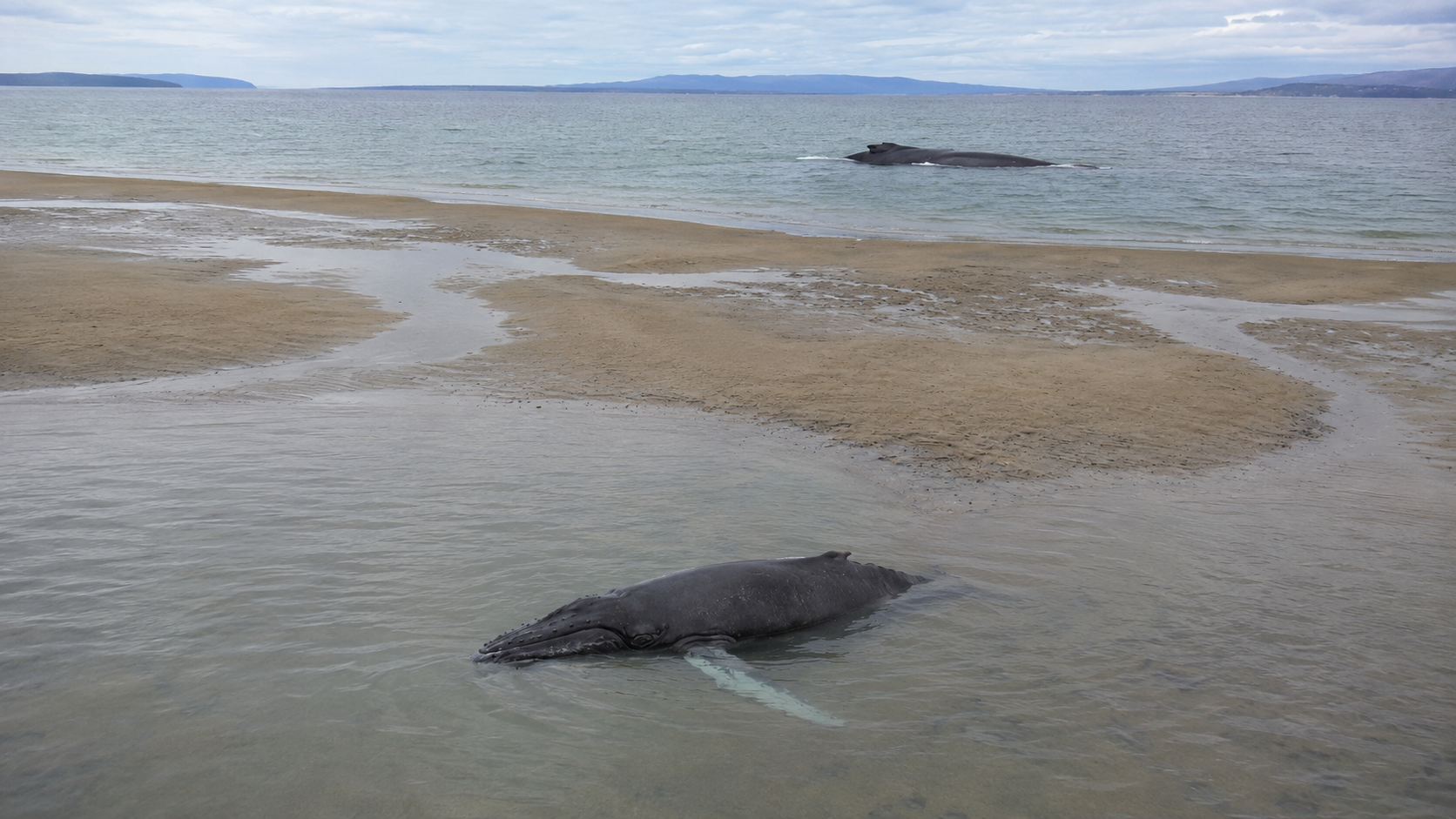
The mother could see her baby.
That was the cruelest part.
The calf was only a short distance away, trapped in the shallow water near a pale strip of wet sand. The ocean had pulled back with the tide, leaving behind a maze of thin channels, soft mud, and water too shallow for a young whale to swim through.
The baby was alive.
But it could barely move.
Its small body rested low in the water, too close to the sandy bottom. Every time it tried to shift, weak ripples spread around it. The calf did not have enough depth to swim forward, and it did not have enough strength to drag itself back to deeper water.
Just beyond the sandbar, the mother waited.
She was close enough to see everything.
But not close enough to help.
The adult humpback circled slowly in the deeper water, turning her massive body toward the trapped calf again and again. She did not leave. She did not move away with the open sea behind her. She stayed near the edge of the shallow barrier, where the water dropped just enough for her to float, but not enough for her to safely cross.
For a whale her size, the sandbar was not just sand.
It was a wall.
If she tried to reach the calf, she could become stranded too.
That is what made the moment so painful. The mother was one of the largest animals in the ocean, powerful enough to cross entire seas, strong enough to protect her baby from waves and distance and storms.
But in that shallow water, strength did not matter.
The tide controlled everything.
The calf had likely followed its mother too close to the sandbar when the water was higher. In deeper water, the path may have looked safe. The bay may have seemed open, calm, and easy to cross.
Then the ocean began to pull away.
Slowly, the water level dropped.
Channels narrowed.
Sand appeared where water had been.
And by the time the calf tried to leave, there was not enough ocean left beneath it.
The mother stayed in deeper water, facing the calf.
She moved slowly, almost carefully, as if every turn was a decision. Each time the calf shifted, she angled toward it. Each time the baby’s body settled lower, she paused again.
But she could not lift it.
She could not push the tide back in.
She could only wait.
For a young humpback, shallow water can become dangerous quickly. A calf is built for buoyancy. Its body is meant to be held by the sea. When the water becomes too shallow, the weight of its own body begins to work against it. Movement becomes harder. Breathing becomes more stressful. Heat, exhaustion, and pressure from the sand below can turn a simple mistake into a fight for survival.
The calf tried to move again.
Only a little.
Its tail tightened beneath the surface. A pale pectoral fin shifted in the shallow water. Small ripples moved outward, but the calf did not go anywhere.
The mother watched from the deeper channel.
The distance between them was not large.
But it was enough.
That is why people who saw the scene could not look away. It was not a dramatic attack. There were no predators, no blood, no sudden violence.
Just a baby in the wrong depth of water.
And a mother who could not reach it.
The sandbar made the whole bay feel divided in two.
On one side, the calf was stuck in the shallows.
On the other, the mother floated in water deep enough to live.
Between them was a thin, pale stretch of sand and mud that looked harmless from above — but for the whales, it had become the difference between safety and danger.
The mother circled again.
She did not go far.
She seemed to test the edge of the deeper water, moving along the line where the channel began to rise toward the sandbar. But each time, the water grew too shallow.
A humpback mother can guide her calf through long migrations. She can keep it close through storms. She can shield it in rough seas.
But she cannot cross land.
And for those hours, the low tide had turned part of the ocean into land.
The calf raised its head slightly.
For a moment, it looked as if it might find a deeper channel. A small wave pushed around its body, lifting it just enough to make the water shimmer. The mother turned toward it.
Then the wave passed.
The calf settled again.
Still trapped.
Still waiting.
That was the question everyone would ask later:
Would the tide come back in time?
There are moments in the wild where survival depends on speed, strength, or instinct. But this was different. This survival depended on patience — on whether the sea would rise before the calf became too weak.
The mother could not speed it up.
The calf could not understand it.
And anyone watching from shore could only wait with them.
Minute by minute, the bay changed.
The wet sand darkened.
Small channels began to fill.
The shallow water around the calf moved more freely. At first, the change was almost invisible. Then a thin sheet of water slid farther across the sandbar. More ripples reached the calf’s body. The water around its tail deepened slightly.
The mother noticed first.
She moved closer to the edge of the deeper channel, still careful, still unable to cross fully, but no longer as far away as before.
The calf shifted again.
This time, the movement carried a little farther.
A wave passed under its body.
Then another.
The calf’s lower body lifted slightly from the sand.
For the first time in hours, the shallow water began to look like ocean again.
The mother held her position.
She did not rush.
She waited until the channel deepened enough for the calf to move without dragging across the bottom. Then, slowly, the baby turned.
Not quickly.
Not strongly.
But enough.
The calf moved toward the deeper water.
The mother came forward as far as she safely could.
For a few seconds, the distance between them seemed to disappear.
The calf reached the edge of the channel, where the water finally held it again. Its body rose more naturally with the swell. The weak ripples around it became a small wake.
The mother turned beside it.
And the calf followed.
It did not leap. It did not race away. There was no dramatic rescue moment, no perfect ending made for a movie.
Just a young whale finally floating again.
Just a mother staying close.
Just the tide returning before it was too late.
Together, they moved slowly away from the sandbar, back into the deeper blue-green water. The mother stayed beside the calf, matching its pace, never letting the distance grow too wide.
Behind them, the sandbar remained visible beneath the rising water.
The place that had trapped the calf was disappearing again, covered by the same ocean that had left it behind.
That is what made the moment unforgettable.
The sea had nearly separated them.
Then the sea gave them back to each other.
For the mother, the danger was not a predator. It was not a storm. It was not something she could fight.
It was distance.
A few meters of shallow water.
A strip of sand.
A tide that had gone out too far.
And for the calf, survival came down to whether the ocean would return in time.
This time, it did.
But the image of the mother waiting beyond the sandbar stayed heavy in the mind: close enough to see her baby, close enough to hear it, close enough to know it was struggling — but unable to reach it.
Sometimes the wild is painful not because animals stop caring.
But because even love cannot cross every barrier.
The mother stayed.
The calf held on.
And when the tide finally returned, the baby moved back into the water where it belonged.
Beside her.
More ocean stories:
