The world had spent years trying to give Keiko one thing.
Freedom.
He had been lifted from a cramped amusement-park pool, rehabilitated in cold seawater, flown back to Iceland and slowly introduced to an environment he had not experienced since he was captured as a young orca.
Then, in the summer of 2002, something extraordinary happened.
Keiko left his human caregivers, moved among wild killer whales and began a journey across the North Atlantic. He traveled roughly 1,000 miles before appearing off the coast of Norway, apparently healthy after weeks without direct human support.
It sounded like the ending everyone had hoped for.
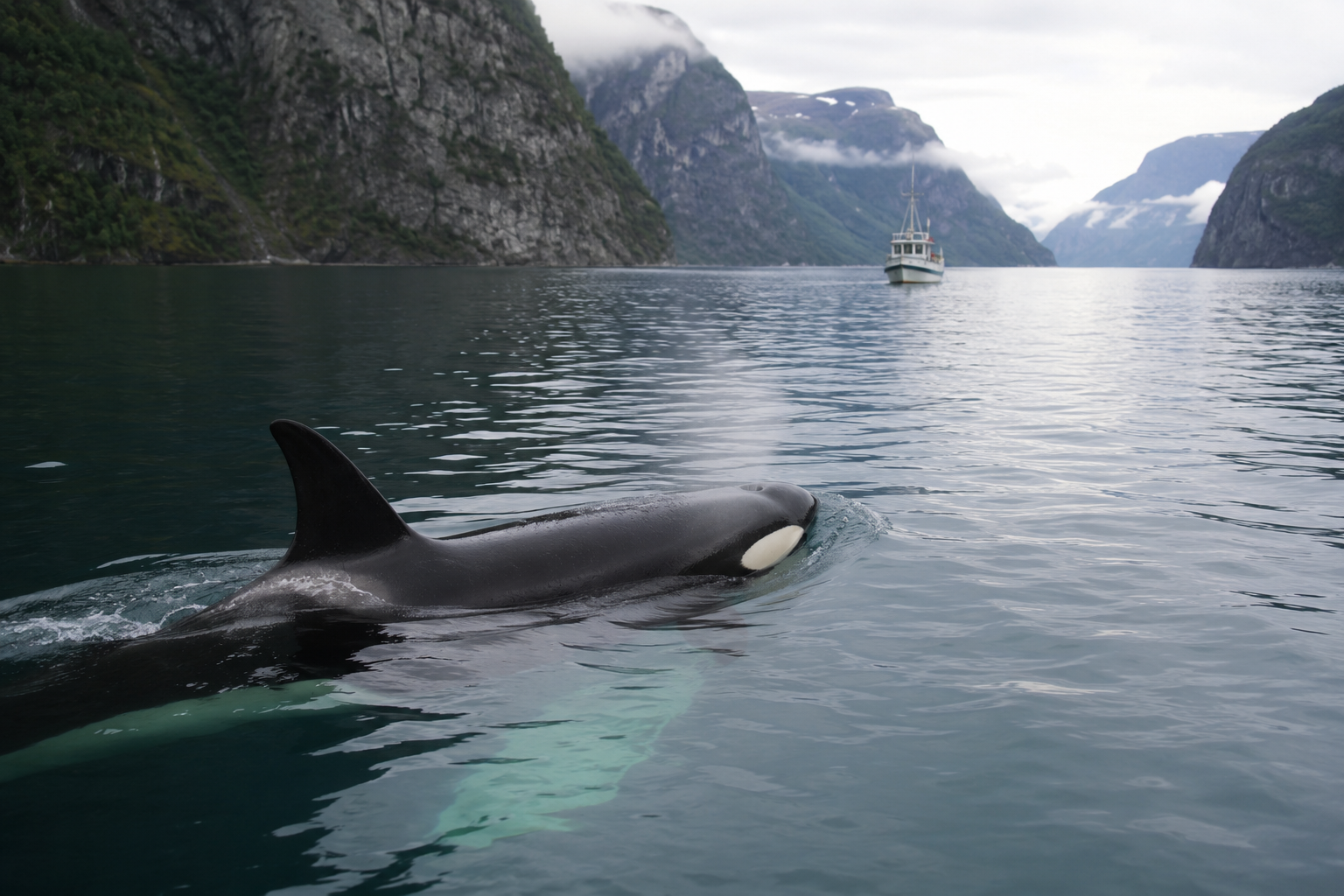
But when Keiko reached the Norwegian fjords, he did not simply disappear into the ocean.
He followed a fishing boat toward people.
And once people found him, he repeatedly sought their company again.
The orca who had finally been given the open ocean appeared unwilling—or perhaps unable—to leave humans completely behind.
Why?
The answer reveals why returning a captive animal to nature is far more complicated than opening a gate.
The real whale behind Free Willy
Keiko became famous as the orca who played Willy in the 1993 film Free Willy.
The movie told the story of a captive killer whale escaping an abusive marine park and returning to the ocean. Its ending was hopeful, simple and emotionally satisfying.
Keiko’s real life was nothing like that.
He had been captured near Iceland in 1979 while still very young. He was first transported to an aquarium in Iceland, then moved to Marineland in Canada and eventually sold to Reino Aventura, an amusement park in Mexico City.
There, he lived in an artificial pool that was small and shallow for an adult male orca. By the time the film made him globally famous, his physical condition had raised serious concern.
The success of Free Willy created an uncomfortable contrast.
On screen, Willy was free.
In reality, Keiko remained in the same pool.
Children around the world began writing letters and raising money to help him. That public pressure contributed to the creation of the Free Willy–Keiko Foundation and a plan unlike anything previously attempted on that scale: rehabilitate a long-term captive adult orca and return him to his native waters.
Freedom did not happen in a single moment
Keiko was moved to the Oregon Coast Aquarium in January 1996.
When he arrived, he was underweight and had visible skin problems. In Oregon, he entered a larger seawater pool, gained substantial weight and began learning behaviors needed for a possible return to the ocean.
One of the most important lessons was also one of the most basic: catching and eating live fish.
At first, Keiko caught fish but brought them to his trainers instead of eating them. Over time, he began consuming them himself. His health improved, and his skin lesions disappeared.
In September 1998, Keiko was flown to Iceland and placed inside a sea pen in Klettsvík Bay.
He was now in natural ocean water, surrounded by tides, weather, fish and the sounds of the North Atlantic—but he was still under continuous human care.
Over the following years, his team took him on controlled open-ocean “walks.” Boats guided him beyond the bay while researchers monitored his health, feeding and reactions to wild orcas.
The goal was not simply to release him and hope for the best.
It was to reduce his dependence on humans gradually, encourage natural foraging and give him opportunities to associate with members of his own species.
Keiko met wild orcas—but did not truly join them
Keiko did make contact with wild killer whales.
During the rehabilitation program, he approached them and sometimes spent extended periods away from his tracking boat. In 2001, observers reported that he initiated interactions with wild orcas, although some encounters appeared difficult and included aggression directed toward him.
This was a critical challenge.
Orcas do not live as interchangeable members of one enormous population. They grow up inside tightly bonded family groups with learned calls, hunting methods and social rules.
Keiko had been removed from that world while very young.
He had then spent most of his life around humans and, for long periods, without normal social contact with other orcas.
Even if he encountered wild animals from the same region, that did not mean they would recognize him as family—or that he would understand how to become part of their group.
OrcaLab later reported that Keiko made increasingly extensive contact with wild orcas but probably never found his immediate family and did not remain permanently with the groups he met.
He was physically in the ocean.
Socially, he may still have been alone.
The day Keiko left
In the summer of 2002, Keiko left his tracking boat while wild orcas were nearby.
For approximately three weeks, he was observed in and around groups of killer whales. Then he began moving away from Iceland.
He traveled across the North Atlantic, passing the Faroe Islands and eventually reaching the coast of Norway. Project accounts place the journey at approximately 1,000 miles, while OrcaLab described it as nearly 1,200 kilometres.
For around 50 to 60 days, he received no direct food or assistance from his human team.
When he arrived in Norway, veterinarians found him in good physical condition. That strongly suggested he had successfully obtained food during the journey, although researchers could not observe every feeding event.
This was one of the most important achievements of the entire project.
Keiko had navigated across open ocean.
He had survived without scheduled hand-feeding.
He had shown that decades in captivity had not erased every natural ability.
But his arrival in Norway also revealed the limit of that independence.
He entered a fjord while following a fishing boat.
Why did he approach people again?
No one can know exactly what Keiko was thinking when he followed that boat.
Several explanations may have overlapped.
Humans had been his social world
Keiko had spent most of his remembered life interacting with human trainers, caretakers and visitors.
Food, stimulation, guidance and physical contact had all come from people.
Even during rehabilitation, humans remained nearby. They monitored him, traveled with him on boats, called him back with trained signals, examined him and sometimes provided food.
The program attempted to reduce that dependency, but it could not erase decades of learning.
For Keiko, a boat may not have represented danger.
It may have represented familiarity.
He had not formed a lasting bond with a wild pod
Keiko’s encounters with wild orcas were real, but he did not permanently integrate into a family group.
A captive-raised orca does not automatically become socially wild simply because it enters the ocean.
The 2009 peer-reviewed analysis of the release effort concluded that Keiko did not achieve full independence from humans or stable integration with wild killer whales. His return to boats and people was one of the most important limitations of the project.
This does not mean he was incapable of surviving in open water.
It means survival and social reintegration were two different challenges.
Approaching boats had been repeatedly rewarded
Throughout his rehabilitation, boats were part of Keiko’s daily routine.
They guided his ocean walks and carried the people he trusted. Following a vessel had often led to interaction, direction or food.
When he encountered a fishing boat near Norway, following it may have been a learned response rather than a conscious rejection of freedom.
He had been trained to associate boats with safety.
Now, without his familiar team nearby, he may have applied that behavior to strangers.
Norway was not prepared for him
News of Keiko’s arrival spread rapidly.
People traveled from far away to see the world’s most famous orca. Crowds gathered along the water, and some visitors entered the fjord to swim with him, touch him or attempt to climb onto his back.
One of Keiko’s caregivers later described the situation as chaotic, with thousands of visitors arriving on busy weekends and police becoming involved because people ignored requests to remain out of the water.
The attention created a dangerous cycle.
Keiko approached humans because human contact was familiar.
People responded by rewarding that approach with excitement and physical interaction.
The more attention he received, the harder it became to encourage him to behave independently.
Norwegian authorities and Keiko’s team introduced rules intended to keep the public away and prevent him from being, as one project account put it, “loved to death.”
A sheltered area near Taknes Bay became his home base. Keiko remained free to leave, but staff resumed monitoring him and provided supplemental food to protect his health.
He was no longer inside a concrete tank.
But he was not completely separated from human care.
Did Keiko choose humans over the ocean?
It is tempting to describe the story that way.
It is also too simple.
Keiko did not immediately swim back to a marine park or seek confinement. He crossed a large section of the North Atlantic by himself, found food and spent his final years in natural seawater.
He had freedom of movement.
He could dive, explore and experience weather, currents and open space.
What he continued seeking was not necessarily captivity.
It was contact.
Humans had become part of the environment in which he understood how to live.
When he failed to establish a permanent place among wild orcas, returning to people may have been the most familiar social option available to him.
In that sense, Keiko’s behavior may reveal one of captivity’s deepest effects.
A tank changes where an animal lives.
Years of dependency can also change what feels safe, recognizable and socially meaningful.
Was the project a failure?
The answer depends on what “success” means.
If success required Keiko to join a wild pod permanently, hunt independently for the rest of his life and never seek human support again, the project did not achieve its ultimate goal.
The peer-reviewed assessment was critical of the release effort and found that Keiko did not become fully independent.
But members of the project and several animal-welfare organizations argue that judging it only by that standard ignores what Keiko gained.
He recovered physically.
He returned to the waters where he had been born.
He learned to catch fish.
He interacted with wild orcas.
He crossed the North Atlantic without direct support.
And he spent years in ocean water rather than ending his life in the small Mexican pool where he had once performed.
Keiko’s story was therefore neither the perfect release imagined by the film nor a meaningless failure.
It was a partial success, a scientific warning and an extraordinary welfare experiment.
Keiko’s final year
Keiko remained near Taknes Bay in Norway through 2003.
His caretakers continued monitoring him and hoped that passing wild orcas might offer another opportunity for social contact.
That opportunity did not come in time.
On December 12, 2003, Keiko became lethargic, stopped eating and developed irregular breathing. He moved toward the shoreline in Taknes Bay and died. His caregivers believed the immediate cause was probably pneumonia or a similar acute respiratory infection.
His death renewed the argument over the project.
Critics said the attempt proved that captive orcas could not simply be returned to nature.
Supporters replied that Keiko had lived for years in the ocean, exercised choices unavailable in captivity and completed a journey no long-term captive orca had achieved before.
Both sides were responding to the same complicated truth.
Keiko had been free.
But freedom could not return the childhood, family or wild education that captivity had taken from him.
What Keiko’s return to humans really meant
Keiko’s repeated approach toward people was not proof that he preferred a concrete tank.
Nor was it proof that the ocean meant nothing to him.
It showed that physical release and psychological independence are not the same thing.
The gate can open in a moment.
Rebuilding a life may take years—and some missing experiences can never be recreated completely.
Keiko crossed an ocean.
He fed himself.
He experienced open water and chose where to go.
But when he reached a strange coast without a family group beside him, he followed the one thing he had understood for most of his life:
A human boat.
That is why his story remains more powerful than the ending of Free Willy.
The movie asked whether a captive orca could reach the ocean.
Keiko’s life asked a much harder question:
After humans have shaped an animal’s entire world, is freedom alone enough to make that animal wild again?
