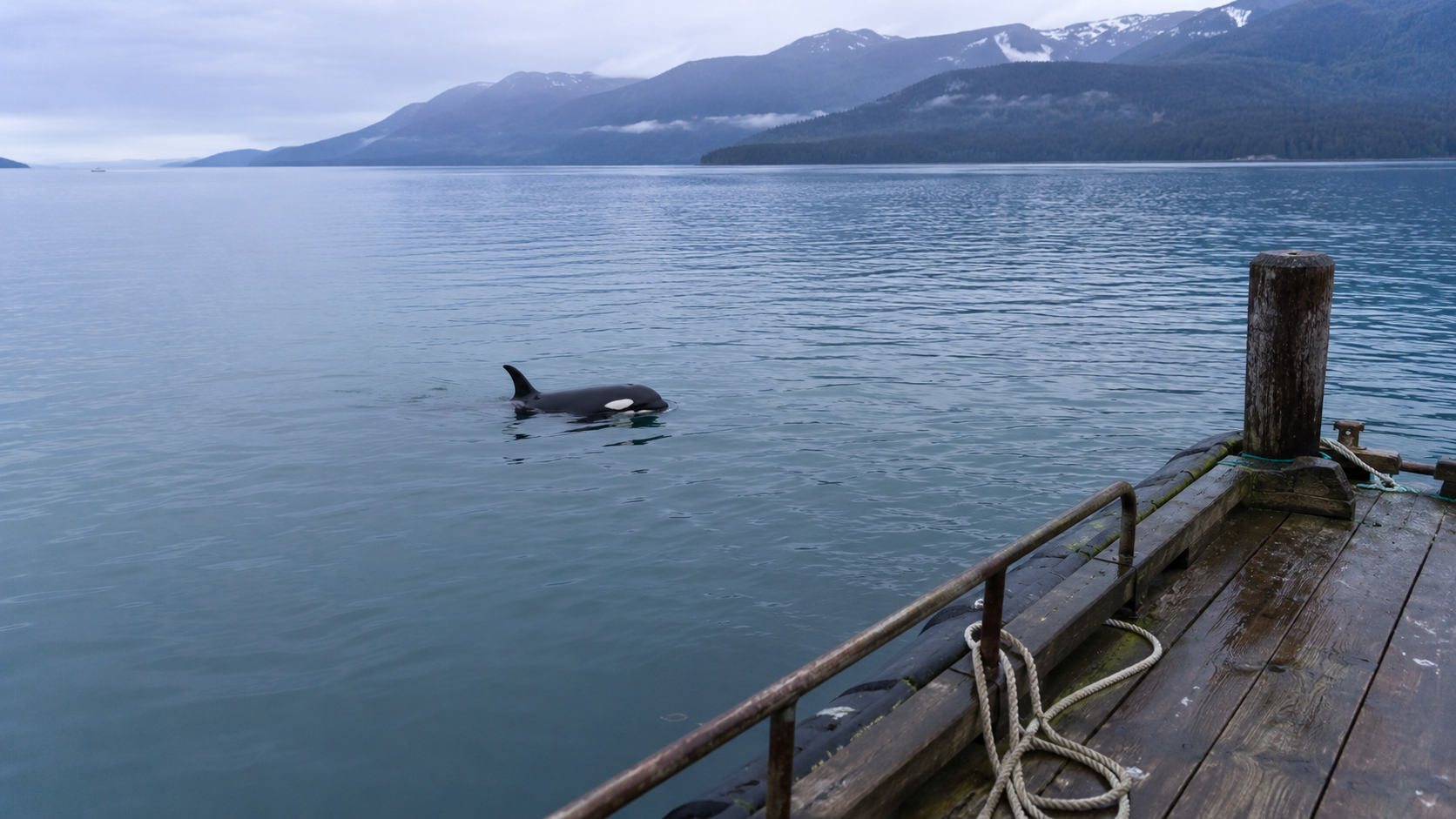
Every morning, the young orca came back to the same empty dock.
At first, the people in the small harbor thought he was hungry.
That was the easiest explanation.
A young whale, alone in cold blue-green water, appearing near the wooden posts just after sunrise. He would surface slowly beside the dock, breathe once, drift for a few moments, and then turn toward the boats as if he expected something from them.
Some people thought he wanted fish.
Others thought he had learned to follow humans.
A few said he was only curious.
But Aro never begged.
He never slapped his tail for attention.
He never opened his mouth for food.
He never chased the boats.
He never acted like an animal trying to perform.
He only waited.
That was the part nobody understood.
The first time Aro appeared, the harbor was still quiet. Fog sat low over the water. The old dock creaked softly in the morning air, and the ropes on the empty mooring posts moved with the tide.
Then a black dorsal fin rose from the water.
Someone on the dock stopped walking.
At first, they thought it was part of a pod passing through the inlet. Wild orcas sometimes moved through those waters, following fish, seals, and the deep channels between the islands.
But there was no pod.
No mother beside him.
No calls from the distance.
No other fins cutting the surface.
Only one young orca, moving slowly beside the dock as if he had been there before.
The people began calling him Aro.
No one knew where he had come from. Some believed a storm had pushed him away from his family. Others thought he may have followed boats into the inlet and lost the trail of his pod. In the first few days, everyone expected him to leave.
A wild orca does not belong beside an empty dock.
But the next morning, Aro came back.
And the morning after that.
And again after that.
Always around the same time.
Always near the same wooden posts.
Always waiting in the same patch of cold water.
People started watching from a distance. They were careful not to feed him, not to touch him, not to turn him into something he was never meant to be. But even from far away, they could see that Aro’s behavior was not random.
He did not react much when people stood on the dock.
He did not follow every boat.
He did not seem interested in the harbor itself.
But whenever a small engine started somewhere in the distance, Aro changed.
His body would slow.
His head would angle slightly.
Sometimes he would turn toward the sound and hold still for a moment, as if listening for something hidden behind the noise.
That was when people began to realize the young orca was not waiting for food.
He was waiting for a sound.
And that made the whole story hurt more.
Nobody knew what Aro heard in those engines. Maybe the low rumble reminded him of the last place he heard his family. Maybe the sound of boats had mixed with the calls of his pod on the night he was separated. Maybe every distant motor made him believe, for one second, that the voices he had lost were coming back.
Of course, no one could know for certain.
Aro could not explain why he returned.
He could only keep coming back.
Day after day, the young orca surfaced beside the dock.
The water around him was beautiful in a cold, lonely way — blue-green, clear in some places, dark in others, with pale light moving across the surface. But the beauty only made the scene feel emptier.
One orca in all that water.
One dock with no answer.
One animal waiting for something nobody could see.
The people who watched him began to notice small things.
He rarely stayed long when the harbor was silent.
But if a boat moved far away, he would turn.
If a hull knocked softly against a mooring, he would pause.
If a low engine echoed across the inlet, he would lift slightly in the water, breathe, and wait.
It was not excitement.
It was not play.
It looked more like recognition.
As if the sound had opened a door in his memory.
But every time, the sound faded.
And every time, no pod appeared.
Aro would drift away from the dock, sink lower into the water, and disappear into the inlet.
Then the next morning, he would return.
After a while, the empty dock became part of his story. People stopped asking only where he came from. They began asking what would happen if he never stopped waiting.
A young orca needs more than water.
He needs family.
Orcas are not animals built for loneliness. Their lives are shaped by sound, memory, movement, and social bonds. A calf learns from its pod. A young orca follows calls, patterns, hunting routes, and the quiet rules of a family that knows the sea better than he does.
Aro had the ocean.
But he did not have the voices that made it home.
That was why the dock felt so painful.
It was not a cage.
It was not a tank.
It was not a wall.
It was open water.
And still, he looked trapped by waiting.
One evening, after almost two weeks of sightings, a small local research team placed a hydrophone in the inlet. They did not want to chase Aro. They did not want to interfere. They only wanted to listen.
If other orcas were moving somewhere beyond the harbor, the water might carry their calls.
That night, the dock was empty. The boats were tied. The inlet was calm, and a thin mist moved over the water.
For hours, there was almost nothing.
Only the quiet pressure of the sea.
Then, sometime after midnight, the hydrophone picked up something far away.
Faint calls.
Not engines.
Not waves.
Orcas.
The sounds were distant, broken by water and space, but they were there — voices moving somewhere out in the fjord.
No one knew if Aro heard them at the same time.
But just before sunrise, he appeared near the dock again.
This time, he did not stay as long.
He surfaced once near the old wooden posts.
He turned, not toward the harbor, but toward the open water.
For a moment, he waited.
Then he moved away.
Slowly at first.
Then farther.
Past the last mooring.
Past the quiet boats.
Past the place where people had watched him return every morning.
By the time the sun rose behind the pale clouds, Aro was no longer beside the dock.
People waited that day.
They waited the next morning too.
And the morning after that.
But Aro did not come back.
Nobody saw the moment he found his family.
Nobody could prove that the distant calls belonged to his pod.
Nobody could say for certain that the young orca had finally heard the voice he had been waiting for.
But the dock stayed empty.
And somehow, that emptiness felt different.
Before, the empty dock had felt like a place where Aro was missing something.
Now, it felt like a place he no longer needed.
Maybe he found them.
Maybe he followed the calls into deeper water.
Maybe he only stopped waiting in the wrong place.
No one knows.
But for the people who watched him, the last image stayed with them: a young orca turning away from the dock, not because he had given up, but because something in the distance had finally mattered more than the noise of boats.
For days, people thought Aro was looking for food.
He was not.
He was waiting for a sound.
A voice.
A memory.
Something that told him he was not alone.
And one morning, after returning to the same empty dock again and again, Aro finally turned toward the open water.
Then he vanished into the blue-green fjord.
The dock remained behind.
Quiet.
Empty.
Waiting for an orca that never came back.
