The ocean pulled away.
And when it did, it left one of its most powerful animals trapped where she was never meant to be.
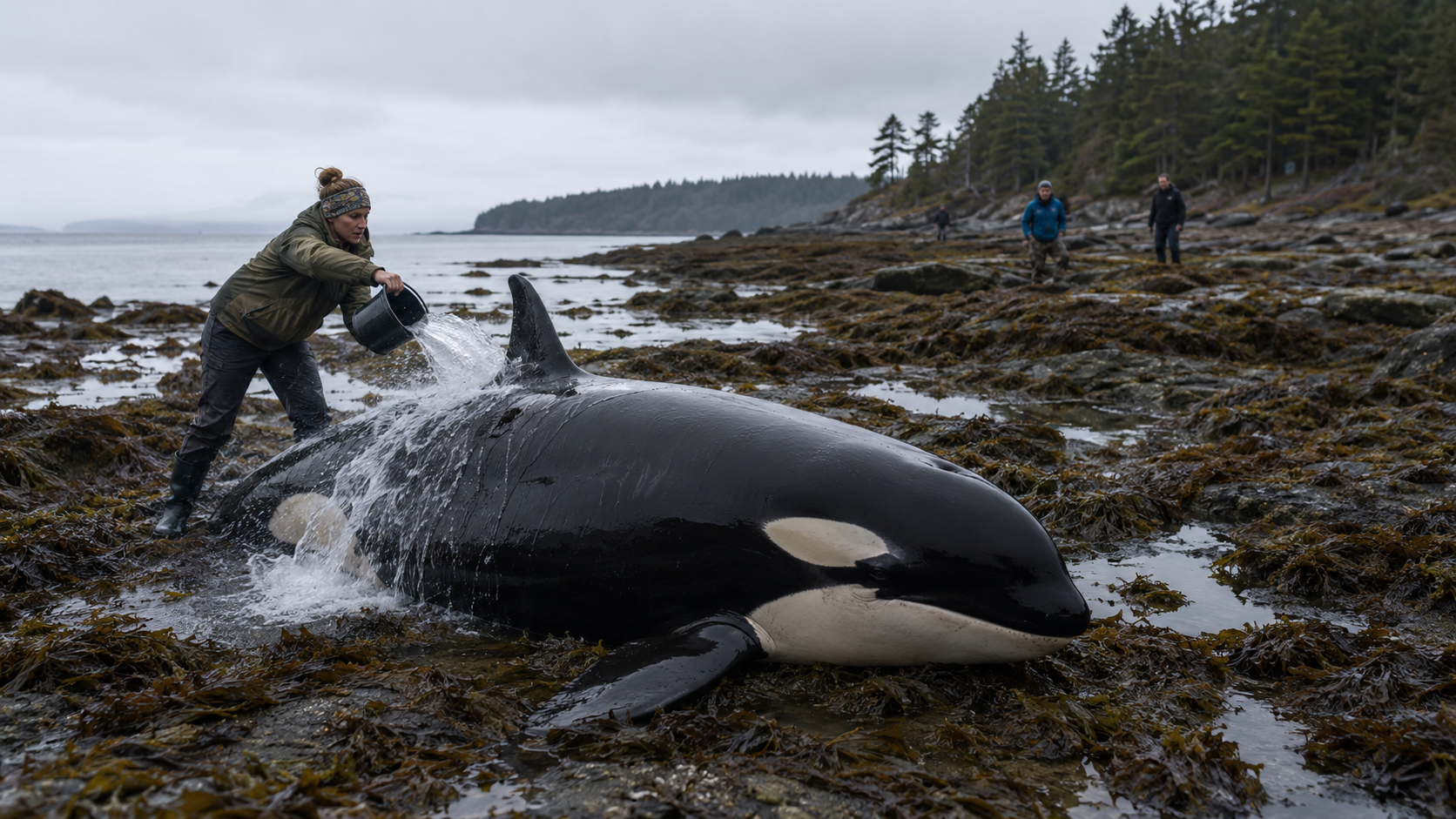
A young orca lay across the wet rocks on Prince of Wales Island in Alaska, her black-and-white body pressed against seaweed, tide pools, and sharp coastal stone. The water was close enough to see, close enough to hear, but not close enough to lift her body back into the sea.
She was alive.
But she could not move herself.
The killer whale had become stranded at low tide, stuck above the waterline on a rocky shore. Nearby people could see her breathing, hear her vocalizing, and understand the danger immediately: without the ocean covering her body, her skin could dry, her weight could crush her organs, and every passing minute could make survival harder.
Nobody could simply pick her up and put her back.
She was too large.
Too heavy.
And the tide had gone too far.
So the people nearby did the only thing they could do.
They kept her wet.
The stranded orca was found near Prince of Wales Island in July 2021. A nearby vessel, the Steadfast, discovered her on the rocks, and NOAA later authorized the crew to use a seawater pump to keep the whale wet and to keep birds away while responders were on their way.
That is the part of the rescue that looks simple on video but means everything.
Water over the skin.
Again and again.
Buckets, pumps, spray, whatever could keep her body from drying out while everyone waited for the only force strong enough to save her.
The tide.
For people watching, it must have felt helpless. The orca was right there. You could stand near her. You could see her breathing. You could see the ocean behind her. But you could not just drag her across the rocks. You could not roll her back like a small animal. You could not force the sea to return faster.
All they could do was buy time.
And time was exactly what she needed.
The orca was later identified as T146D, a 13-year-old juvenile Bigg’s killer whale. Researchers identified her using photo-identification details, including the shape of her dorsal fin and the distinctive markings around her eye patch.
That name may sound cold compared with the emotion of the video, but it matters. In the world of orca research, an identification is not just a label. It is how scientists can know whether an animal survives after a stranding, whether it returns to its family, and whether it continues living a normal wild life.
In that moment on the rocks, though, she was not a catalog number.
She was an animal waiting for the ocean to come back.
At times during the stranding, the killer whale was vocalizing, and other killer whales were seen nearby. That detail makes the scene even more painful. She was not stranded in silence. Somewhere in the surrounding water, other orcas were close enough to be seen.
Maybe they were her family.
Maybe they understood something was wrong.
But they could not pull her off the rocks either.
The ocean had left her there.
And only the ocean could fully lift her again.
Strandings are especially dangerous for large whales because their bodies are built for water. In the ocean, buoyancy supports their weight. On land or rocks, that weight presses down in ways their bodies are not designed to handle. Add drying skin, stress, possible cuts from rocks, and a long wait under open air, and every hour becomes a fight.
That is why keeping her wet was so important.
The people helping her were not performing a dramatic rescue for the camera. They were doing something more basic and more urgent: preventing her skin from drying while waiting for the tide to rise.
The image is unforgettable because it reverses everything we expect about orcas.
In the water, an orca looks almost untouchable.
Powerful. Fast. Intelligent. In control.
But on the rocks, even a killer whale becomes vulnerable.
Her strength did not matter there.
Her size did not save her.
The same body that makes an orca so powerful in the ocean became part of the danger when the ocean pulled away.
People online sometimes ask why rescuers did not just push her back into the water. But looking at the terrain explains the problem. She was not lying on a smooth sandy beach with an easy path to the sea. She was stuck on a rugged rocky shoreline at low tide. Moving a whale that large across rocks could have injured her more badly, and it could have put people at serious risk.
So the rescue became a waiting game.
Water over her back.
People watching her breathing.
The sea still too low.
The tide slowly turning.
NOAA said the orca finally refloated as high tide came in that afternoon. After hours stranded on the rocks, the rising water gave her body back the support it needed.
Then came the moment everyone had been waiting for.
She was able to free herself.
Not because people lifted her.
Not because machines dragged her.
But because the ocean finally returned.
That is why the story feels so powerful. The people did not “control” the rescue. They held the line long enough for nature to give the orca a chance.
And she took it.
Reports at the time said the whale swam free once the tide came back in. Researchers were also cautiously hopeful because the whale appeared to be in relatively good condition, with no significant amount of blood visible and a tide pool below her during the stranding.
Still, the story was not completely finished the moment she left the rocks.
For a wild orca, surviving the first stranding is one thing. Surviving afterward is another. Researchers still needed to know whether T146D would be seen again, whether she would rejoin other whales, and whether injuries from the rocks would affect her.
That is why her identification mattered so much.
Killer whale researcher Jared Towers explained that documenting the animal’s identity allows researchers to track what happens after a stranding. He also noted that other Bigg’s killer whales from this population had survived previous live strandings and later rejoined their families.
That gives the story a hopeful shape.
Not a guaranteed fairy-tale ending.
A real one.
A young orca got trapped on the rocks.
People kept her wet.
The tide came back.
She swam free.
And because researchers knew who she was, there was a chance that one day they could recognize her again and know what happened after the rescue.
There is another strange possibility behind the whole event.
Why did she strand in the first place?
No one can say for certain. But Bigg’s killer whales are mammal-hunting orcas, and researchers noted that this population is known to hunt harbor seals in shallow waters. Towers said he would guess that harbor seal hunting may have been the motivating factor behind how she ended up so close to the rocks.
That possibility makes the moment even more dramatic.
The orca may have come into the shallows as a hunter.
Then the tide changed.
And suddenly, the hunter was the one in danger.
That is the ocean at its most unforgiving.
One moment, a top predator is moving through coastal water.
The next, the water is gone.
The rocks remain.
And everything depends on whether the tide returns in time.
The people on that shore could not change the tide. They could not make the whale lighter. They could not erase the rocks underneath her body.
But they could keep her alive long enough to give her a chance.
And sometimes that is what rescue really looks like.
Not a helicopter.
Not a dramatic lift.
Not a perfect hero scene.
Just ordinary people standing on wet rocks, pouring seawater over a stranded orca while the ocean slowly rises behind them.
The video is painful because for most of it, nothing is certain.
You see the whale.
You see the water being thrown over her skin.
You see the people waiting.
And the whole question becomes impossible to ignore:
Will the tide come back before it is too late?
In this case, it did.
The ocean that left her there finally returned.
And the young orca, after hours on the rocks, slipped back into the water where her body belonged.
That is the part that makes the story stay with people.
Not just that she was stranded.
Not just that people helped.
But that for a few hours, one of the ocean’s most powerful animals survived only because strangers kept her wet and waited for the sea to come back.
