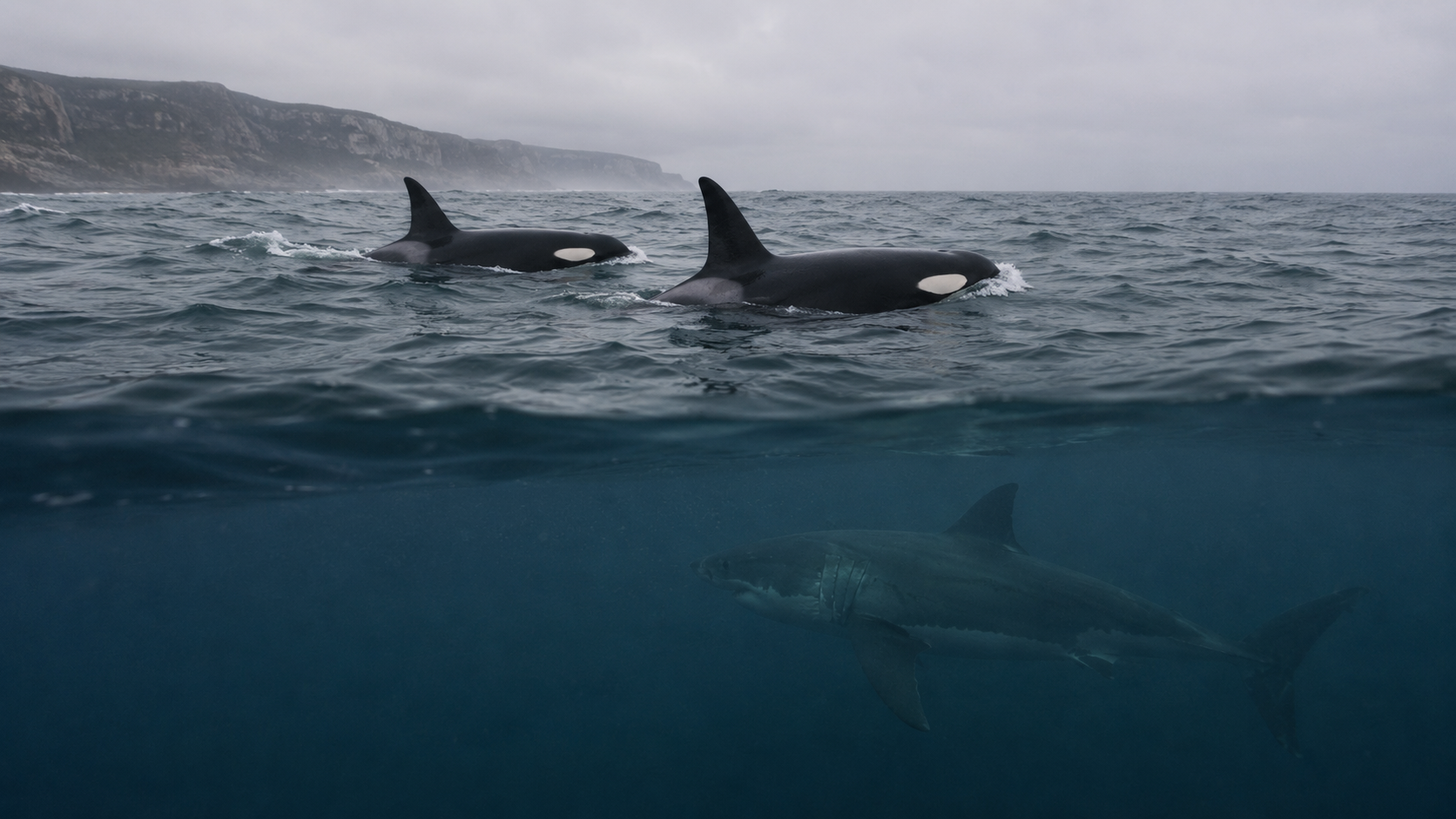
For years, great white sharks ruled these waters.
They moved through the cold South African coast like ghosts with teeth — silent, heavy, and feared by almost everything around them. Around places like Gansbaai and False Bay, they were more than predators. They were the animals everyone came to see. Cage-diving boats searched for them. Tourists waited for them. Seals feared them. The whole coastline carried their reputation.
The great white shark was supposed to be the top predator here.
Then something changed.
The sharks started disappearing.
At first, it did not look like one dramatic moment. It was not a single attack seen by the world. It was quieter than that. Sightings dropped. Famous shark waters became strangely empty. Places where great whites had been seen for years suddenly became unreliable. In South Africa, researchers have documented major declines and sudden absences of white sharks from historic aggregation sites such as False Bay and Gansbaai.
And then the bodies began to wash ashore.
That was when the mystery became darker.
Some of the sharks were not simply dead.
They carried the same strange sign.
The wounds were precise. The bodies were mostly intact. But something important was missing.
Their livers.
In 2017, five great white shark carcasses washed up around Gansbaai in South Africa. Four had their livers removed. That detail helped researchers connect the deaths to killer whales — especially the now-famous male orcas known as Port and Starboard.
The idea sounded almost impossible.
A great white shark is one of the most feared animals in the ocean. NOAA describes the white shark as an apex predator at the top of the food chain, with an important role in marine ecosystems.
But even an apex predator can have a predator.
And in this case, the animals above them were orcas.
Killer whales are not just powerful. They are intelligent, social, and highly adaptable. NOAA notes that killer whale diets and hunting tactics can be strongly shaped by culture — learned behaviors passed through groups.
That matters because this did not look like random violence.
It looked targeted.
The orcas were not eating the whole shark. They appeared to be going for one part: the liver. Shark livers are large, oily, and extremely energy-rich. For an intelligent predator, that makes them a valuable prize. Reports from South Africa described orcas extracting the liver with shocking precision, leaving much of the rest of the shark behind.
And once that started happening, the ocean changed.
The sharks did not stay.
Studies linked killer whale predation events to white sharks leaving major aggregation sites in South Africa. One study documented white sharks emigrating from Gansbaai after killer whale predation and after further sightings of the orca pair and other pods nearby.
That is the part that makes the story so haunting.
The orcas did not need to kill every shark.
They only needed to make the sharks understand the risk.
Fear can move animals as powerfully as teeth.
In ecology, predators do not only shape the ocean by what they kill. They also shape it by what other animals avoid. When a predator becomes dangerous enough, prey animals change where they feed, where they travel, and where they feel safe.
And here, the prey animal was the great white shark.
The animal people usually imagine as the fear itself.
In 2022, researchers captured direct evidence of killer whales preying on white sharks in Mossel Bay, South Africa. At least two, possibly three, white sharks were killed by a group of killer whales over about 71 minutes. The study reported that white sharks fled the area immediately and remained away for at least seven weeks.
That is not just a kill.
That is a message moving through the water.
A shark disappears.
Another disappears.
Then the others leave.
The coast that once belonged to great whites begins to feel different.
People often ask how an orca can kill a great white shark. The answer is not just strength. It is intelligence, coordination, and technique.
Orcas have been observed using methods that exploit shark biology. When sharks are turned upside down, they can enter a state known as tonic immobility — a temporary, trance-like paralysis. Recent observations in the Gulf of California also described orcas flipping juvenile white sharks and consuming their livers, showing that this type of hunting behavior may not be limited to South Africa.
But South Africa remains the place where the story became famous.
There, Port and Starboard became names people remembered. The two male orcas were recognizable because of their collapsed dorsal fins: one bends left, the other right. They were linked to attacks on sevengill sharks and great whites, and their presence seemed to turn some of the world’s most famous shark waters into places where sharks no longer felt safe.
That does not mean orcas are “evil.”
And it does not mean great whites are weak.
It means the ocean’s hierarchy is more complicated than people thought.
A great white shark can be the nightmare of seals, fish, and almost anything that crosses its path. But when orcas enter the story, even the shark becomes cautious.
That is why this story is so powerful.
It flips the fear.
For decades, the great white shark was the animal in the movie poster. The fin. The shadow. The mouth. The thing coming from below.
But in the real ocean, there is another predator that can make even that shadow turn away.
The scariest part is not that orcas can kill sharks.
It is that the sharks seem to know.
They leave.
They avoid.
They disappear from places they once dominated.
That kind of fear changes ecosystems. When great whites vanished from some South African sites, other predators and prey shifted too. Researchers have described ecological changes around white shark declines, including other shark species becoming more prominent in areas where great whites were once the dominant predator.
Still, the full story is not simple.
Not every missing shark can be blamed only on orcas. White sharks in South Africa also face pressure from human activity, bycatch, fishing-related mortality, and other environmental changes. Conservation researchers have warned that ongoing mortality and uncertainty around population size make white shark recovery difficult to understand and protect.
That is what makes the mystery more real.
The orcas are part of the story.
Maybe the most dramatic part.
But the disappearance of great whites is also a warning about how fragile even top predators can be.
People like to imagine the ocean as a clean ranking system.
Small fish fear bigger fish.
Seals fear sharks.
Sharks fear nothing.
But the real ocean does not work that way.
Power shifts.
Predators learn.
Prey remember.
One new behavior can change an entire coastline.
That may be what happened here.
The great whites ruled these waters.
Then black fins arrived.
A few sharks washed ashore with the same strange injury.
Others stopped returning.
And suddenly, the animal everyone feared was no longer acting like the top predator.
The video shows only the beginning of that feeling: a great white shark in cold water, orcas moving calmly nearby, the shark no longer looking like the only danger in the scene.
But the real story is what happened after moments like this.
The sharks started disappearing.
Not because they were suddenly less powerful.
Not because they stopped being great whites.
But because something even more intelligent, more social, and more dangerous had entered the same water.
And in the ocean, sometimes the strongest message is not a chase.
It is absence.
A place that used to have sharks.
A coastline waiting for fins.
A predator that once ruled the water — gone quiet after something bigger arrived.
