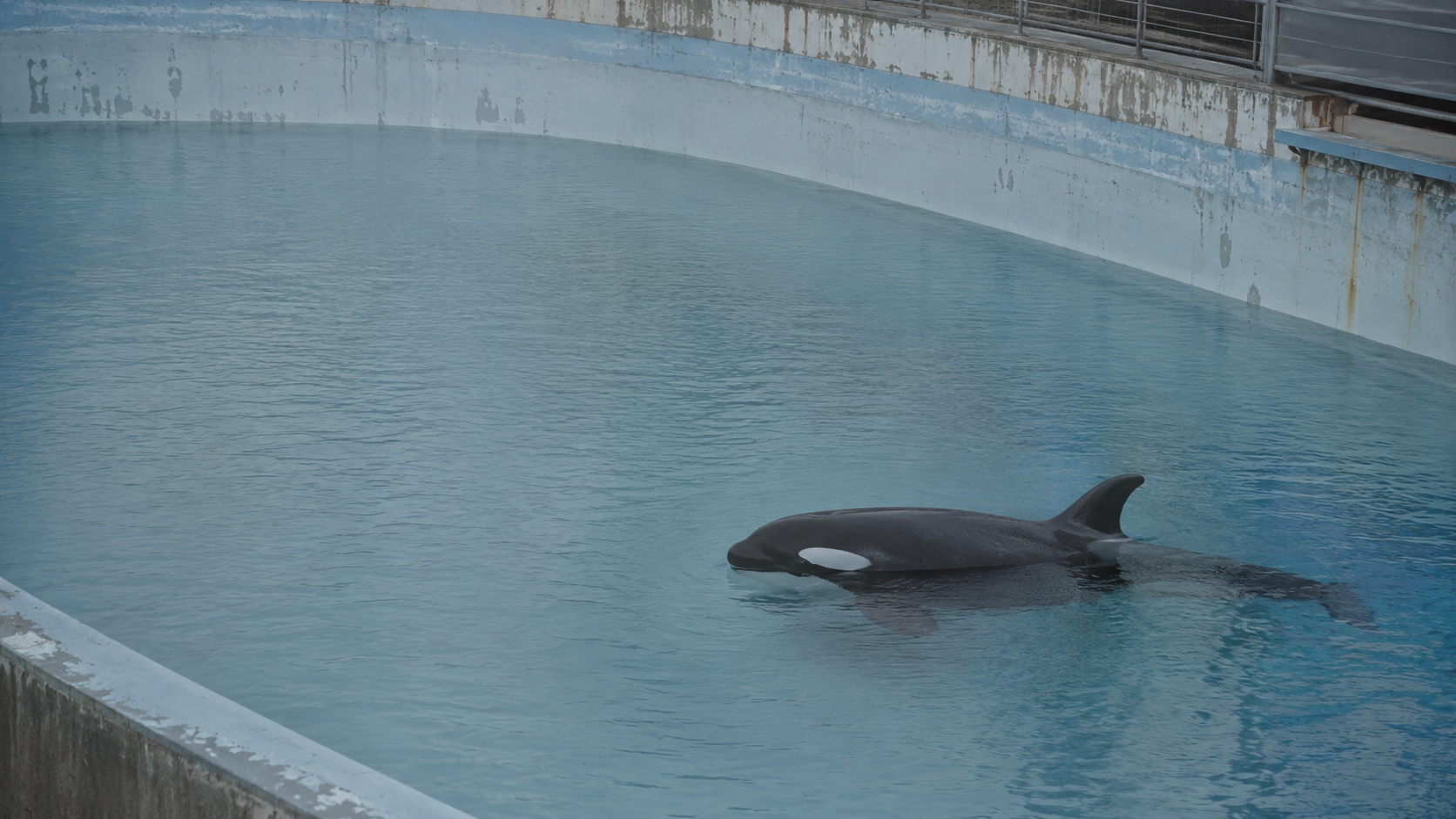
At the end, there was only water.
Pale blue water. Concrete walls. A quiet tank where the surface moved, but nothing answered back.
Kiska was still swimming, still breathing, still circling through the same artificial world she had known for decades. But for an animal born into a species built around family, sound, and social life, the silence around her became the most painful part of the story.
She was not always alone.
That is what makes Kiska’s life so heartbreaking.
Before the empty tank, before the viral videos, before people around the world called her “the loneliest orca,” there had been other voices around her. Other orcas. Other bodies moving through the water. Other calls that could have returned her own.
Then, one by one, they disappeared.
Kiska was captured in Icelandic waters in 1979 and later brought to Marineland in Niagara Falls, Ontario. She was captured alongside Keiko, the orca who would later become famous as the whale from Free Willy. The two lived together at Marineland for years before Keiko was sold to an aquarium in Mexico in 1985.
It is strange how two orcas taken from the same ocean could become symbols of such different endings.
Keiko became known around the world because people tried to give him a path back toward the wild. Kiska became known because she stayed behind.
For most visitors, she may have looked powerful. A black-and-white shape cutting through blue water. A marine-park animal in a place built for crowds.
But an orca is not only a body.
An orca is a voice inside a family.
Killer whales are highly social animals, and NOAA describes most as living in pods made up of maternally related individuals. Many stay closely connected to their matrilineal groups — the family lines that shape their lives, movements, communication, and survival.
That is what captivity took from Kiska first: not just the ocean, but the social world she was born to understand.
Over the years, other orcas came and went around her. She was not always the only one. But the tank kept changing in the cruelest way possible: every connection seemed temporary.
Kiska gave birth to five calves during her life in captivity. According to World Animal Protection Canada, all five died young.
That fact is almost too heavy to pass over quickly.
Five calves.
Five beginnings.
Five voices that never grew old beside her.
For a species known for strong family bonds, the loss of offspring is not just a statistic. It is the kind of detail that makes the empty tank feel different. When people say Kiska spent her final years alone, they are not only talking about the absence of another orca beside her in the water.
They are talking about a life where every possible family tie was broken.
By the last decade of her life, Kiska was no longer performing publicly. Marineland had stopped her public performances more than ten years before her death, and she spent her remaining years separate from other marine animals.
That is when the story became unbearable for many people watching from the outside.
A tank can look full from a distance. It can be full of water, full of reflections, full of movement.
But for Kiska, it was empty.
There was no pod moving beside her. No calf. No companion. No other orca call returning through the concrete. She lived alone in her tank for more than a decade before her death.
That was the image that stayed with people.
Kiska swimming by herself. Kiska floating in the same blue water. Kiska moving in slow circles where no other orca followed.
The world called her “the loneliest whale,” but even that phrase feels too small. Loneliness in a human life is painful enough. Loneliness for a social marine mammal, an animal whose natural world is built from sound, movement, family, and shared travel, is something harder to imagine.
In the wild, orcas do not simply exist next to each other. They communicate. They coordinate. They travel, hunt, rest, and learn in social groups. For many orca populations, family is not temporary; it is the center of the animal’s world.
Kiska’s final years were the opposite of that.
There is a kind of silence that is not the absence of noise, but the absence of anyone who understands you.
That was Kiska’s tank.
People who followed her story often focused on the image of her alone at the surface. But the deeper tragedy is that her isolation did not happen in one day. It happened slowly, over decades. The ocean was taken first. Then the original pod. Then companions. Then calves. Then public performances ended. And finally, even the idea of another orca beside her was gone.
She became Canada’s last captive orca.
When Kiska died in March 2023, she was 47 years old. The Associated Press reported that her health had declined despite medical intervention, and Marineland conducted a necropsy with provincial officials present. Her death marked the end of captive orcas in Canada.
For some, that sentence sounded like closure.
But it did not feel like victory.
Because the end of orca captivity in Canada came only after Kiska had already lived the story people wanted to prevent from happening again.
She did not die in the open ocean. She did not die beside a pod. She did not die in the waters where her first life began.
She died in a tank.
And for many who watched her story unfold, the hardest question was not only why she was kept there. It was why it took so long for the world to fully understand what that isolation meant.
The debate around Kiska was never simply about one park, one tank, or one animal. It was about what humans owe to animals whose intelligence and social lives are now impossible to ignore.
A tiger alone in a cage looks wrong to most people immediately. An elephant alone behind a barrier feels painful because we understand that elephants are social, emotional, and intelligent.
With whales and dolphins, the water sometimes hides the same truth.
A tank can make loneliness look clean.
It can hide the walls under reflections. It can make a circle look like swimming. It can make survival look like care.
But survival is not the same as living well.
Kiska survived for decades.
That does not mean the life given to her matched the animal she was.
Her story also became part of a larger shift in public feeling. Canada passed legislation ending the captivity of whales and dolphins, often called the “Free Willy” bill, though existing animals were not simply released by that law. Kiska remained in captivity under the reality of her circumstances, and her case became a symbol of why the debate mattered so much.
By the time many people learned her name, her life had already been reduced to the final image: one orca, one tank, no companions.
But that image only matters because of everything that came before it.
She had once been a young wild orca in Icelandic waters.
She had once had Keiko beside her.
She had once had calves.
She had once lived in a tank with other orca voices around her.
Then, at the end, there was no one.
That is why “The Last Voice in the Tank” is more than a title. It is the simplest way to understand what happened to her.
Kiska’s story was not only about captivity.
It was about disappearance.
The disappearance of the ocean from her life.
The disappearance of her companions.
The disappearance of her calves.
The disappearance of sound that belonged to her species.
And finally, the disappearance of Kiska herself.
When she died, animal advocates described it as heartbreaking, while others pointed to it as the final chapter in Canada’s captive-orca era. But the real weight of her story is not found only in the day she died. It is found in the years before it — the quiet years, the repeated circles, the empty water, the absence of another orca beside her.
Because Kiska did not become the loneliest orca in the world in one moment.
She became that way one loss at a time.
And maybe that is why her story stays with people.
It is not loud. It is not violent. It is not a sudden tragedy.
It is slower than that.
It is the story of a social animal living out her final years in a place where every wall returned her silence.
A tank can hold water.
It can hold a whale.
But it cannot hold an ocean.
And for Kiska, in the end, it could not hold the voices that had already disappeared.
