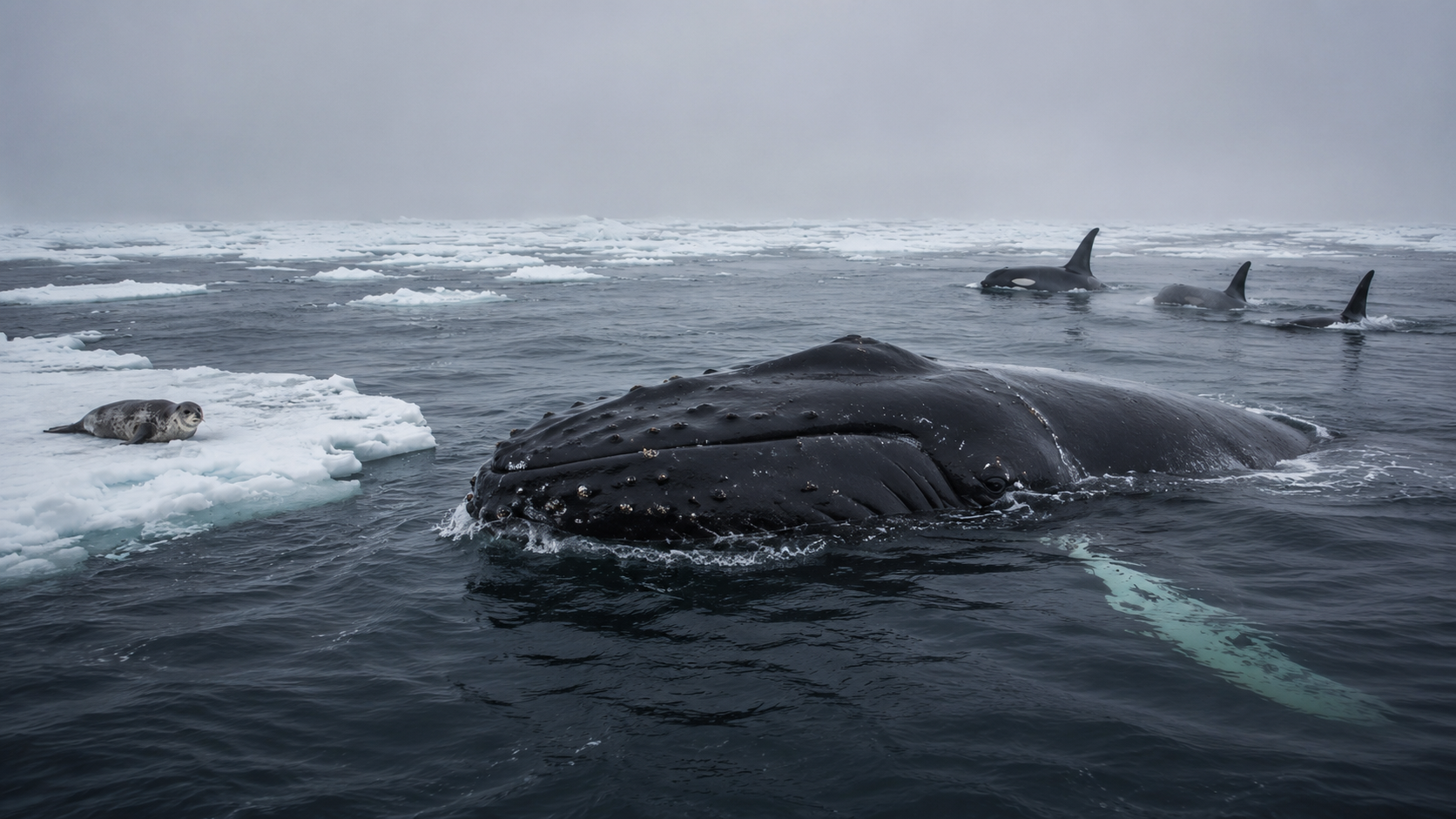
At first, it looked like the hunt was already decided.
A seal was trapped near the edge of the ice. Around it, the water moved with the quiet confidence of hunters that knew exactly what they were doing. Orcas are not random predators. They are strategic, social, and intelligent. When a pod closes in, the ocean itself can start to feel smaller.
For the seal, the ice was the last place of safety.
But then something strange happened.
A humpback whale moved into the middle of the hunt.
It did not belong there. It was not the seal’s mother. It was not hunting the orcas. It was not protecting its own calf. And yet, there it was — a massive whale placing its body between predator and prey, turning a normal hunt into something scientists are still trying to understand.
This behavior sounds almost impossible, but it is not just a story from one video. Researchers have documented many cases of humpback whales interfering when mammal-eating killer whales attack other animals. A major scientific review looked at 115 interactions between humpbacks and killer whales, and found that humpbacks often actively moved toward these hunts rather than simply reacting when orcas came near them.
That is what makes the behavior so fascinating.
The humpback is not always saving another humpback.
Sometimes the target is a seal. Sometimes it is a sea lion. Sometimes it is another whale species. In some cases, humpbacks have appeared to disrupt attacks on animals that were not related to them at all.
So the question becomes unavoidable:
Why would a humpback whale risk itself for another species?
One explanation starts with the humpback’s own past. Orcas can attack young humpback calves. The same scientific review found that when mammal-eating killer whales approached humpbacks, they attacked in most of those cases and targeted calves.
That means humpbacks have a real reason to treat mammal-hunting orcas as enemies.
For a mother humpback, an orca pod is not just another group of animals. It can represent one of the greatest threats her calf may ever face. A young humpback cannot outrun or outfight a coordinated orca attack. Humpbacks may carry memories, instincts, or learned responses connected to that danger.
So when a humpback hears or sees killer whales attacking, it may not first ask, “Who is the victim?”
It may simply respond to the sound and chaos of an orca hunt.
That could explain why humpbacks sometimes rush into attacks even when the prey is not a humpback calf. They may be reacting to a danger signal that evolution has taught them to take seriously. If orcas are hunting, a humpback may intervene because stopping an orca hunt is useful in general — even if the victim turns out to be a seal.
But that still does not explain everything.
Because in some cases, humpbacks appear to stay involved even after it is clear the prey is another species. National Geographic reported on this behavior and noted that scientists have considered several possibilities: humpbacks may be rescuing other animals by mistake, or there may be some form of interspecies altruism involved.
That word — altruism — is where the story becomes controversial.
In nature, scientists are careful with emotional language. It is tempting to say the whale “felt sorry” for the seal or “wanted to save it,” but we cannot know exactly what was happening inside the whale’s mind. Animals do not need human emotions to do extraordinary things. Behavior can be driven by instinct, experience, social learning, or a response to threat.
Still, the behavior is difficult to dismiss.
A humpback whale is not a small animal making a harmless gesture. It is a giant body entering a dangerous situation. Orcas are powerful predators. A group of them can be dangerous even to large whales, especially calves. For a humpback to move toward them, slap the water, vocalize, roll, or physically place itself near the hunted animal suggests something more complicated than coincidence.
Some accounts describe humpbacks using their huge bodies almost like shields. In one famous case, a humpback whale was observed near a seal during an orca attack, with the seal even ending up on or near the whale’s body as the orcas tried to continue the hunt. These stories are shocking because they reverse what people expect from nature. We expect predators to hunt and prey to flee. We do not expect a third animal to enter the scene and change the outcome.
But humpbacks are known for powerful defensive behavior.
They have enormous pectoral fins, sometimes almost one-third of their body length. NOAA describes humpbacks as large baleen whales that can grow to about 60 feet, with long pectoral fins and global migrations across oceans.
Those fins are not just beautiful. In conflict, a humpback can use its body, tail, and pectoral fins to create disturbance and make life harder for attackers. Against orcas, size matters. A single humpback cannot always stop a pod, but it can make a hunt more difficult, more dangerous, and more expensive in terms of energy.
For orcas, hunting is not free.
Every chase costs energy. Every failed attack wastes time. If a humpback shows up and disrupts the hunt, the orcas may eventually abandon the prey and move on. That means the humpback does not have to “defeat” the orcas in a dramatic battle. It only has to make the hunt less worth continuing.
That may be part of the reason this behavior exists.
If humpbacks regularly interfere with mammal-eating orcas, they may reduce orca hunting success in general. Over time, that could benefit humpbacks as a species, especially if orcas are less successful around humpback calves. Even if a seal is saved in the moment, the deeper evolutionary logic may be: make orca hunts harder whenever possible.
But then there is the more emotional possibility.
Maybe humpbacks sometimes respond to distress.
Whales live in a world of sound. The ocean is not silent to them. Calls, splashes, panic movements, and hunting vocalizations can travel through water in ways humans barely understand. A struggling animal on the surface may create signals that attract attention. A humpback hearing the chaos of an attack may move toward it, then react to what it finds.
This does not mean humpbacks are “heroes” in the human sense.
But it does mean they may be capable of a kind of response that looks protective from the outside.
And that is enough to make the behavior powerful.
The most interesting part is that this is not a simple case of predator versus prey. Orcas themselves are highly intelligent animals with complex cultures and hunting techniques. They hunt in groups, coordinate movements, and pass traditions through generations. Humpbacks are also intelligent, long-lived, social animals with their own communication, migrations, and memory.
So when a humpback interrupts an orca hunt, it is not just muscle against muscle.
It is one intelligent marine mammal responding to another intelligent marine mammal’s strategy.
That is why scientists still debate it.
Is it mobbing behavior, like birds attacking a hawk?
Is it a defense response triggered by the danger orcas pose to humpback calves?
Is it accidental rescue, where the humpback responds before knowing what animal is being attacked?
Or is there a real form of interspecies aid happening in some cases?
The honest answer is that no single explanation probably covers every event.
Some humpbacks may be reacting automatically to orca hunting sounds. Some may have personal experience with orca attacks. Some may be protecting nearby calves or other humpbacks. And sometimes, the result may be that a seal or another animal survives because a humpback decided to interfere.
From the seal’s point of view, the reason may not matter.
One moment, the ice is surrounded by predators. The next, a giant whale appears between life and death.
For humans watching, the scene feels almost impossible because it challenges the simple way we often tell nature stories. We like clear roles: predator, prey, victim, hunter, rescuer. But real nature is messier. Sometimes predators are brilliant. Sometimes prey are clever. Sometimes a third animal enters the story and changes everything.
That is what makes the humpback so extraordinary in these moments.
It does not need to be there.
It has no obvious reward.
It may even be putting itself at risk.
And yet, again and again, humpbacks have been seen interfering with killer whale attacks on other marine mammals. The scientific paper that reviewed these interactions even framed the question directly in its title: is this mobbing behavior, or could it be interspecific altruism?
That question is the heart of the mystery.
Maybe the humpback is not thinking, “I will save this seal.”
Maybe it is thinking nothing in a human way at all.
Maybe it hears orcas and reacts with an ancient response carved by generations of danger.
But whatever the reason, the result is unforgettable.
A seal trapped on ice.
Orcas closing in.
A massive whale moving into the middle.
And a hunt that suddenly does not go the way it was supposed to.
The ocean is full of violence, but it is also full of intelligence we do not fully understand. Humpbacks remind us of that. They are not just gentle singers or giant travelers. They are powerful animals with memories, defenses, and behaviors that still surprise the people who study them.
So when a humpback whale places its body between orcas and a seal, the moment is more than a rescue scene.
It is a question.
A question about instinct.
A question about memory.
A question about whether animals sometimes act beyond simple survival.
And maybe that is why the story stays with us.
Because somewhere in the cold water, when the seal had almost nowhere left to go, a whale that owed it nothing moved into the way.
