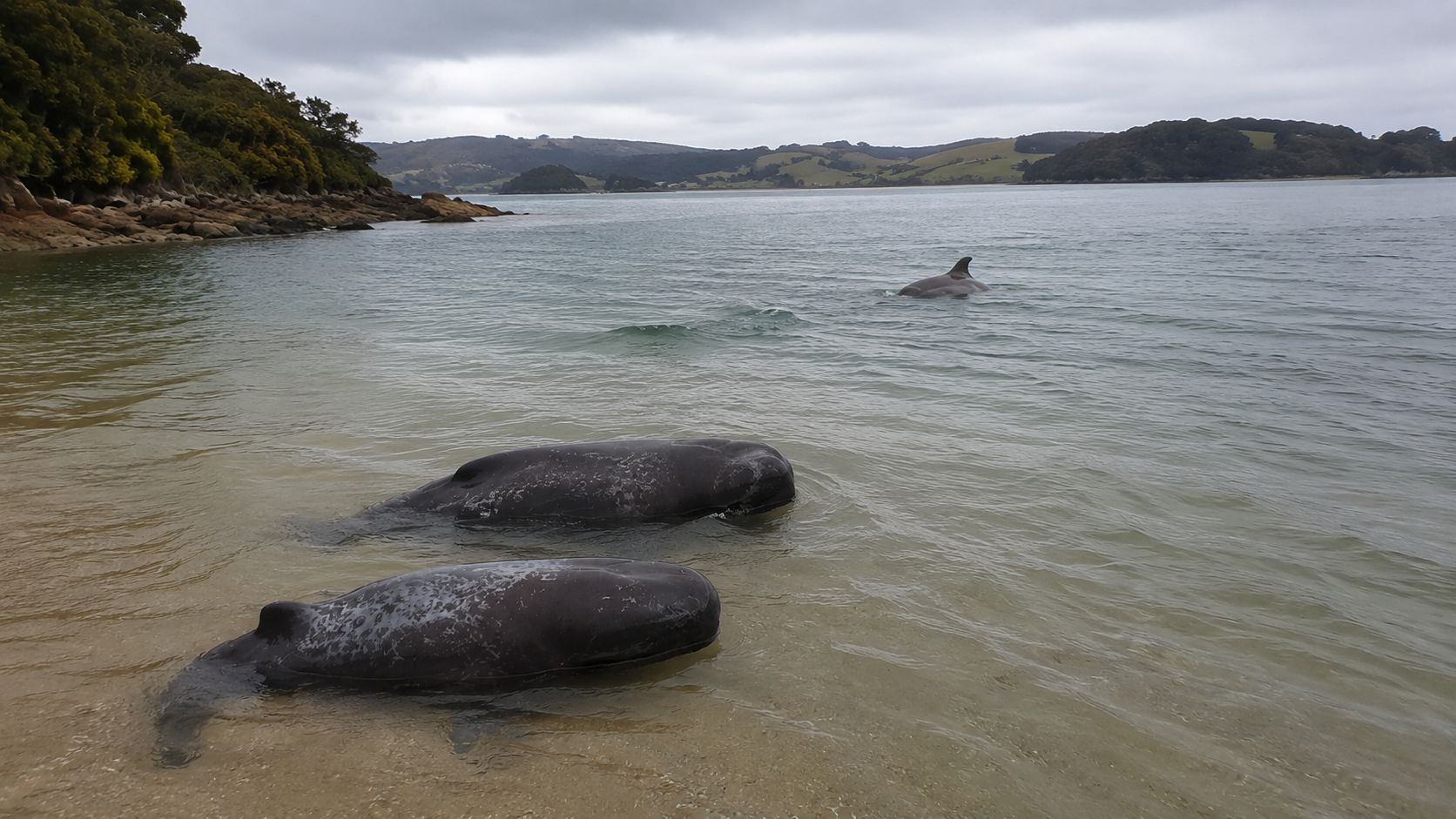
Two whales were running out of time.
They were trapped in shallow water near Mahia Beach on New Zealand’s North Island, confused, disoriented, and unable to find their way back to deeper water. They were not giant ocean whales, but pygmy sperm whales — small, dark, compact whales that can become dangerously vulnerable when they enter shallow coastal areas.
Rescuers tried to help them.
Again and again, people attempted to guide the whales away from the beach and back toward open water. But the whales kept turning the wrong way. Every time they seemed close to safety, they became confused again and headed back toward the shallows.
For the people watching, the situation was becoming desperate.
A whale stranding can turn fatal quickly. The animals can become exhausted. Their bodies are not built to rest in shallow water for long. If the tide changes or they remain stuck too long, rescue teams sometimes have very few options left.
Then something unexpected happened.
A bottlenose dolphin named Moko appeared.
Moko was already known around Mahia Beach. He often interacted with swimmers and had become a familiar presence along the coast. But on this day, he did something that made people around the world stop and wonder what animals understand that humans still do not.
According to reports from the time, Moko approached the distressed whales and seemed to guide them through a channel toward deeper water. Conservation official Malcolm Smith said people had tried unsuccessfully to move the whales for about an hour and a half before Moko appeared, and described the moment as something he had never seen before.
The whales followed him.
That is the part of the story that still feels almost impossible.
Humans had been trying. The whales had resisted. The shore was too confusing. The shallow water kept pulling them into danger. But when the dolphin moved ahead, the whales seemed to understand.
Moko did not need ropes. He did not need boats. He did not push them or force them. He simply moved through the water in a way they followed.
And slowly, the two lost whales were led back toward safety.
The animals involved were reported as two pygmy sperm whales — a mother and her calf in several accounts — trapped near a sandbar and Mahia Beach. Te Ara, New Zealand’s official encyclopedia, notes that Moko first began visiting Mahia Peninsula beaches in 2007 and that in 2008 he led two trapped pygmy sperm whales back out to sea after human intervention failed.
That is what makes the story so powerful.
It was not just a dolphin swimming near whales.
It was a moment where a wild animal seemed to step into a rescue that humans could not finish.
Of course, no one can say exactly what Moko was thinking. Scientists are careful about giving human motives to animals. Maybe he recognized distress. Maybe he understood the channel better than the whales. Maybe the whales responded to his movement, his sounds, or simply his confidence in the water.
But whatever the reason, the result was real enough for witnesses to remember it for years.
A dolphin appeared.
The whales followed.
And a rescue that was failing suddenly changed direction.
Moko’s story became famous because it touches something people deeply want to believe: that intelligence in the ocean is not only about hunting, survival, or instinct. Sometimes, it can look like awareness. Sometimes, it can look like communication. Sometimes, it can look like help.
Bottlenose dolphins are among the most intelligent marine mammals. They are social, curious, vocal, and capable of complex behavior. They use sound, body movement, and social learning in ways that scientists are still studying. That does not mean every dolphin is a hero, or that every strange rescue story should be turned into a fairy tale.
But Moko’s case is difficult to ignore because it was observed in a real rescue setting and reported internationally at the time.
The Dolphin Communication Project described Moko as a lone sociable dolphin off New Zealand’s coast who was said to have helped escort two beached pygmy sperm whales back to open waters. Time later included Moko in a list of heroic animals, summarizing the famous moment as a case where the dolphin appeared just in time and seemed to lead the whales safely back into deeper water.
The details are almost cinematic.
A quiet New Zealand bay.
Two small whales trapped where they should not be.
Rescuers on the shore, running out of ideas.
Then a single dolphin appears from deeper water, moves toward the whales, and somehow becomes the guide they needed.
For anyone who loves ocean stories, this is the kind of event that stays in the mind. It is not violent. It is not tragic. It is not about captivity, hunting, or loss. It is about a moment of strange cooperation between species — a dolphin, two whales, and the humans who could only watch as the ocean solved a problem they could not.
But there is also a deeper lesson in it.
Wild animals do not always behave in the simple ways humans expect. We often divide them into categories: predator, prey, smart, instinctive, dangerous, friendly. Nature is rarely that simple.
A dolphin can be playful one day and serious the next.
A whale can be powerful in deep water and helpless in the shallows.
A rescue team can do everything right and still need the animal itself to choose the path out.
Moko’s role was not magic. It was movement, timing, and maybe communication. But from the shore, it must have looked like something close to a miracle.
One reason the story works so well is because Moko was not a trained animal. He was not performing in an aquarium. He was not following a command. He was a wild dolphin already known in the area, moving freely in his own environment.
That makes the moment feel different.
He was not brought there to help.
He simply appeared.
And after he appeared, everything changed.
For the whales, the difference may have been survival. Malcolm Smith said Moko’s actions probably meant the difference between life and death for them.
That sentence is what turns the story from interesting to unforgettable.
Because if the whales had stayed trapped, the ending may have been very different. Stranded whales can deteriorate quickly. Even when they are not fully beached, shallow water can exhaust them. Their orientation can fail. Their stress can rise. Their bodies are adapted for open water, not sandbars and narrow channels.
The whales needed a path.
Moko seemed to know one.
There is something beautiful in the simplicity of that.
Humans tried to explain.
The dolphin moved.
The whales followed.
And the sea opened again.
After the rescue, Moko’s fame grew. He became one of New Zealand’s most recognizable wild dolphins, known for his interactions with people around Mahia and later other areas. His life was not without concern; wild dolphins that become too used to humans can face risks from boats, fishing gear, and unsafe interactions. Moko was later found dead in 2010 near Matakana Island, and his story remains both beloved and complicated.
That does not erase what happened in 2008.
If anything, it makes the story more meaningful.
Moko was not a cartoon hero. He was a real wild dolphin living a risky life close to humans. He was curious, social, and sometimes unpredictable. But on one day near Mahia Beach, he became part of one of the most remarkable marine rescue stories ever reported.
Two whales were trapped.
People could not guide them out.
Then Moko arrived.
And for reasons we may never fully understand, the whales followed him back toward the sea.
Maybe that is why the story still moves people. It reminds us that the ocean is full of intelligence we do not completely understand. It reminds us that animals may notice more than we think. And it reminds us that sometimes, the most powerful rescue does not come from force.
It comes from knowing the way.
Moko did not drag the whales to safety.
He did not fight the tide.
He did not make the moment dramatic.
He simply swam ahead.
And somehow, that was enough.
