They live in the water, but they can’t breathe it. Every breath a whale takes is a conscious choice. So how does a creature that must decide to breathe ever manage to fall asleep? The answer is one of the most extraordinary survival tricks in all of nature.
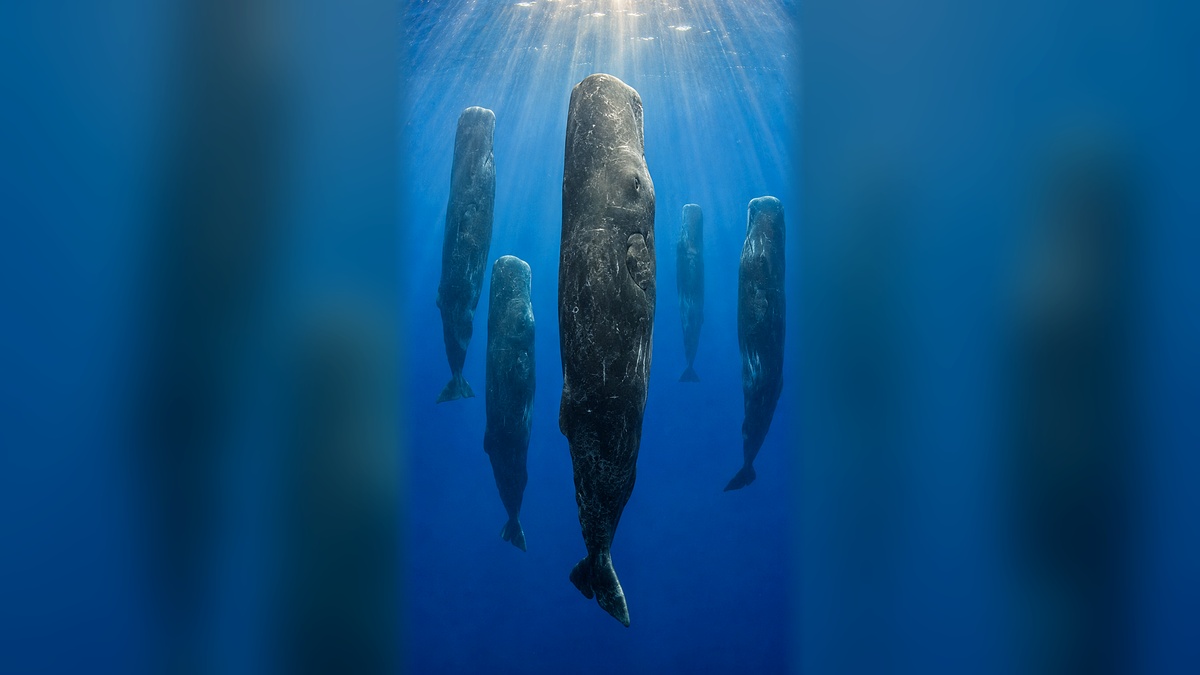
Somewhere out in the open ocean right now, a giant whale is hanging perfectly still beneath the surface — head up, tail down, suspended in the blue like a great column of stone. It looks lifeless. It isn’t. It’s sleeping. And the way it does so is one of the strangest, most beautiful solutions evolution has ever produced.
Because for a whale, sleep isn’t the simple thing it is for us. For a whale, sleep is a matter of life and death.
The problem no land animal has to solve
Think about how you breathe. Right now, you’re doing it without a single thought. When you fall asleep tonight, your body will keep breathing on its own, automatically, all night long. You never have to decide to take a breath. Your brainstem handles it for you, whether you’re awake, asleep, or completely unconscious.
Whales don’t have that luxury.
Whales are conscious breathers — sometimes called “voluntary breathers.” Every single breath a whale takes is a deliberate act. It has to actively decide to rise to the surface, open its blowhole, exhale, and inhale. Nothing about it is automatic. And this creates a terrifying problem that no land mammal ever has to face:
If a whale fell completely, deeply asleep — the way you do every night — it would simply stop breathing. It would sink beneath the waves and drown.
For an animal that spends its entire life in the water and cannot breathe that water, this is the ultimate paradox. It must sleep to survive. But sleeping the normal way would kill it.
So how do whales solve it?
[EMBED YOUR VIDEO HERE]
Half a brain at a time
The answer is almost impossible to believe the first time you hear it: whales sleep with only half their brain at a time.
It’s called unihemispheric slow-wave sleep. One half of the whale’s brain drifts into deep sleep and shuts down to rest. The other half stays fully awake and alert — keeping watch, monitoring the surroundings, and, most importantly, remembering to breathe. After a while, the two halves switch. The rested half wakes up, and the tired half finally gets its turn to sleep.
In this way, a whale is never fully unconscious. There is always one half of its brain on duty, quietly running the essential systems and making sure the animal rises to breathe when it needs to. It is, in effect, always half-awake — for its entire life.
Dolphins, which face the very same challenge, do exactly the same thing. If you ever watch a sleeping dolphin, you may notice it keeps one eye open and one eye closed. That open eye is connected to the half of the brain that’s still awake and watching the world. The closed eye belongs to the half that’s resting. It’s a living window into one of the most remarkable adaptations in the animal kingdom.
Sleeping standing up
This brings us back to that eerie, beautiful sight: whales hanging vertically in the water, motionless, heads toward the surface.
In 2008, scientists studying sperm whales captured footage that stunned the world. Entire groups of these giants were drifting near the surface completely still, their bodies vertical, nose up, like a silent forest of enormous pillars floating in the blue. They weren’t sick. They weren’t dying. They were sleeping — together, in one of the most surreal natural scenes ever filmed.
Researchers believe these vertical naps are surprisingly short. Sperm whales may sleep for only around ten to fifteen minutes at a time, drifting in these still, vertical clusters, before waking and moving on. It appears they may need less total sleep than almost any other mammal — a matter of hours a day, snatched in brief, floating rests.
Different whales rest in different ways. Some drift slowly near the surface. Some “log” at the top of the water, lying still like a floating tree trunk, only the top of the back and blowhole exposed. Others rest while swimming slowly alongside their pod. But in every case, the same underlying rule holds: they never switch off completely. The waking half of the brain always stays on watch.
Why mothers and babies never stop moving
There’s an even more astonishing chapter to this story — and it involves newborns.
When a whale or dolphin calf is born, it faces a brutal challenge. In those first weeks of life, the baby and its mother barely sleep at all in the way we understand it. In fact, studies of dolphins found that mothers and their newborns can stay active and moving almost continuously for weeks after birth, getting virtually none of the deep rest that most animals — including adult dolphins — normally need.
The reason is survival. A newborn isn’t yet strong enough to simply float and rest safely; it must keep swimming, keep surfacing, keep close to its mother in dangerous open water. So mother and calf keep moving, day and night, until the baby grows strong enough to rest more safely. It’s an act of endurance and devotion that would be impossible for almost any land animal — and these ocean giants do it instinctively, out of love and necessity.
The quiet miracle beneath the surface
We tend to think of sleep as the most ordinary thing in the world. We do it every night without a second thought, trusting our bodies to keep us alive while our minds switch off completely.
A whale can never afford that trust. It carries the responsibility of every single breath, awake or asleep, for its entire life. And rather than let that impossible burden defeat it, evolution found a breathtaking answer — a brain that sleeps in halves, a body that rests standing up in the deep, and mothers who will forgo sleep entirely to keep their newborns alive.
So the next time you drift off to sleep tonight — easily, automatically, completely — spare a thought for the giants in the deep. Somewhere out there, one of them is hanging silent and still in a shaft of blue light, half-dreaming, half-watching, and never, ever fully letting go.
Because in the ocean, even sleep is an act of survival.
If this gave you a new sense of wonder about these animals, share it. The more people understand how extraordinary the giants of the ocean truly are, the more we’ll care about protecting them — and the deep blue world where they rest.
