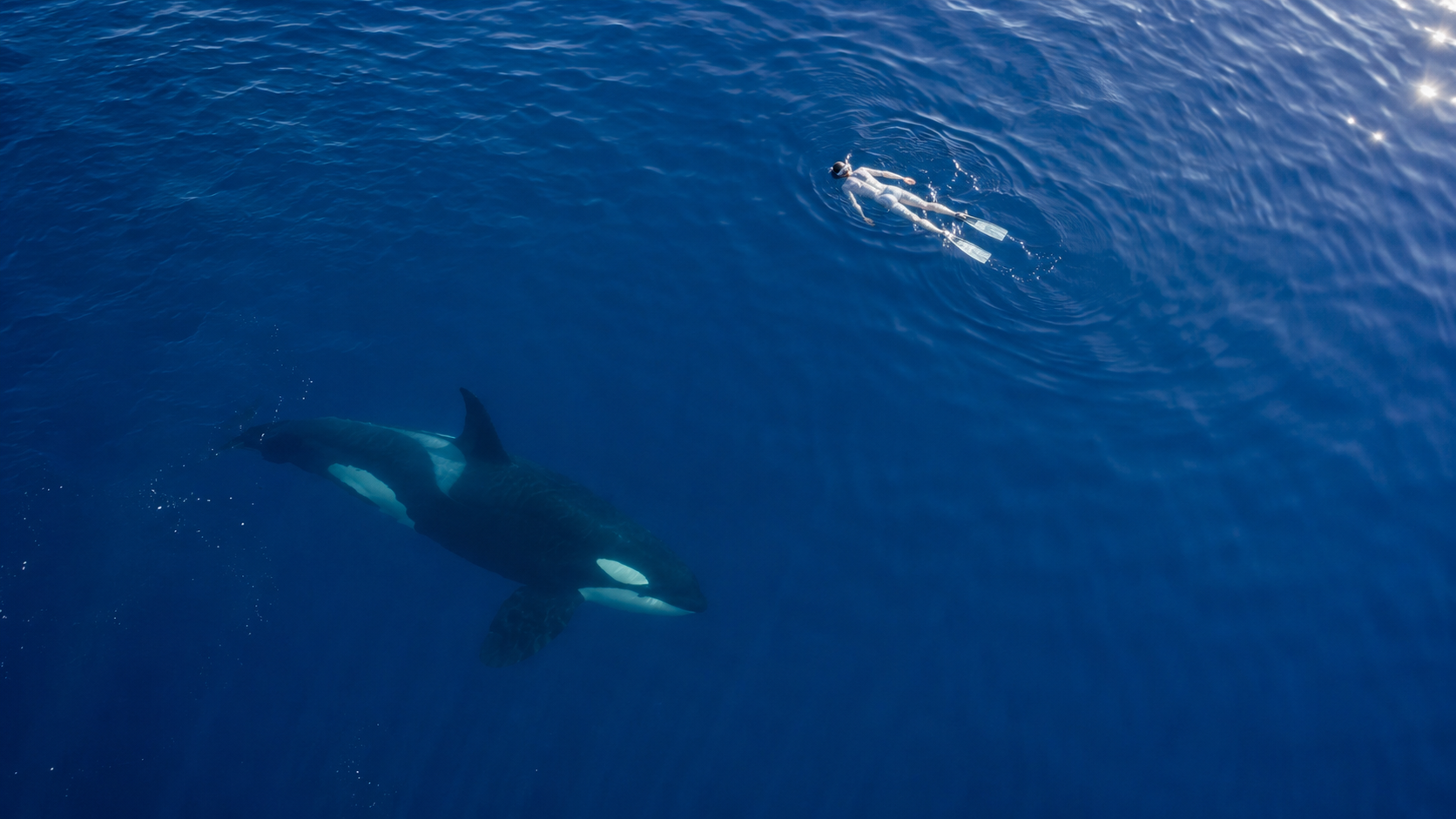
It looks impossible at first.
A human floats alone in the blue water. A massive black-and-white shape moves beneath the surface. It is bigger, faster, stronger, and completely in control. One turn of its body could change everything. One strike from its tail could knock a person helpless. One bite would be enough.
But the orca does not attack.
It glides closer, watches, circles, and then moves away as if the human is not prey at all.
That is the mystery that has fascinated people for decades: why does one of the ocean’s most powerful predators almost never attack humans in the wild?
Orcas, also called killer whales, are not weak animals. They are not harmless. They are apex predators — the top hunters of the ocean. NOAA describes killer whales as the ocean’s top predator and the largest member of the dolphin family. They can hunt fish, seals, sea lions, dolphins, sharks, and even large whales depending on the population and region. Different orca groups often specialize in different diets and hunting methods.
So the answer is not that orcas “cannot” attack humans.
They absolutely could.
The real answer is stranger: in the wild, humans do not seem to be part of their idea of food.
A Predator That Knows What It Is Hunting
To understand orcas, you have to stop thinking of them as random killers.
An orca does not simply see movement and bite. These animals are intelligent, social, and highly trained by their family groups. Orca hunting is not just instinct; it is culture. Young orcas learn what to hunt, where to hunt, and how to hunt by watching their mothers and pod members.
Whale and Dolphin Conservation explains that different orca ecotypes hunt different prey, and once an orca family has learned a food tradition, they are not likely to suddenly switch diets. Some groups specialize in fish. Others hunt marine mammals. Others target sharks or rays. Their diets are not random — they are inherited knowledge.
That may be one of the biggest reasons humans are usually ignored.
To a wild orca, a human in the water does not fit the pattern. We do not look like a seal moving through the water. We do not sound like their normal prey. We do not behave like the animals their mothers taught them to hunt. We are strange, awkward, slow, and unfamiliar.
An orca may investigate us.
But investigation is not the same as predation.
They Are Dangerous — But Not Toward Us
The name “killer whale” makes people imagine a monster. But the name originally came from observations of orcas hunting other whales. Ancient sailors saw them as “whale killers,” and over time the phrase became “killer whale.” That history helped create an image of orcas as violent animals that attack everything in front of them.
The real animal is more complex.
Orcas can be terrifying hunters when they are hunting. They can cooperate in groups, chase prey with strategy, and use techniques that look almost planned. Some orcas create waves to wash seals off ice. Others separate calves from whale mothers. Some flip sharks over to immobilize them. They are not gentle in the way humans like to imagine nature as gentle.
But they are selective.
That is the key.
A great white shark may sometimes bite a human because it mistakes a shape for prey. Orcas appear to be far more careful. They are not just reacting to a silhouette. They are making decisions based on what they have learned, what their pod eats, and what kind of animal is in front of them.
This is why the video of an orca calmly moving around a swimmer feels so powerful. The danger is real — but so is the restraint.
Have Wild Orcas Ever Killed Humans?
There is no verified record of a wild orca killing a human in the way people normally imagine — a clear, confirmed predatory attack in open water. Reports of violent wild encounters are extremely rare, and the few stories that exist usually involve special circumstances, mistakes, or uncertainty. Live Science notes that orcas almost never attack humans in the wild, while the story is different for captive orcas, which have been involved in multiple serious and fatal incidents.
That difference matters.
In the wild, orcas live in family groups, travel huge distances, hunt naturally, and make choices inside their own environment. In captivity, orcas have been placed inside artificial spaces, separated from natural social structures, and exposed to stress that does not exist in the open ocean.
So when people bring up famous captive cases like Tilikum, they are talking about a very different situation.
Captive orca incidents do not prove that wild orcas hunt humans. They prove that an intelligent, powerful predator inside an unnatural environment can become dangerous in ways we do not fully control.
Curiosity Is Not an Attack
Many wild orca encounters with humans look frightening because the size difference is so extreme.
A human in the water is fragile. An orca can be more than 20 feet long. A large male can be even bigger. When an animal like that turns toward a swimmer, the human brain reads danger instantly.
But from the orca’s side, the moment may not be aggression at all.
It may be curiosity.
Orcas are intelligent dolphins. They inspect objects. They learn socially. They interact with their environment. They sometimes approach boats, floating objects, and animals that are not prey. In recent years, Iberian orcas became famous for damaging boat rudders, but many experts warned that calling these events “attacks” was misleading. An open letter signed by orca specialists argued that the behavior looked more like play, social behavior, or a cultural fad than hunting or revenge.
That is important for understanding swimmer encounters too.
An orca may come close because it is interested. It may circle because it is inspecting. It may pass beneath a person because it is aware, controlled, and curious.
The frightening part is that curiosity from an orca can still be dangerous. Even a gentle movement from such a powerful animal could injure a human by accident. But the fact that these encounters so rarely become violent suggests that orcas often know exactly where their bodies are and how close they are getting.
That level of control is part of what makes them so remarkable.
Humans Are Not Worth the Risk
Another possible reason is simple: humans are not useful prey.
A wild orca does not need to experiment with strange food when it already has a learned diet. Hunting is energy. Hunting can be risky. A seal, fish, shark, or whale calf fits a known pattern. A human does not.
For a predator, unfamiliar prey can be a bad decision.
Humans are bony, oddly shaped in the water, often surrounded by boats, bubbles, fins, cameras, or noise. We are not abundant in the ocean compared with their natural prey. We do not form part of any known orca food tradition.
So even if a wild orca recognizes that a human is vulnerable, that does not mean it sees the human as food.
In nature, predators do not attack everything they can overpower. Lions do not eat every animal they see. Sharks do not bite every object they pass. Orcas, with their strong social learning and specialized diets, may be even more selective than most.
The Ocean’s Most Misunderstood Predator
The most powerful thing about orcas is not just their strength.
It is their mind.
They live in societies. They pass knowledge through generations. They use dialects and hunting traditions. They learn from each other. NOAA notes that killer whales have many distinct populations and ecotypes around the world, with different diets and behaviors. As a whole, the species has a varied diet, but individual populations are often specialized in what they hunt and how they hunt.
That means an orca is not just an orca.
A fish-eating resident orca is not the same as a mammal-hunting transient orca. A shark-hunting orca is not the same as an orca that follows herring. Their world is shaped by family, culture, and learned behavior.
And in all those cultures, humans appear to remain outside the menu.
That is not because orcas love us.
It is not because they are secretly gentle giants.
It is because they are intelligent predators with rules of their own.
The Real Lesson
When people see an orca beside a swimmer, they often ask the wrong question.
They ask: why didn’t it kill the human?
But maybe the better question is:
what did the orca understand that we don’t?
It knew the swimmer was not a seal. It knew the person was not part of its hunt. It could approach without attacking. It could inspect without biting. It could be powerful without being violent.
That is what makes the moment so unforgettable.
The human is defenseless. The orca is not.
The orca has every advantage — size, speed, strength, intelligence, and control of the water. Yet it chooses nothing. No strike. No bite. No chase. Just a silent pass through the blue.
For an animal with the word “killer” in its name, that restraint may be the most shocking thing of all.
Wild orcas are not harmless. They deserve distance, respect, and protection. No one should enter the water expecting a safe encounter with a massive predator. But their long record of not hunting humans tells us something extraordinary.
Orcas are not mindless killers.
They are families, cultures, hunters, learners, and decision-makers.
And sometimes, when one of the ocean’s greatest predators comes close enough to end a human life, the most powerful thing it does is simply swim away.
