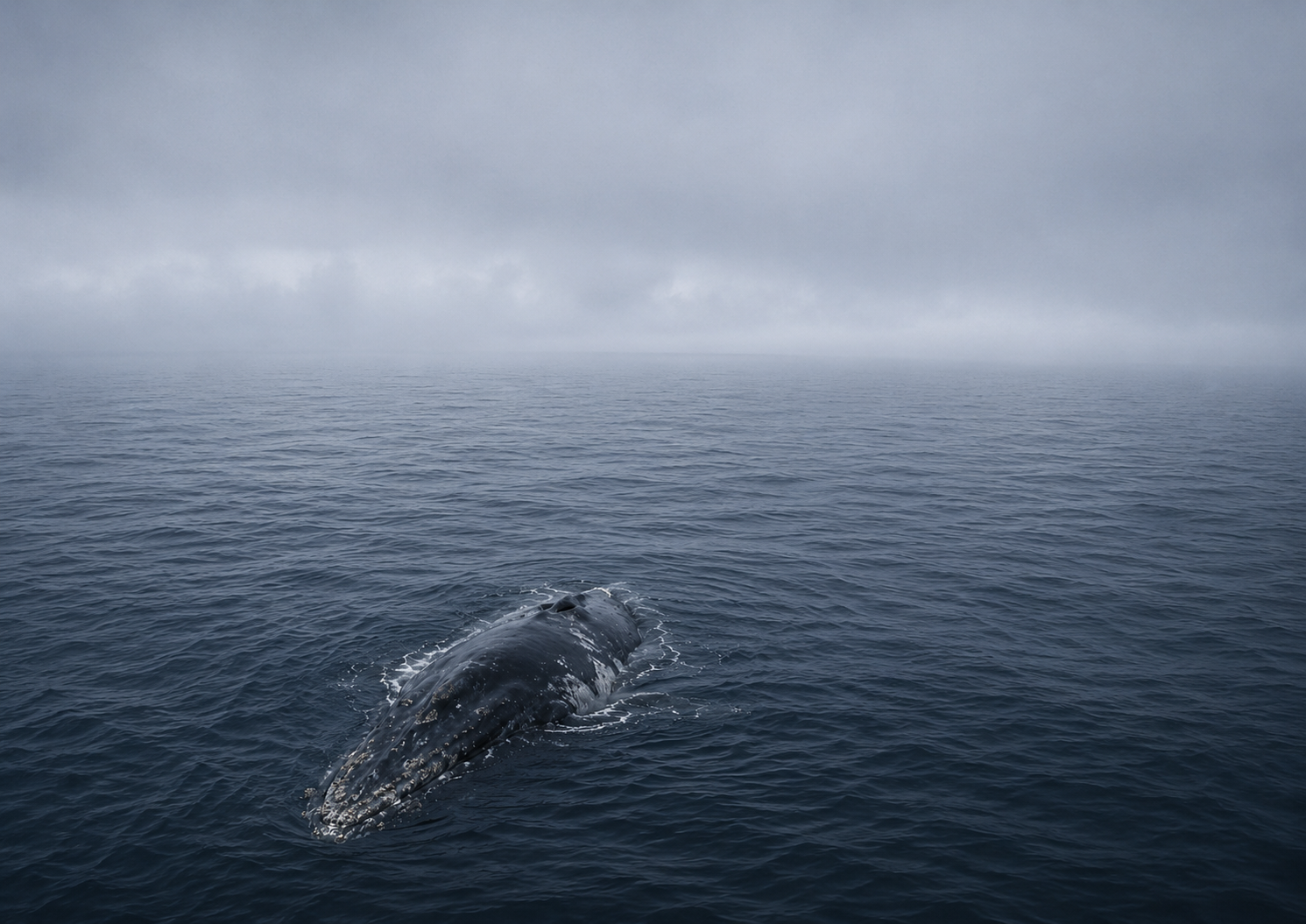
Far out in the open ocean, where there are no lights, no roads, and no voices from land, a whale once sang into the dark water.
His call moved through the sea the way only whale song can — low, haunting, and powerful enough to travel across enormous distances.
But what made this whale unforgettable was not only that he sang.
It was that, for years, people believed no one was answering.
The story became known around the world as one of the loneliest mysteries in the ocean: a whale whose song seemed different from the others, a voice moving through the North Pacific at a frequency that made people wonder whether he was living unheard.
Some called him the loneliest whale in the world.
Scientists were more careful.
But the mystery stayed.
Because even when the science is cautious, the image is almost impossible to forget:
One whale.
One voice.
A whole ocean listening — and silence coming back.
A Song That Did Not Sound Like the Others
The story is often linked to the famous 52-hertz whale, sometimes called 52 Blue.
This whale became known because researchers detected calls at around 52 hertz, a frequency considered unusual compared with typical calls from many large baleen whales. Woods Hole Oceanographic Institution described researchers picking up the call of the same 52-hertz whale through the SOSUS underwater listening system and tracking it as it moved widely through the North Pacific.
The whale itself was never clearly seen in the way people might imagine from a wildlife film. For years, the mystery came through sound, not sight. Hydrophones heard him. Researchers followed the acoustic signature. But the animal behind the voice remained hidden beneath the surface.
That made the story feel even more haunting.
Most wildlife stories begin with an image.
This one began with a sound.
Why Whale Songs Matter
Whales do not sing for humans.
They sing because sound is part of how their world works.
Underwater, sound travels far better than light. For whales, calls can help with communication, social contact, navigation, mating behavior, and finding each other in a world where visibility can disappear quickly. NOAA explains that whales make sounds to communicate, locate food, and find each other, and that whales use different types of noises such as clicks, whistles, and pulsed calls.
Humpback whales are especially famous for song. Male humpbacks produce complex songs during the breeding season, and NOAA notes that scientists believe these songs likely play a role in reproductive behavior, even though the exact function remains debated.
That is why the idea of one whale singing differently struck people so deeply.
A whale song is not just noise.
It is contact.
It is presence.
It is a voice saying, in the only way a whale can:
I am here.
The Loneliness People Heard
The phrase “loneliest whale” became powerful because humans understood it emotionally.
People imagined a whale calling into the sea, again and again, with no other whale able to respond. Scientific American described the story as a whale vocalizing at a unique frequency of 52 hertz, which, as the story goes, no other whale could seemingly understand.
But this is where the story must be told carefully.
Scientists have not proven that the whale was emotionally lonely in the human sense. They have not proven that no whale ever heard him. They have not proven that no animal ever responded somewhere beyond the range of the instruments.
The ocean is too large for that kind of certainty.
What scientists found was unusual sound.
What people felt was loneliness.
And between those two things, the legend was born.
A Voice Moving Through Empty Water
Imagine the North Pacific at night.
No moon bright enough to mark the surface.
No land nearby.
Only dark water, moving in every direction.
Somewhere below, a whale releases a call. The sound passes through layers of cold water, through distance, through a world humans can barely imagine.
Then the call fades.
And the ocean returns to silence.
That is what made the story so unforgettable. It was not violent. It was not dramatic. There was no chase, no attack, no rescue.
Just a voice.
A voice that sounded different.
A voice that made people wonder whether being heard is as important in the ocean as it is on land.
Was He Really Alone?
The honest answer is: no one knows.
The 52-hertz whale became famous because the call was unusual and repeatedly detected over time. But an unusual call does not automatically mean the whale had no contact with others. It does not prove he was rejected by other whales. It does not prove he was the last of his kind.
Those ideas are part of the myth.
The reality is more mysterious and, in some ways, even more interesting.
He may have been a hybrid. He may have had an unusual body size or vocal structure. His call may have changed over time. He may have traveled near other whales without being detected visually. The ocean could have held answers that hydrophones never captured.
That uncertainty is why the story still works.
It leaves space for wonder.
It leaves space for sadness.
And it leaves space for the question that keeps people listening:
What if he really was calling alone?
The Whale We Never Saw
One of the strangest parts of this story is that the whale became famous without becoming visible.
Most famous animals have a face people recognize.
A photograph.
A video.
A place where they were seen.
But this whale became a symbol through sound alone.
That makes him different from almost every other wildlife story. People did not fall in love with his image. They fell in love with the idea of his voice moving through the ocean.
That is why creators, filmmakers, writers, and ocean lovers kept returning to him.
He became more than a whale.
He became a symbol of being unheard.
A symbol of calling out and not knowing whether anyone is listening.
Why the Story Still Hurts
Maybe the 52-hertz whale was not truly lonely.
Maybe another whale heard him.
Maybe the ocean was not as silent as people imagined.
But the story still hurts because it touches something real.
Whales depend on sound. Marine life depends on communication. And the modern ocean is not as quiet as it once was. Ships, sonar, industrial noise, and human activity have changed the soundscape of the sea.
For animals that listen across distance, noise is not just background.
It is interference.
It can cover calls.
It can break contact.
It can make the ocean harder to understand.
So even if the loneliest-whale legend is partly human imagination, the deeper issue is very real: sound matters in the lives of whales.
A Song That Became a Mirror
The old whale who sang alone became famous because people heard themselves in him.
Not literally.
But emotionally.
Everyone knows what it feels like to speak and wonder if anyone understands. Everyone knows what it feels like to call into silence. Everyone knows the fear of being surrounded by a world that does not answer back.
That is why this whale’s story became so much bigger than marine biology.
It became a mirror.
A whale in the dark sea.
A voice at a strange frequency.
A mystery that sounded like loneliness.
The Ocean Did Not Give an Answer
To this day, the story remains unresolved.
That is part of its power.
There is no simple ending where the whale is found, understood, and reunited with a pod. There is no perfect answer that makes the sadness disappear.
There is only the image the sound left behind:
An old whale rising in dark water.
A breath in the cold air.
A song moving through the deep.
And somewhere beyond the mist, an ocean too large to know whether anyone answered.
Maybe he was alone.
Maybe he was not.
But the reason people still remember him is simple.
For a moment, the ocean seemed to have a voice that sounded like every lonely thing humans have ever felt.
And once people heard that story, they never forgot the whale who sang alone.
