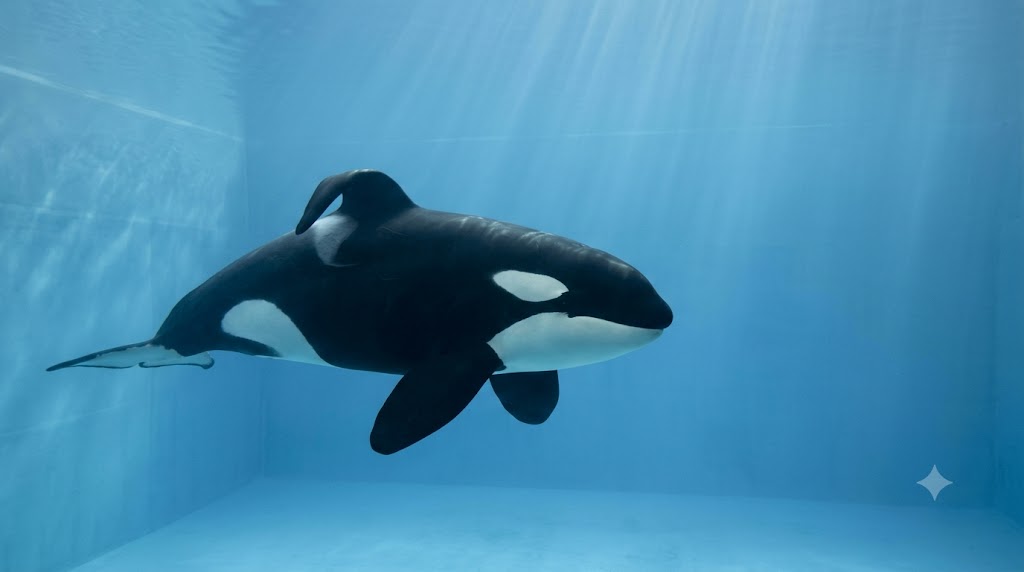
Here is a fact that stops most people cold: in all of recorded history, there has never been a single confirmed case of a wild orca killing a human being. For as long as we have shared the seas with them, these powerful ocean predators have lived alongside people without a single fatal attack in the open water.
And yet one orca, living in captivity, was involved in the deaths of three people. His name was Tilikum — and the question of why would eventually change how the entire world thinks about keeping these magnificent animals in tanks.
This is his story, told with honesty and care.
Stolen From the Sea
In November 1983, in the cold waters off the coast of Iceland, a two-year-old orca calf was captured and torn away from his family. He was barely 13 feet long — a baby. In the wild, he would have stayed beside his mother for his entire life, swimming up to a hundred miles a day within a tight-knit family pod, speaking a dialect of clicks and calls unique to his own bloodline.
Instead, he was sold into a life behind concrete walls. He spent nearly a year in a small holding tank at a marine zoo near Reykjavík, able to do little more than swim in slow circles as he grew. Then, in 1984, he was shipped across the world to Sealand of the Pacific, a marine park near Victoria, Canada.
Conditions there were grim. Tilikum was housed with two older, dominant female orcas, Haida II and Nootka IV, neither of whom was his mother. They frequently bullied and raked him with their teeth. At night, all three whales were locked together in a tiny, dark holding module — a space so cramped that Tilikum could barely move, and could not escape the aggression of his tankmates. Trainers later described him emerging each morning covered in fresh rake marks and wounds. Many scientists believe the stress and confinement of these early years caused him lasting psychological harm.
A Life Marked by Tragedy
Tilikum’s story is inseparable from three human deaths, and they must be told truthfully, because they sit at the very heart of why his life came to matter so much.
The first came in February 1991, when a young marine biology student and trainer named Keltie Byrne slipped and fell into the orcas’ pool at Sealand. She drowned in a tragedy that shook everyone who witnessed it. Soon after, Sealand of the Pacific closed its doors, and Tilikum was sold to SeaWorld in Orlando, Florida, where he arrived in 1992.
At SeaWorld, Tilikum became the park’s star attraction and its most prolific breeding male, eventually siring 21 calves over the course of his life. The second death connected to him came in 1999, when a man named Daniel Dukes was found dead in Tilikum’s pool, having apparently entered the park and gotten into the water after closing hours.
The third, and most widely known, came on February 24, 2010. After a show, Dawn Brancheau — one of SeaWorld’s most experienced and beloved trainers, a woman devoted to the animals she cared for — was interacting with Tilikum at the edge of his pool when he pulled her into the water. Despite the desperate efforts of the staff, she could not be saved. She was 40 years old.
Dawn Brancheau was, by every account, careful, skilled, and deeply passionate about her work. Her death was a profound tragedy that stunned her colleagues, many of whom could not believe that she, of all people, had been the one lost. And it forced an unavoidable question into the open: why would an intelligent animal do such a thing — and was a lifetime of confinement to blame?
The Question That Changed Everything
That stark contrast — an animal gentle for millennia in the wild, yet dangerous in a tank — pointed many scientists, former trainers, and observers toward a painful conclusion. It was not the animal’s nature that had turned deadly. It was what captivity had done to him.
An orca is built to roam vast distances, to dive deep, to live surrounded by family, and to communicate across miles of open water. Tilikum was denied all of it for decades. Confined, understimulated, socially isolated, and under constant psychological strain, something in him appears to have broken. Former trainers who knew him at Sealand remembered a gentle, motivated, curious young whale with a tremendous personality — and watched, over the years, as that personality changed in his sterile confinement.
There is a grim piece of scientific evidence that underscores just how unnatural his life had become. Studies have documented that while only a small number of bacterial species are typically found in wild orcas, captive orcas at SeaWorld were found to carry many times more — a sign of chronically compromised health. And after Dawn Brancheau’s death, Tilikum was often seen floating motionless at the surface of his pool for hours at a time, a listless behavior never observed in wild orcas, who are almost constantly moving, hunting, and socializing.
Blackfish and the “Blackfish Effect”
In 2013, the documentary Blackfish told Tilikum’s story to the world. It traced his capture, his decades of confinement, and the tragedies connected to him, and it asked a simple, devastating question: can it ever be right to keep such intelligent, far-ranging animals in concrete tanks for human entertainment?
The impact was enormous. Public opinion turned sharply against SeaWorld. Attendance and stock value dropped. Sponsors cut ties, musicians canceled scheduled performances at the parks, and protests sprang up across the country. The shift was so powerful and so widespread that it earned its own name — the “Blackfish Effect.”
Under mounting public pressure, SeaWorld announced in 2016 that it would end its orca breeding program, meaning the whales then in its care would be the last generation of orcas born into captivity there. The company also announced it would phase out its theatrical orca shows and stopped allowing trainers in the water with the whales during performances. It was one of the most dramatic reversals in the history of the captive animal entertainment industry — and Tilikum, whose life had sparked it all, was at the very center of the story.
A Quiet, Lonely End
Tilikum spent his final years in declining health, kept largely apart from the public and increasingly isolated. In March 2016, SeaWorld announced that his health was deteriorating, and that he was believed to be suffering from a persistent bacterial lung infection.
On January 6, 2017, after more than three decades in captivity, Tilikum died at SeaWorld Orlando. He was estimated to be around 35 or 36 years old — old for a captive orca, though wild males can live far longer, and the females of some populations can reach their eighties or beyond.
When he passed, the trainers and advocates who had followed his story felt the weight of it deeply. Here was an animal who had killed three people, and yet inspired an extraordinary well of public sympathy. As Blackfish co-writer Tim Zimmerman observed, perhaps the most amazing thing about Tilikum’s story is that a whale involved in three human deaths could leave the world feeling not fear, but compassion — and a determination to do better.
Why Tilikum’s Story Matters
It would be easy to remember Tilikum only as “the whale who killed.” But the truth is far sadder, and far more important. He was a baby stolen from his family and confined for a lifetime in a world that could never meet his needs. The tragedies of his life — and above all the loss of three human beings, especially Dawn Brancheau, whose love for animals was genuine and whose death was a true tragedy — forced humanity to confront hard truths about how we treat the most intelligent creatures in the sea.
We should never forget the people who died. But we also should not forget what Tilikum’s life revealed. Because of him, millions of people changed their minds about marine parks. Because of him, an entire industry began to change its ways. Because of him, fewer orcas will ever have to endure the life he was forced to live.
A baby orca taken from the ocean in 1983 ended up changing the world — and reminding us of something we should never have needed teaching: that freedom, family, and the open sea are not luxuries for these animals. They are everything. And a creature meant to swim the boundless ocean should never have had to spend his life measuring the walls of a tank with his own body.
Tilikum is gone now. But the movement his suffering awakened swims on — and so, perhaps, does the hope that no orca will ever again live and die the way he did.
