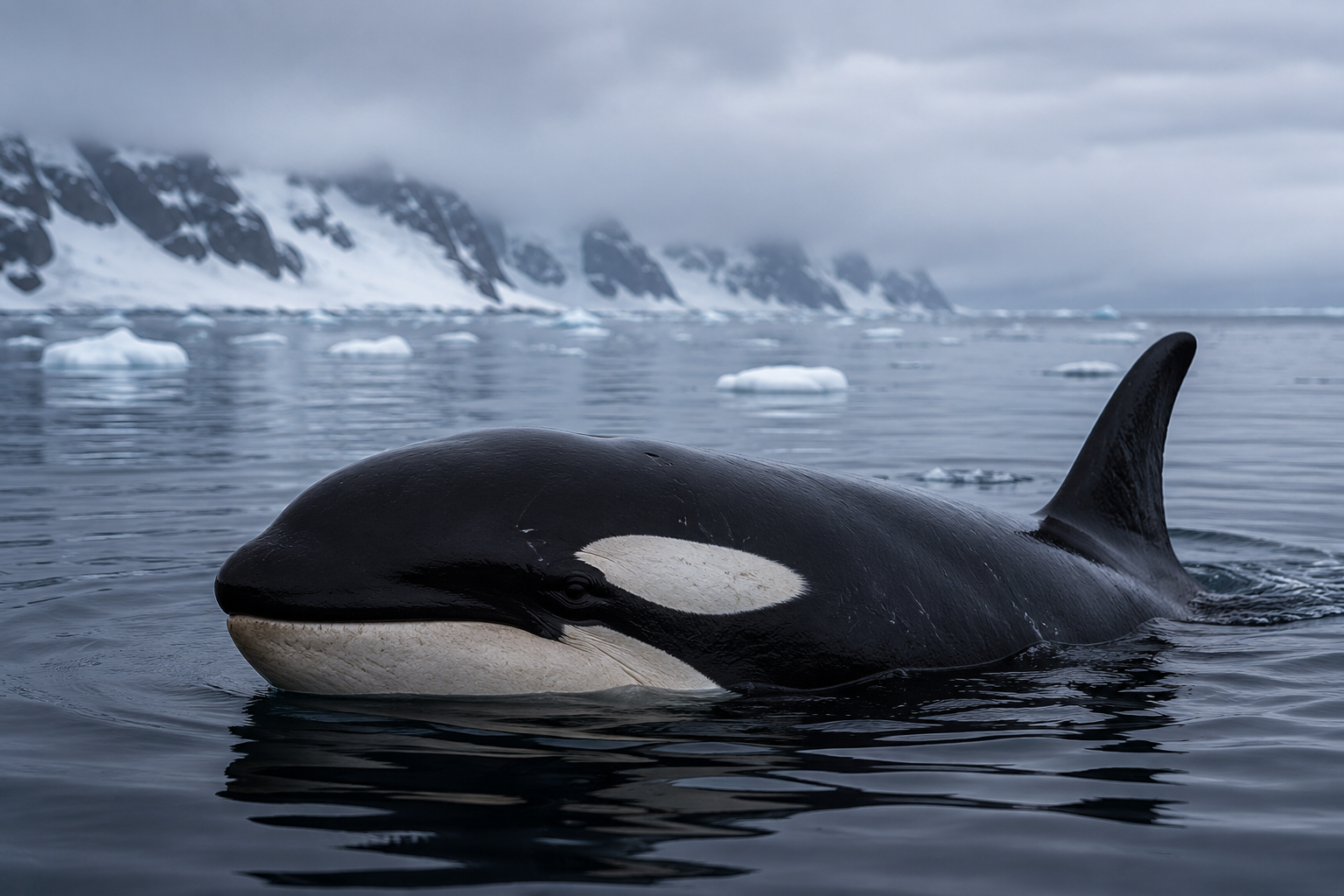
Every morning, she came back.
The same stretch of cold grey water. The same quiet bay. The same empty space between the floating ice and the dark cliffs in the distance.
At first, people thought the orca was simply passing through. Orcas are powerful travelers, built for long distances, and seeing one surface in northern waters is not always unusual. But this female did not behave like a whale moving on.
She stayed.
She surfaced slowly, circled the same patch of water, and lifted her head as if listening for something no one else could hear. Then she would disappear beneath the surface, only to return again later.
Day after day, the same pattern repeated.
The water around her was empty.
And that emptiness was what made the scene so haunting.
A Mother Alone in the Cold
Orcas, also known as killer whales, are not solitary animals by nature. They are among the most social and intelligent animals in the ocean. Many live in family groups called pods, and those groups are often built around maternal lines — mothers, calves, siblings, and relatives moving through the sea together. NOAA describes killer whales as highly social animals, with many living in pods made up of maternally related individuals.
That is why the sight of a lone mother orca can feel so emotional.
A mother orca is not just a large predator in the ocean. She is a teacher, protector, guide, and source of comfort for her calf. In some populations, young orcas remain close to their mothers and family groups for many years, and Southern Resident killer whales are known for staying with their mothers and families throughout their lives.
So when a mother returns to one place again and again, people naturally wonder why.
Was she searching?
Was she waiting?
Or was she calling for someone who would never answer?
The Calls No One Could Ignore
The most heartbreaking part was not how she looked.
It was the sound.
Witnesses described the orca pausing near the surface, almost motionless, before releasing long calls across the cold water. There was no calf beside her. No other orcas came close. Only the sound moved through the bay.
Whales use sound to communicate, socialize, locate food, and find each other. NOAA notes that whales make clicks, whistles, and pulsed calls, and that sound is one of the most important tools whales use in the ocean.
For an orca mother, sound can mean contact.
It can mean location.
It can mean family.
That is why the scene felt so painful to those who saw it. The mother was not attacking. She was not hunting. She was not performing for anyone.
She was calling into empty water.
And nothing called back.
Why People Believed She Was Searching for Her Calf
No one can step inside the mind of an orca and know exactly what she feels. Scientists are careful about using human words like grief, sadness, or heartbreak when describing animal behavior.
But some behaviors are difficult to watch without feeling that something emotional is happening.
In 2018, a Southern Resident killer whale known as J35, or Tahlequah, made headlines around the world after carrying her dead calf for 17 days. NOAA later referenced that event again when reporting on another calf loss, noting that J35 had made an impression around the world for carrying her dead calf for 17 days.
That moment changed how many people thought about orcas.
It reminded the world that these animals are not machines moving through the sea by instinct alone. They live in families. They remember. They communicate. They react to loss in ways that can look painfully familiar.
So when people saw this lone mother returning to the same water, they began to ask a painful question:
Was this the last place she had been with her calf?
The answer may never be known with certainty.
But the behavior was impossible to ignore.
The Empty Space Beside Her
In wildlife, sometimes the most powerful thing in a scene is not what is there.
It is what is missing.
A mother orca with a calf beside her looks complete. The calf usually stays close, moving beside the mother’s body, learning the rhythm of breathing, diving, traveling, and surviving. The mother’s presence is safety. Her body is protection. Her voice is guidance.
But in this cold bay, the water beside the mother was empty.
That empty space became the story.
She moved slowly through it. She circled it. She surfaced in it. She seemed to return to it as if the water itself still held a memory.
To some, it looked like instinct.
To others, it looked like grief.
Maybe it was both.
The Bond Between an Orca Mother and Her Calf
The relationship between an orca mother and her calf is one of the strongest bonds in the ocean.
A calf depends on its mother for food, protection, social learning, and survival. The mother helps the young whale understand the pod’s calls, movements, hunting methods, and routes through the sea. In orca society, knowledge is not just born into the body — it is passed down.
That makes separation deeply significant.
For humans watching from shore, it is easy to see only a large black-and-white animal. But inside that body is a social creature shaped by relationships.
An orca calf is not just offspring.
It is family.
And for a mother, losing that calf may change everything.
A Story Inspired by Real Orca Behavior
This story is inspired by real orca behavior and the powerful bonds scientists have observed between mothers and calves. It is not meant to claim that one specific named orca was documented in this exact scene. Instead, it reflects something real that researchers, rescuers, and whale watchers have seen again and again:
Orcas are emotional, social, intelligent animals whose family bonds run deep.
That is what makes stories like this so moving.
The image of a mother returning to the same water is not powerful because it is dramatic. It is powerful because it is quiet. There is no chase. No attack. No storm. No blood.
Just a mother.
A cold sea.
And a call that never receives an answer.
Why This Story Touches So Many People
People connect with wildlife stories when they recognize something human inside them.
Not because the animal is human.
But because love, attachment, and loss are not ideas that belong only to us.
A mother waiting for her young is something every person can understand. A call into silence is something every heart recognizes. A return to the last place where someone was seen is one of the oldest forms of grief.
That is why this orca’s story stays with people.
It does not need to explain everything.
It only needs to show the empty water.
The Ocean Does Not Always Give Answers
Eventually, the orca would dive.
Her black dorsal fin would slip beneath the surface. The ripples would widen. The cold water would close over her back.
For a moment, the bay would look completely still again.
But anyone who had watched her return would know that the silence was not empty.
It carried a question.
What was she waiting for?
Who was she calling?
And how long does a mother keep searching after the sea has taken what she loves?
Maybe the answer is something science will one day understand more clearly. Maybe it is something we can only feel from a distance.
But one thing is certain:
When an orca mother returns to the same water again and again, people remember.
Not because she was dangerous.
Not because she was powerful.
But because, for a few quiet moments, the ocean showed us something heartbreaking.
A mother who would not stop coming back.
A voice calling across the cold water.
And beside her, the space where her calf should have been.
