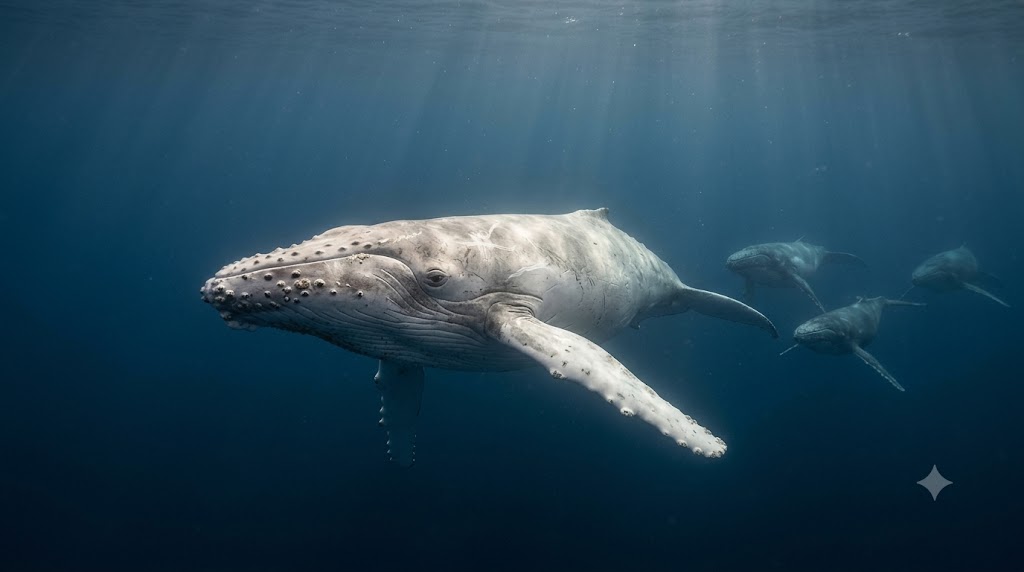
Somewhere in the vast, trackless ocean, an old whale is leading her family along a path she cannot see. There are no landmarks out here, no signs, no roads — only endless water in every direction. And yet she knows exactly where to go: which way to turn, where the food will be this season, which ancient route her ancestors have followed for longer than human civilization has existed.
She is the oldest female in her family, the matriarch. And within her mind she carries something priceless and invisible — a living map, built over a lifetime, that keeps her entire family alive. But here is the heartbreaking truth that scientists have only recently come to understand: when she dies, that map can die with her. And her family may lose their way.
The Grandmothers of the Sea
For a long time, we assumed the ocean’s great animals were guided mostly by instinct. The reality is far more moving. In some of the most intelligent species in the sea — orcas, or killer whales, chief among them — survival depends not on instinct alone, but on knowledge. And that knowledge lives inside the elders.
Killer whales are among only a tiny handful of animals on Earth known to go through menopause. Females stop reproducing in their thirties or forties, yet they can live into their eighties, nineties, or beyond. In almost all of the animal kingdom, this makes no evolutionary sense — an animal that can no longer reproduce should, in theory, fade away. So why do these grandmothers live for decades after their last calf?
Scientists at the Center for Whale Research and the University of Exeter spent years studying this puzzle, following wild orca families off the Pacific Northwest across generations. Their answer is beautiful. These old females survive so long because they are far too valuable to lose. As researcher Darren Croft put it, these elder females act as “repositories of ecological knowledge” — living libraries of where and when to find food, especially when times are hard.
In other words, a grandmother whale is her family’s memory.
A Living Library of Survival
Imagine everything an old whale learns across eighty years of life. She remembers the years the salmon ran thin, and where the last few fish could still be found. She knows the hidden feeding grounds that only appear in certain seasons, the routes that lead to safety, the timing of the great migrations. None of this is written down. None of it is instinct. It is learned, remembered, and carried in a single mind.
The evidence for how much the family relies on her is striking. Researchers found that during years when salmon were scarce, it was almost always the oldest females who swam at the front of the group, leading the hunt. When food was plentiful, the pod spread out; when food was scarce, they followed their grandmother. The pod leaned on her wisdom precisely when survival was hardest — exactly as, before maps and Google, human communities in times of drought or famine would turn to their eldest members to remember where water and food could be found.
The whales, it turns out, do the very same thing. Their elders are their encyclopedias, their navigators, their guides.
When the Map Dies
And this is where the story turns tragic.
Because so much irreplaceable knowledge lives inside a single aging animal, her death is not just an emotional loss for the family — it can be a matter of life and death. In one of the most sobering findings of the research, scientists discovered that when a grandmother orca dies, the risk of death for her grandcalves rises dramatically in the years that follow. A young whale that loses its grandmother is significantly more likely to die itself.
Think about what that means. It is not simply that the family grieves — though they almost certainly do. It is that they lose the one who knew the way. Without her, they may struggle to find food in a lean year. They may hesitate at a crossroads in the open sea where she would have turned without a moment’s doubt. The map that took eight decades to build vanishes in an instant, and everyone who depended on it is left more vulnerable than before.
A lifetime of learning, gone. And no way to get it back.
Knowledge That Outlives Generations
The most staggering part is the sheer timescale of what these animals carry. Whale families follow migration routes and cultural traditions that are passed down from mother to calf across countless generations — patterns of movement and behavior that may stretch back not just decades, but centuries or even thousands of years.
Each generation inherits the map from the one before. A calf learns the routes by swimming them beside her mother and grandmother, year after year, until the knowledge becomes part of her too. This is not biology written in genes — it is culture, taught and remembered, handed down through living memory in an unbroken chain. When scientists talk about whale “culture,” this is what they mean: knowledge that exists only because one generation took the time to teach the next.
But a chain is only as strong as its links. If an old matriarch dies before she has fully passed on what she knows — if she is lost too soon, before a daughter or granddaughter has learned the routes by heart — then a thread of knowledge thousands of years in the making can simply snap. And once it is broken, it may never be recovered.
A Warning in Our Time
This is not just a poignant fact of nature. In our era, it has become an urgent warning.
The very orca families that taught us about grandmother wisdom — the Southern Resident killer whales of the Pacific Northwest — are now critically endangered, with only around 70-some individuals left. Their survival is tied to the salmon they depend on, and those salmon are disappearing. In hard times like these, the knowledge held by the oldest females matters more than ever — and yet these are exactly the conditions in which whales are most likely to die.
Every time an old matriarch is lost — to hunger, to pollution, to a ship strike, to the simple toll of age in a world we have made harder for her — we may be losing far more than a single animal. We may be losing a library that can never be rebuilt. A map of the ocean that existed nowhere else but inside her mind.
It is a quiet kind of extinction, one that doesn’t show up in the population counts right away: the extinction of knowledge. A family can still have members and still, in a sense, be lost — because the one who remembered the way is gone.
The Weight of a Single Life
We tend to think of a single animal’s death as a small thing against the vastness of nature. The story of the whale matriarch tells us otherwise. In these ancient, intelligent families, one life can hold the accumulated wisdom of a thousand years. One mind can carry the difference between a family that thrives and a family that starves.
There is something profoundly humbling in that. These are creatures that build no monuments and write no books, yet they pass down knowledge across the generations as carefully as any human culture ever has — entirely through memory, patience, and the bond between an old grandmother and the young who follow in her wake.
So picture her once more: the old whale at the head of her family, leading them through the endless blue toward a place only she remembers. She is tired now, and slower than she once was. But as long as she swims, her family has their map. Their guide. Their memory made flesh.
And when at last she is gone, the greatest hope for those she leaves behind is a simple one — that somewhere in the pod swims a young female who watched, and followed, and learned the way. So that the map lives on. So that the song of the route does not fall silent. So that the knowledge of a thousand years finds one more mind to call home.
Because in the ocean, as in our own world, the wisdom of the elders is the most precious inheritance of all — and the easiest, if we are not careful, to lose forever.
