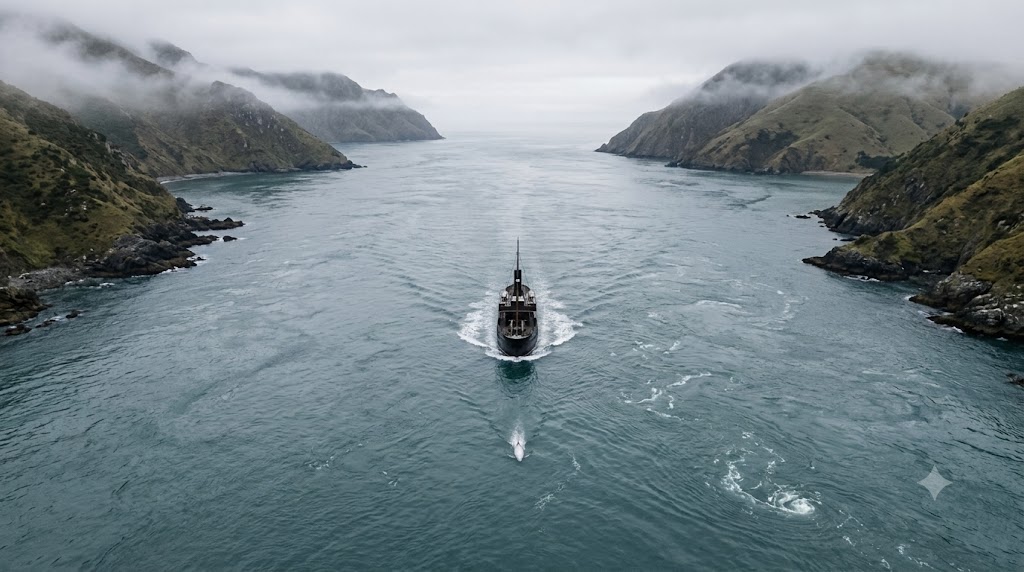
For nearly a quarter of a century, sailors crossing one of the most dangerous stretches of water in the world were met by an unlikely guardian. Not a lighthouse. Not a harbor pilot. A dolphin.
He appeared out of the grey New Zealand sea, alone, and swam at the bow of passing ships — steering them safely through a channel that had swallowed countless vessels before him. He did this, faithfully, for 24 years. Ships would wait for him. Sailors trusted him with their lives. A world-famous author crossed an ocean just to see him. And then, one day in 1912, he simply disappeared — and to this day, no one knows for certain what happened to him.
His name was Pelorus Jack. And his story is one of the strangest and most touching true tales the ocean has ever given us.
A Guardian Appears
The first recorded meeting happened around 1888, near a treacherous channel called French Pass, off the coast of New Zealand’s South Island. A schooner named the Brindle was approaching the passage when the crew spotted a large, pale dolphin bobbing in the water ahead of the bow.
According to the story that has been passed down, some of the sailors’ first instinct was to kill it — a grim reflex of the era. But the captain’s wife, horrified, begged them to spare the animal. They relented. And then something remarkable happened: instead of fleeing, the dolphin took up position at the front of the ship and guided it safely through the narrow, rock-strewn channel.
It was the beginning of a relationship that would last a generation.
The Deadliest Water in the Region
To understand why Pelorus Jack mattered so much, you have to understand where he worked.
French Pass is a slender channel between D’Urville Island and the New Zealand mainland, and it is genuinely dangerous. The tide surges through the gap at speeds of up to eight knots, creating violent currents, swirling whirlpools, and submerged rocks that had claimed many ships over the years. For the vessels traveling between Wellington and Nelson, it was one of the most nerve-wracking stretches of the entire voyage.
And yet, for as long as Pelorus Jack was there to meet them, not a single ship is recorded as having wrecked while under his guidance. He would join a vessel near Pelorus Sound, ride alongside its bow for around twenty minutes — the time it took to cross Admiralty Bay — and then peel away, leaving the ship in safe water. So reliable was he that captains reaching the entrance would sometimes stop and wait, refusing to attempt the passage until their pale escort appeared.
What Kind of Dolphin Was He?
Part of what made Pelorus Jack so striking was that he didn’t look like the dolphins most people knew.
He was a Risso’s dolphin — a species rarely seen in New Zealand waters, and unusual-looking even among its own kind. Around four meters (13 feet) long, he had a blunt, rounded head with no beak at all, and skin that had turned a pale, ghostly white-silver with age. His body was covered in a fine web of grey scratches and scars, the natural markings that Risso’s dolphins accumulate over a lifetime. To the sailors who saw him gliding through the dark water, he must have looked almost otherworldly — a white shape moving with impossible grace at the head of their ship.
Confusion about him was common. One reverend who glimpsed him reported the wild rumor that the creature had “the tail of a shark, the fins of another fish, and the head of another.” It was only later, from photographs, that scientists confirmed what he truly was.
Why Did He Do It?
This is the question that has fascinated people for over a century, and the honest answer is: we don’t fully know.
The romantic explanation — the one the sailors believed — was that Jack was a selfless guardian who had appointed himself protector of the ships. The scientific explanation is more modest but no less charming. Dolphins love to ride the invisible pressure wave that a moving ship pushes ahead of and beneath its hull — essentially a free, effortless surf. Pelorus Jack, many researchers believe, was simply a lone dolphin who discovered that ships passing through his home range offered a wonderful ride, and returned again and again for the thrill of it.
There may be a sadder truth underneath, too. Because his 24-year career roughly matches a Risso’s dolphin’s natural lifespan, experts think Jack was probably a very young calf in 1888 — possibly one orphaned or separated from his pod before he was even weaned. A lone young dolphin, cut off from his own kind, may have found in the steady parade of ships something to accompany. A substitute, perhaps, for the family he had lost. It is impossible to know — but it gives his lonely devotion an ache that is hard to shake.
Fame, and a Gunshot
By the early 1900s, Pelorus Jack was famous across the world. Newspapers wrote about him. Postcards bearing his image were sold and mailed around the globe. In 1906 the London Daily Mail declared that no steamer passed through the Sound without being met by “a large white fish, part shark, part dolphin.” Tourists sailed from Australia and beyond specifically to catch a glimpse of him — and among them, famously, was the American writer Mark Twain, who traveled to see the celebrated dolphin for himself.
But fame could not protect him from human cruelty. Sometime around 1904, a passenger aboard a steamer called the SS Penguin pulled out a rifle and shot at Pelorus Jack. The crew, according to accounts, were so enraged that they nearly turned on the shooter themselves. The dolphin disappeared, trailing blood, and for a time it was feared he was dead.
Then, weeks later — miraculously — he came back. Wounded but alive, he resumed his work, guiding ships through the pass as before. With one telling exception. From that day on, Pelorus Jack reportedly refused to escort the SS Penguin. Whenever that particular ship approached, he was nowhere to be seen.
The Legend of the Penguin
What happened next has become the eeriest part of his legend.
Years after the shooting, in 1909, the SS Penguin attempted the crossing — still, as the story goes, without Jack’s guidance. This time, the ship struck a rock and sank in Cook Strait in a terrible storm, with the loss of dozens of lives. It remains one of New Zealand’s worst maritime disasters.
To the people of the time, the message seemed almost supernatural: the one ship the guardian dolphin had turned his back on was the one ship that met catastrophe. Whether coincidence or something stranger, the tale only deepened the aura of near-mythical significance that had grown around him.
The First Dolphin Protected by Law
The attempt on his life had one lasting, historic consequence. Public outrage was so intense that the New Zealand government took an unprecedented step. On September 26, 1904, an Order in Council was signed making it illegal to harm Pelorus Jack, with a heavy fine for anyone who tried.
With that single decree, Pelorus Jack became, as far as anyone knows, the first individual sea creature in the world to be protected by law. The order was renewed twice, and remained in force until the day he vanished. For the Māori of the region, this only confirmed what they had long believed — that Jack was no ordinary animal, but a taniwha, a guardian sea-spirit. According to one tradition, he was the reappearance of Tuhirangi, a guardian placed in Cook Strait by the great navigator Kupe to protect canoes crossing those dangerous waters, centuries before.
The Mystery of His Disappearance
In April 1912, after 24 years of faithful service, Pelorus Jack was seen for what would be one of the last times. Ships arrived at the pass and waited for him, as they always had. But he never came.
For days, sailors watched for the familiar pale shape at their bows. It did not appear. And slowly, the awful realization settled in: the guardian of French Pass was gone.
What became of him has never been confirmed, and several theories compete to this day. The gentlest and most likely is simply old age — by 1912 he would have been at least 24, an elderly dolphin whose whitened head and pale body already bore the signs of a long life. Some believed he was harpooned by foreign whalers passing through the region. Others speculated he was cut by the barnacle-crusted hull of a ship, being always so close to the plates. One lighthouse keeper claimed a dolphin’s body had washed up and rotted on a nearby beach. None of it was ever proven. He simply left, the way he had arrived — quietly, out of the grey sea — and never returned.
A Legend That Never Died
More than a century later, Pelorus Jack has not been forgotten. He inspired songs, a Scottish country dance, and even a chocolate bar named in his honor. A short film of him guiding a ship still survives in New Zealand’s archives — grainy, flickering proof that the legend was real. And today, a dolphin still serves as the official emblem of the Interislander ferries that cross the very strait he once patrolled, so that in a sense, Pelorus Jack guides the ships across Cook Strait still.
His story endures because it touches something deep in us. A lone creature, possibly orphaned, who spent his entire life at the bows of our ships — asking for nothing, guiding us through danger, trusting us even after we hurt him. In an age when we too often see ourselves as separate from the natural world, Pelorus Jack is a reminder that the bond between humans and animals can be real, mysterious, and profound.
He was, in the truest sense, a guardian. And somewhere in the grey waters of French Pass, if you believe the old Māori stories, he is guarding still.
