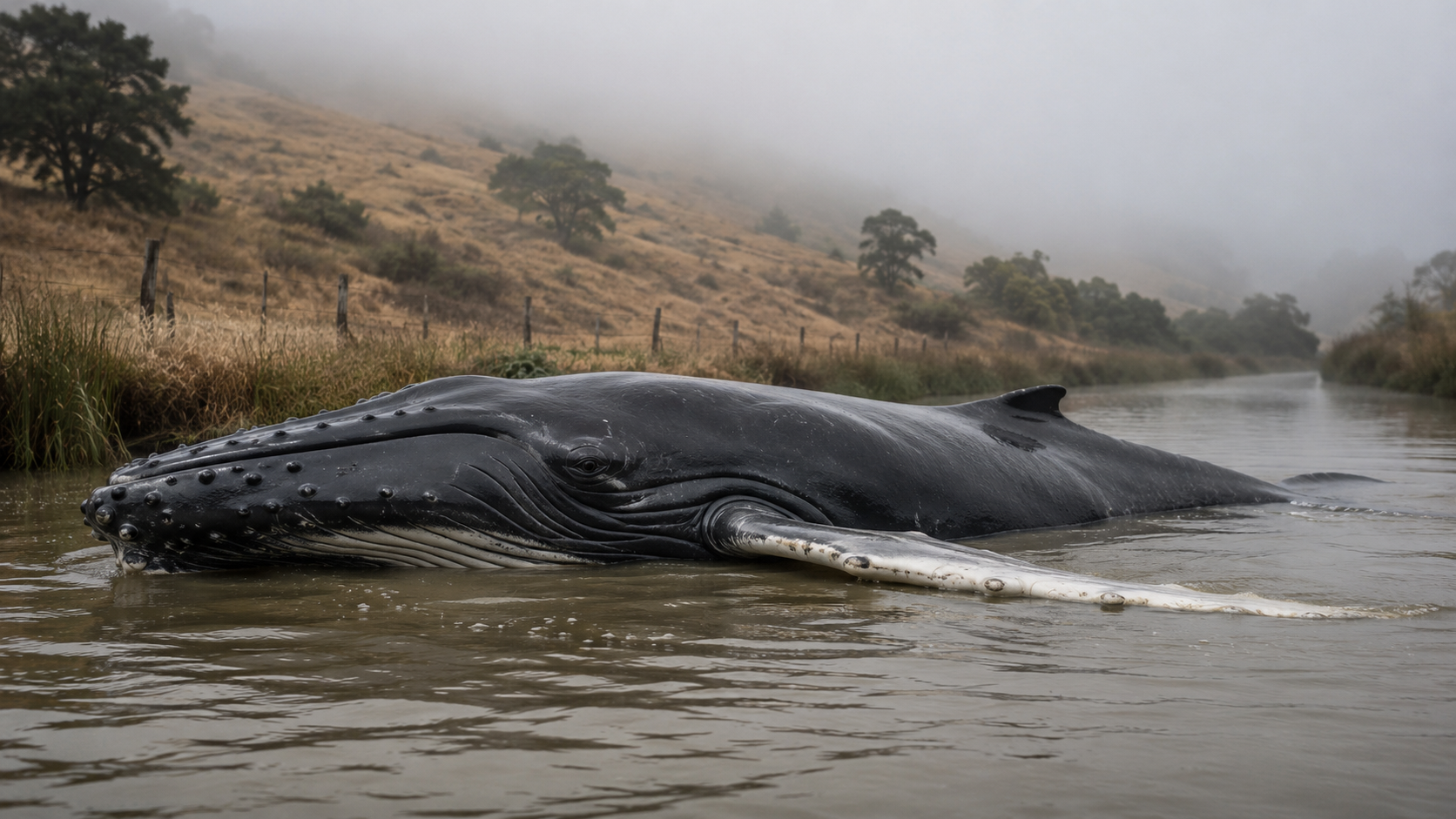
In October 1985, a whale appeared where a whale was never supposed to be.
He was not in the open Pacific, where humpbacks belong during their long migrations.
He was not feeding in cold northern waters or passing along the California coast.
He was inside San Francisco Bay.
Then he kept going.
The whale, later nicknamed Humphrey, swam through the Carquinez Strait and into the Sacramento River system, moving deeper and deeper inland. By the time the story became a national obsession, this giant of the ocean was far from the sea, surrounded not by endless blue water but by riverbanks, bridges, mud, reeds, and human worry.
For nearly a month, America watched one question unfold:
How do you tell a lost whale where home is?
## A Giant in the Wrong World
Humphrey was a humpback whale, one of the most recognizable whales on Earth.
Humpbacks are built for the ocean. They are known for their long, wing-like pectoral fins, which can reach about one-third of their body length, and for the unique black-and-white patterns on the underside of their tail flukes. Scientists use those fluke patterns almost like fingerprints to identify individual whales. NOAA also notes that humpbacks have long white pectoral fins and a small dorsal fin compared with other large whales. :contentReference[oaicite:1]{index=1}
That is what made Humphrey’s journey feel so strange.
This was not a small animal wandering into a stream.
This was a massive ocean traveler inside a human-shaped waterway.
Reports from the time described Humphrey as about 40 feet long. He had entered San Francisco Bay, then continued inland until he reached the Sacramento Delta near Rio Vista, roughly 70 miles from the Pacific Ocean. :contentReference[oaicite:2]{index=2}
For people watching from shore, it must have looked impossible: a whale’s dark back rising from muddy inland water, its breath hanging in the air, its huge body turning in places too narrow for an animal of the open sea.
## The Whale America Couldn’t Stop Watching
Humphrey quickly became more than a local story.
Television crews followed him. Crowds gathered. Scientists debated what to do. Boats tried to guide him. People who had never thought much about whales suddenly found themselves checking the news to see whether one lost animal had made it another mile closer to the sea.
That is why Humphrey’s story still works today.
It is not only about a whale.
It is about the strange way humans react when a wild animal becomes vulnerable in front of us.
A whale in the ocean feels powerful.
A whale trapped inland feels heartbreakingly fragile.
The same animal that can cross entire seas suddenly seemed lost, tired, and dependent on people who were not completely sure how to help.
## Why Freshwater Was a Problem
The danger was not only that Humphrey was lost.
It was where he was lost.
Humpback whales live in saltwater. Their bodies are adapted to marine environments, long migrations, ocean feeding grounds, and open-water movement. Spending too much time in freshwater can become stressful for a marine mammal, especially when combined with shallow channels, boat traffic, confusion, and lack of proper feeding opportunities.
As the days passed, concern grew. Humphrey was not simply taking a scenic detour. The longer he stayed inland, the more urgent the rescue became.
But moving a whale is not like moving a boat.
You cannot grab it.
You cannot command it.
You cannot explain the danger.
Rescuers needed something Humphrey might understand.
They turned to sound.
## The Strange Rescue Plan
The most memorable part of Humphrey’s rescue was the use of a “sound net.”
According to the City of Rio Vista’s account, rescuers used a flotilla of boats behind the whale to create unpleasant sounds by banging on steel pipes. This was meant to discourage Humphrey from turning back inland. At the same time, attractive sounds of humpback whales preparing to feed were broadcast from a boat moving toward open water. :contentReference[oaicite:3]{index=3}
It sounds almost unbelievable.
Behind him: noise he wanted to avoid.
Ahead of him: the sound of other humpbacks feeding.
In simple terms, people tried to build a path out of sound.
Not a wall.
Not a fence.
A sound corridor.
For a whale, that made sense in a way humans often forget. The underwater world is deeply acoustic. Sound travels far in water, and whales use sound as part of their lives in ways we are still learning to understand.
Humphrey did not need a map.
He needed a signal.
## The Song That Led Him Back
On November 3, 1985, the sound strategy finally helped change the story.
Recordings of humpback whales feeding were played underwater, and Humphrey began following the sound toward the bay and the open ocean. SFGATE’s historical account describes how sound engineer Bernie Krause helped prepare the humpback feeding audio so it would feel more natural, and the whale responded quickly once the recording was played. :contentReference[oaicite:4]{index=4}
That is the emotional center of the story.
A lost whale did not read signs.
He did not understand the crowds or the headlines.
He did not know that people across the country were worrying about him.
But he understood the sound of his own kind.
And he followed it.
After days of confusion, false turns, and human uncertainty, Humphrey finally made his way back toward the Pacific.
The giant that had been trapped in a world of mud, bridges, and riverbanks returned to the open sea.
## Why People Still Remember Humphrey
Humphrey’s story did not end in 1985.
He returned to San Francisco Bay again in 1990 and became stuck on a mudflat near what was then known as 3Com Park. He was rescued again with help from The Marine Mammal Center, the Coast Guard, and others. According to Rio Vista, Humphrey was last seen near the Farallon Islands in 1991. :contentReference[oaicite:5]{index=5}
But the reason people remember him is not simply because he got lost twice.
They remember him because his story felt personal.
Humphrey became a symbol of how quickly a wild animal can enter human life and change the mood of an entire region. For a few weeks, a whale became front-page news not because he attacked anything, performed tricks, or lived in captivity — but because he was lost.
People wanted him to survive.
They wanted him to find the ocean again.
They wanted the story to end with a tail disappearing into saltwater.
## The Detail That Makes the Story Powerful
The most powerful part of Humphrey’s story is not that humans saved him.
It is how they saved him.
They did not defeat the whale’s confusion with force.
They used sound.
They used something connected to the animal’s own world.
That is why this story is so different from many rescue stories. It was not only about human effort. It was about learning enough about a whale to communicate in the only way that might matter underwater.
A lost humpback followed the sound of other humpbacks home.
That sentence is simple.
But it carries the whole story.
## A Whale Between Two Worlds
Imagine the scene.
A huge dark back rising in muddy river water.
A breath cloud drifting over reeds.
People standing on the shore, watching an ocean animal move through a place that felt too small for him.
Then, days later, the same whale heading back toward the Golden Gate, toward saltwater, toward the open Pacific.
For Humphrey, the journey was probably confusion, stress, and instinct.
For humans, it became something else.
A reminder that the ocean is not separate from us.
Its animals can enter our world suddenly, helplessly, and without warning. When they do, the question is not only whether we can help.
The question is whether we can listen closely enough to understand what kind of help they need.
Humphrey was lost.
Then somewhere in the water, a sound began to play.
And the whale followed the song home.
