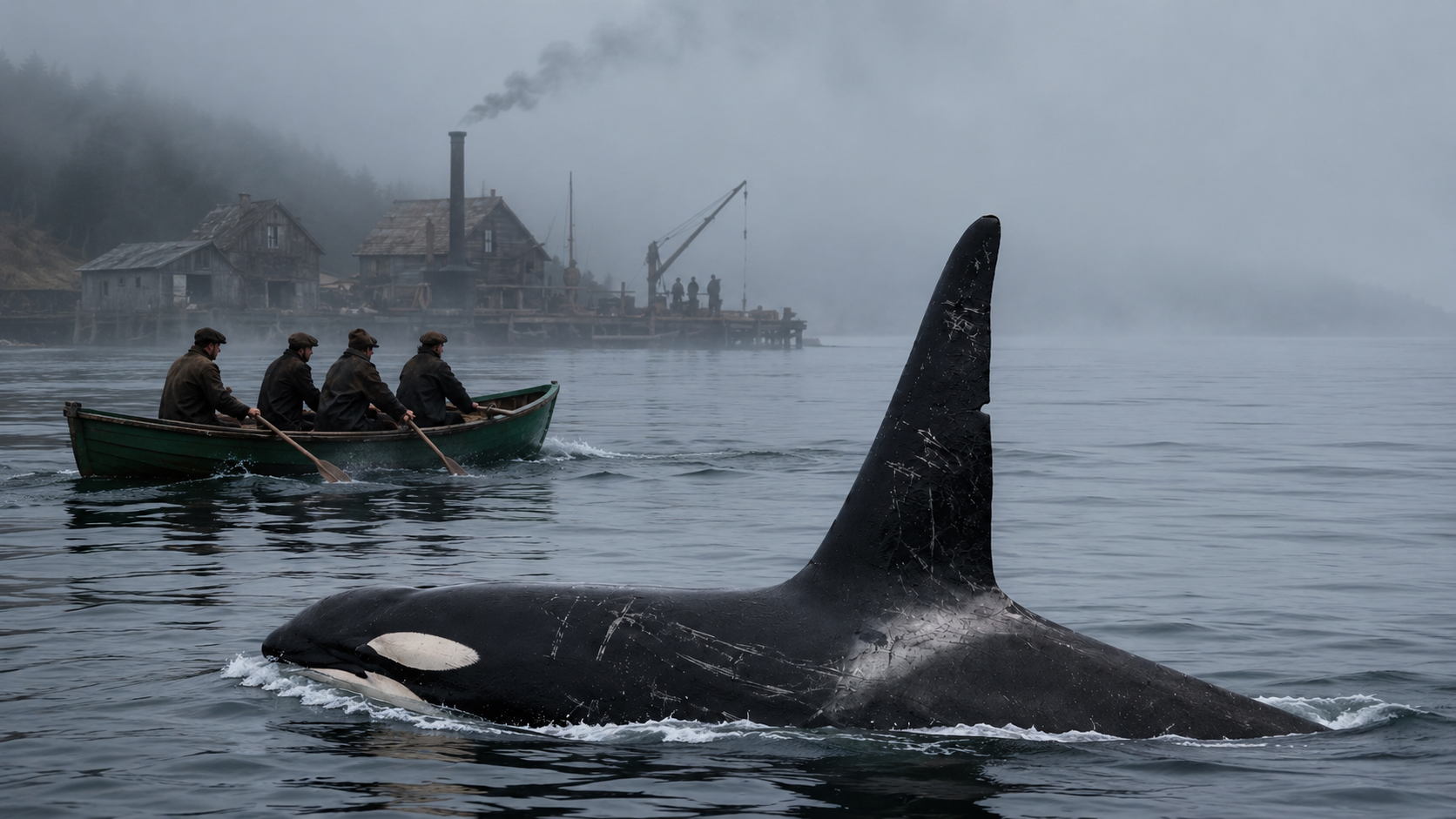
Some animal stories sound like legend.
A wolf that guides a hunter through the forest.
A dolphin that leads fishermen to fish.
A whale that returns to the same bay every year, not to flee humans — but to work beside them.
But the story of Old Tom was not just a myth passed around a seaside town.
Old Tom was a real orca from Eden, New South Wales, Australia. He became famous for his role in one of the strangest relationships ever recorded between humans and wild animals: a cooperative hunting partnership between killer whales and human whalers in Twofold Bay.
For generations, the people of Eden told stories about a pod of orcas known as the “Killers of Eden.” These orcas did not simply appear near the boats. They were said to help herd baleen whales into the bay, alert whalers when prey was nearby, and even take part in the chase. Of all those animals, Old Tom became the most famous. The Eden Killer Whale Museum describes him as a male orca measuring about 6.7 metres long and weighing around six tons, recognised by his tall dorsal fin.
## A Partnership Almost Too Strange to Believe
In most whaling stories, humans are the hunters and whales are the hunted.
But Eden’s story was different.
The orcas were hunters too.
According to the Eden Killer Whale Museum, Old Tom and other orcas helped herd passing whales into Twofold Bay. They would alert whalers, take part in the chase, and sometimes swim alongside the boats. Old Tom was even known for swimming to the mouth of the Kiah River and “flop-tailing” to signal the presence of a whale.
This was not a trained animal performing tricks.
These were wild orcas.
They came and went on their own terms.
The relationship was built around mutual benefit. The whalers wanted the whale carcass. The orcas wanted the parts they valued most: the lips and tongue. That arrangement became known as the “Law of the Tongue.” Flinders University’s 2023 research summary describes how Old Tom and his family helped whalers hunt their target and were rewarded with the lips and tongues from the whale carcass.
It is a brutal story, but also an extraordinary one.
Because beneath the violence of the whaling era, there was something science still finds remarkable: wild orcas and humans coordinating around the same hunt.
## Old Tom Was Not Alone
Old Tom is the name people remember, but he was part of a larger group.
The “Killers of Eden” were a pod, or group of orcas, that became famous around Twofold Bay. Historical accounts describe multiple named orcas, recognised by their dorsal fins and markings. Sapphire Coast tourism notes that whalers could identify individual killer whales by their distinctive dorsal fins, with names including Old Tom, Big Ben, Little Ben, Typee, and others.
This is important because it means the story was not just about one unusually bold animal.
It was about a local orca culture.
Orcas are highly intelligent members of the dolphin family, with complex social systems and learned hunting behaviours. In Eden, that social knowledge appears to have included a relationship with humans — one that passed through generations of both whales and whalers.
But modern research adds an even deeper layer.
A 2023 genetic study led by researchers from Flinders University and collaborators sequenced DNA from Old Tom’s preserved remains. The study found that Old Tom was genetically closest to modern New Zealand killer whales, while much of his DNA variation was not found in sampled orcas around the world. Researchers suggested the Eden killer whale group may now be locally extinct.
That makes the story feel even heavier.
Old Tom was not just a famous animal.
He may have been one of the last visible members of a lost local lineage.
## The Indigenous History Often Left Out
For a long time, the story of Old Tom was told mainly through the lens of European whaling families.
But newer research has emphasized that the relationship between people and orcas in the region did not begin with European commercial whaling.
Flinders University’s report highlights Traditional Custodian knowledge from the Thaua people of the Yuin Nation. According to Traditional Custodian Steven Holmes, the Thaua people considered killer whales — “beowas” — to be brothers, and Dreaming stories connected the people and the whales. The research notes that Indigenous Australians initiated the relationship with the killer whales before European colonisation and before commercial whaling in the area.
That detail changes the story.
Old Tom was not simply an orca who helped whalers.
He was part of a much older human–orca relationship, one that colonial records did not always understand or accurately preserve.
## The End of Old Tom
On 17 September 1930, Old Tom’s body was found floating in Twofold Bay. His remains were recovered and prepared for public exhibition, becoming central to what is now the Eden Killer Whale Museum.
His skeleton is still part of Eden’s identity today. In 2024, ABC News reported that Old Tom’s skeleton was carefully disassembled, conserved, and reassembled into a more natural swimming pose at the museum. The work was done because the skeleton is fragile, historically important, and known far beyond the town itself.
There are many theories about why the Killers of Eden disappeared.
Some point to the decline of whales, changes in whaling, the death of pod leaders, or the end of the old hunting relationship. Sapphire Coast notes that by around 1930 whaling had ceased, and theories about the disappearance of the killer whales include dwindling food sources, the death of leaders, and the end of the whaling activity they had once joined.
Whatever the exact cause, the result was clear.
The orcas that once made Eden famous were gone.
## Why This Story Still Feels So Powerful
The story of Old Tom is not simple.
It is not just beautiful.
It is not just dark.
It is both.
It is a story about intelligence, survival, culture, hunting, trust, exploitation, and memory.
To modern eyes, the idea of orcas helping humans hunt whales can feel uncomfortable. It should. Whaling caused enormous suffering and changed ocean ecosystems. But ignoring the discomfort would also erase what makes the story so unusual.
Old Tom’s life sits at the edge of two worlds.
One world is the old whaling era — dangerous boats, harpoons, smoke from shore stations, and men waiting for signals from the sea.
The other world is the hidden social world of orcas — animals capable of learning, cooperating, remembering, and building traditions that may vanish when a local population disappears.
That is why Old Tom still matters.
He reminds us that the ocean has histories we barely understand.
Some are written in museum bones.
Some are carried in DNA.
Some survive only in the stories of coastal people who watched the same black fins return, season after season.
Old Tom was not a pet.
He was not trained.
He was a wild orca who entered human history on his own terms — and left behind one of the strangest true stories ever told about the relationship between people and the sea.
## Sources
This article is based on historical information from the Eden Killer Whale Museum, recent genetic research reported by Flinders University, the 2023 Old Tom ancestry study, ABC News coverage of Old Tom’s museum display, and Sapphire Coast historical material about the Killer Whale Trail.
