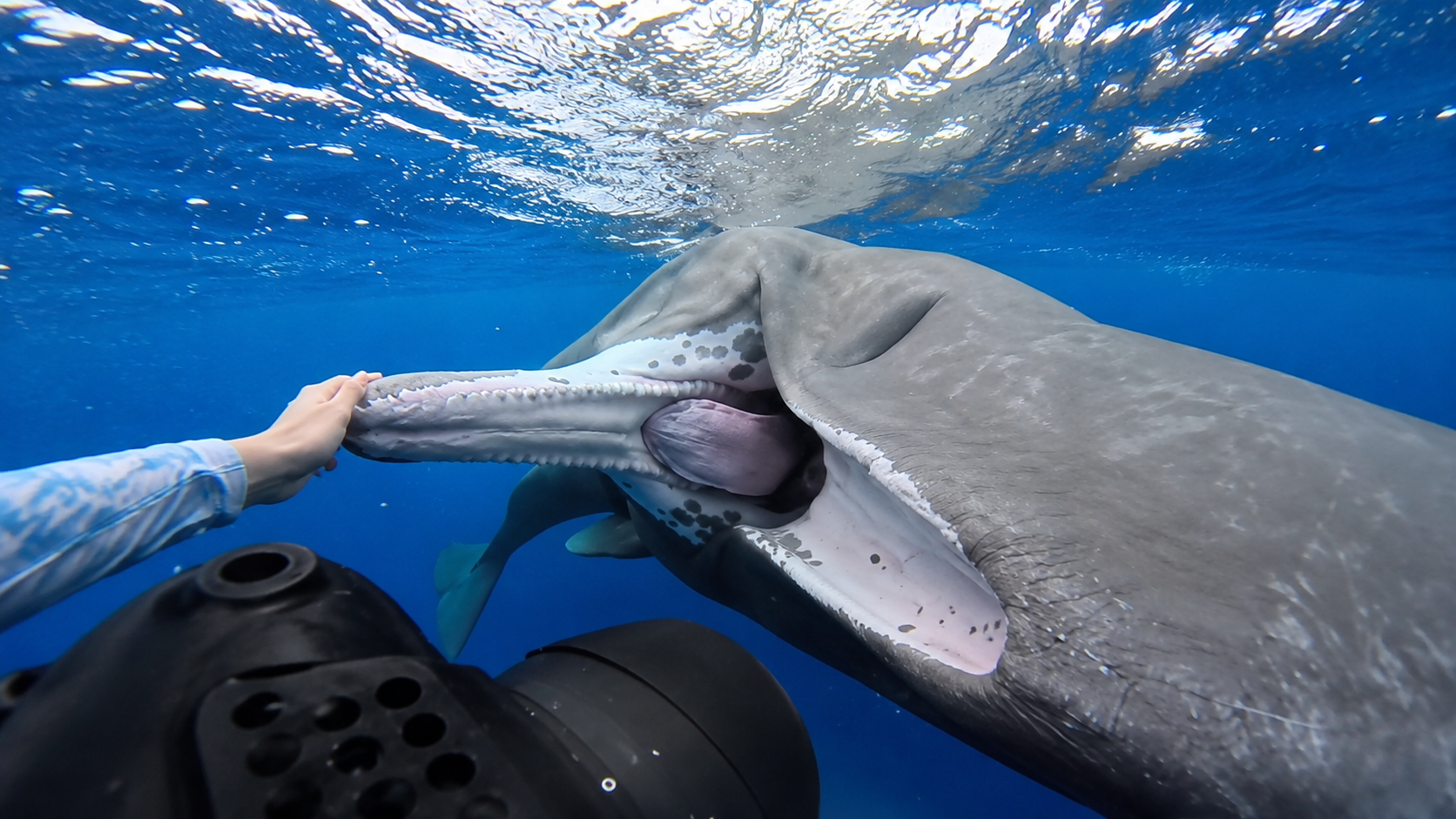
A sperm whale moving slowly through clear blue water is already one of the most powerful sights in the ocean.
But when one comes close enough to fill the camera frame, close enough for a human hand to reach out, the moment becomes something else entirely.
At first, it looks like a simple close encounter: a giant whale, calm water, sunlight above, and a diver lucky enough to be in the right place at the right time.
But the most fascinating part of this video is not only what the camera shows.
It is what the camera cannot capture.
Because a sperm whale does not experience the ocean the way we do.
It does not simply look through the water.
It listens to it.
The Ocean Is Darker Than It Looks
In the video, the water looks bright and open near the surface. To us, the scene feels visual: blue light, moving skin, bubbles, reflections, and the enormous shape of the whale passing close to the lens.
But sperm whales are built for a very different world.
They are deep-diving animals. Much of their life happens far below the surface, where sunlight fades and vision becomes far less useful. In that world, sound is not just communication. It is navigation. It is awareness. It is survival.
NOAA explains that sperm whales produce echolocation clicks to sense their environment and find prey. They listen for echoes bouncing back from objects around them. The longer the echo takes to return, the farther away the object is. As they get closer, the timing changes — and the clicks can speed up into a rapid “buzz” or “creak.”
That means when a sperm whale approaches something in the water, there may be an invisible layer to the encounter.
The whale is not just seeing.
It may be measuring, listening, and building a picture of the world through sound.
Why the Head Matters
The first thing most people notice about a sperm whale is the head.
It is massive, squared-off, and unlike almost any other whale. In adult males especially, the head can look almost impossibly large compared with the body.
That shape is not random.
The sperm whale’s enormous head is part of what makes it one of the most extraordinary sound-producing animals on Earth. Inside that head are structures linked to the production and focusing of powerful clicks.
So when you see the whale turn close to the camera, that huge forehead is not just an impressive physical feature.
It is part of the animal’s acoustic world.
It is one reason sperm whales can function in deep, dark ocean environments where humans would be nearly blind without technology.
The Moment Most People Miss
Most viewers will focus on the contact.
They will ask whether they would stay calm. They will imagine how it feels to be that close to an animal that can weigh many tons. They will replay the moment when the whale passes near the camera and the human hand touches it.
That reaction is natural.
But the deeper question is this:
What did the whale know before it came that close?
A sperm whale does not need to approach blindly. It can use sound to understand distance, shape, movement, and position in the water. The animal in the video appears calm and controlled. It does not rush. It does not move like an animal surprised by the camera. It moves with the slow confidence of a giant that understands its space.
That is what makes the encounter feel so powerful.
The whale is not just a massive body passing by.
It is a highly adapted deep-ocean animal, reading the world in a way humans can barely imagine.
A Giant With a Social Life We Are Still Learning About
Sperm whales are not silent giants.
They produce different kinds of clicks. Some are used for echolocation, especially during deep foraging dives. Others, known as codas, are patterned click sequences used in social communication. Scientists continue to study how complex these sounds may be and what they reveal about sperm whale societies.
Recent research has made sperm whale communication one of the most fascinating subjects in marine science. Researchers studying sperm whale vocal patterns have found that their click sequences can be more structured than many people once imagined. The more scientists listen, the more the ocean seems filled with information we were never trained to understand.
That is why a short video like this can feel emotional even before we know the science.
Somewhere behind the image is a world of sound, memory, distance, and social life.
We see only a few seconds.
The whale lives inside an ocean of signals.
Why Close Encounters Feel Almost Unreal
Part of the reason this video is so captivating is scale.
Humans are used to seeing large animals from a distance: elephants across open land, whales from boats, sharks behind glass or on documentaries.
But underwater, scale becomes personal.
There is no fence. No glass. No boat railing. No stadium distance.
Just water.
When a sperm whale comes close, the human body suddenly feels very small. The camera frame cannot fully explain the size. The movement looks slow, but the presence is overwhelming.
That contrast is what makes people stop scrolling.
A close encounter with a sperm whale is not only visually rare. It also forces the viewer to imagine being physically present in the water with one of the largest predators on the planet.
Not predator in the way people often fear sharks.
A different kind of predator: a deep-diving hunter of squid, built for pressure, darkness, distance, and sound.
The Animal Behind the Viral Moment
It is easy for the internet to turn a whale encounter into a simple viral clip.
A beautiful moment. A huge animal. A few seconds of wonder.
But sperm whales are also a conservation story.
The International Whaling Commission notes that sperm whales were historically heavily hunted, and they are globally listed as Vulnerable on the IUCN Red List.
That context matters.
Every close encounter should remind us that these animals are not ocean props. They are living beings with long lives, complex behavior, family structures, and a history deeply affected by human activity.
The best reaction to a video like this is not only “I wish I was there.”
It is also:
“How much do we still not understand?”
What This Video Really Shows
This video shows a sperm whale close to a human.
But beneath that simple description is a much bigger story.
It shows an animal that can move through the ocean with calm precision.
It shows a body shaped by millions of years of deep-water survival.
It shows a creature that uses sound in ways humans are only beginning to understand.
And it shows why the ocean still feels mysterious, even in a world where almost everything is filmed.
The camera captures the whale’s skin, the water, the movement, and the contact.
But it does not capture the invisible clicks.
It does not capture the echoes returning through the water.
It does not capture the acoustic map the whale may be building in its mind.
That is the real story.
A sperm whale came within inches.
But the most powerful part of the encounter was the sound we could not hear.
One Question
If a sperm whale came this close to you, would you stay still — or would your body freeze before your mind could react?
Sources
This article is based on publicly available information from NOAA Fisheries and the International Whaling Commission about sperm whale behavior, echolocation, clicks, and conservation status.
