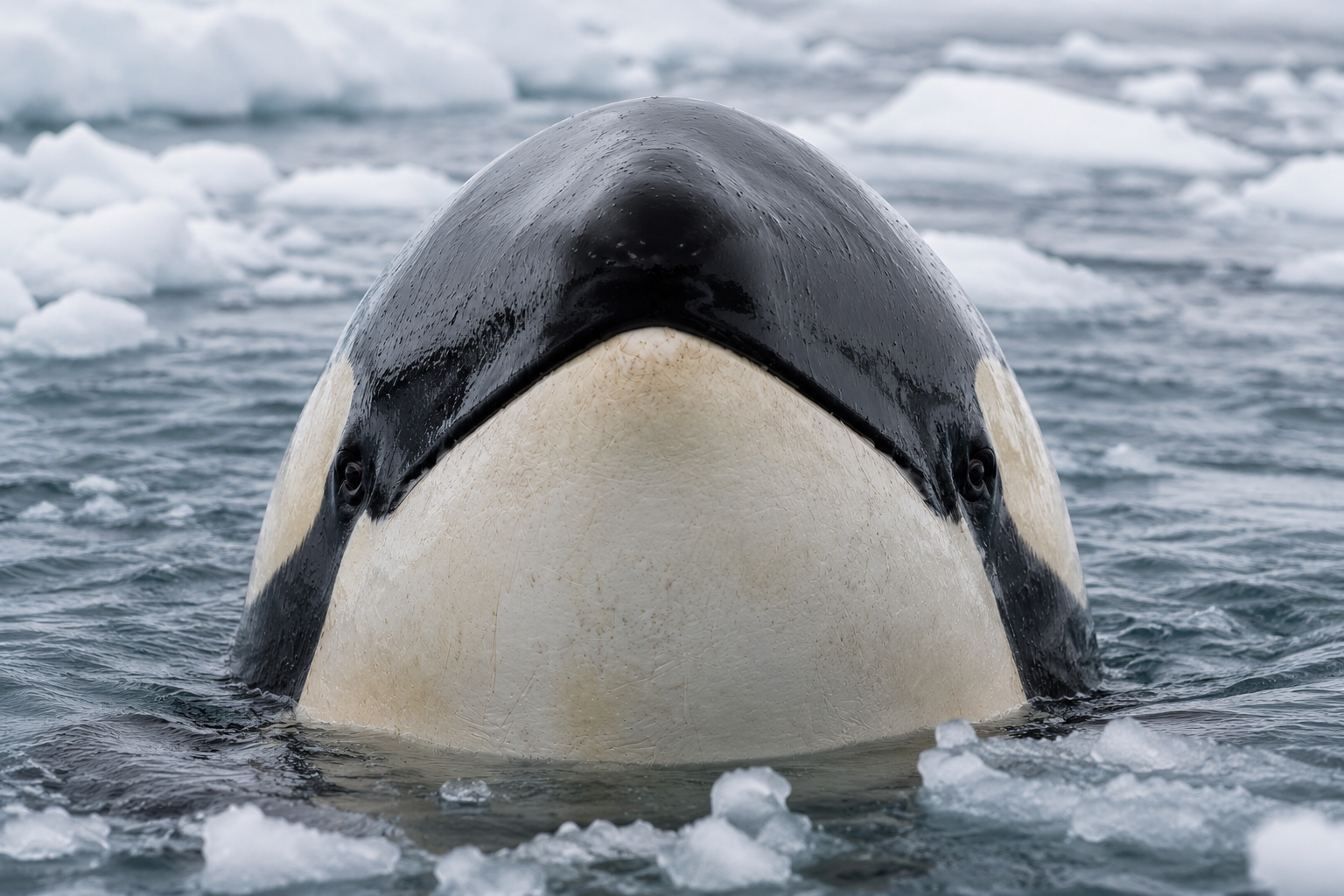
There are moments in the ocean that feel almost impossible to explain.
A black-and-white giant rises silently from cold water. Ice drifts around its body. Water runs down its face in thin shining streams. For a few seconds, the animal does not leap, chase, attack, or disappear. It simply holds itself above the surface and looks.
To a human watching from the other side of the screen, it can feel strangely personal — as if the orca is not just looking at the ocean, but looking directly into you.
But this haunting behavior is not fantasy. Orcas really do rise vertically out of the water like this. The behavior is commonly called spyhopping, and it is one of the most fascinating surface behaviors seen in whales and dolphins. During a spyhop, a whale or dolphin lifts part of its head above the surface, often in a slow and controlled way, allowing its eyes to sit near or above the waterline.
And when an animal as large, intelligent, and visually striking as an orca does it in icy water, the result can look almost supernatural.
What Is Spyhopping?
Spyhopping is a surface behavior where a whale or dolphin rises vertically in the water, often exposing the head and upper body above the surface. It can look a little like the animal is “standing” in the ocean.
The reason it feels so powerful is simple: most of the time, we only see a small part of a marine animal. A dorsal fin. A back. A blow. A tail. The ocean hides almost everything.
But during a spyhop, the animal breaks that rule.
Suddenly, the face appears.
The head rises. The eyes become visible. The body is no longer just a shadow under the surface. For a brief moment, the ocean gives us a direct meeting with one of its most powerful predators.
Spyhopping is usually slow and controlled, not a panicked movement. In many cases, it appears to help the animal observe what is happening above the water. That could mean looking at ice, shorelines, boats, other animals, or anything unusual at the surface.
With orcas, that visual inspection can be especially dramatic because they are not ordinary whales. Orcas, also called killer whales, are actually the largest members of the dolphin family, and NOAA describes them as the ocean’s top predator. They are found in every ocean in the world and are known for coordinated hunting, complex social lives, and distinctive black-and-white markings.
Why Does It Feel Like the Orca Is Staring at You?
Part of the answer is biology. Part of it is emotion.
Humans are extremely sensitive to eyes. We notice when something appears to be looking at us. A direct gaze can feel intense even from a small animal. From an orca, it becomes unforgettable.
An adult orca can grow up to 32 feet long and weigh up to 11 tons, according to NOAA. When an animal of that size rises from the water and holds its head still, the effect is not like watching a fish or a bird. It feels like meeting a presence.
The orca does not need to roar. It does not need to attack. It does not need to move fast.
Its stillness is what makes the moment powerful.
A fast-moving animal creates excitement. A calm giant creates awe.
That is why footage of an orca spyhopping often feels emotional. The animal appears curious, deliberate, and aware. We should be careful not to pretend we know exactly what the orca is thinking, but the posture can make it look almost human in its focus.
It is not “staring into your soul” in the literal sense. But it can feel that way because the behavior creates the rare illusion of eye contact between two worlds: the human world above the surface, and the hidden world below it.
The Ice Makes the Moment Even Stronger
An orca rising in open blue water is already impressive. But an orca rising among ice feels different.
Ice changes the emotional temperature of the scene.
The colors become colder. The sound feels quieter. The ocean looks more ancient. There is less visual noise — no beach, no city, no warm sunset, no boats in the frame. Just grey sky, cold water, floating ice, and a black-and-white predator holding itself above the sea.
In polar environments, spyhopping can be especially useful because the surface is not empty. There may be ice floes, cracks in the ice, seals resting above the water, or other visual clues that matter to the animal. Some descriptions of orca spyhopping around ice suggest it may help them inspect prey or surface conditions near ice floes.
That is what makes an icy orca stare feel so cinematic. The animal is not just appearing in a beautiful place. It belongs there. The ice, the cold water, and the silence all make the orca look like a ruler of its environment.
It does not look lost.
It looks at home.
Why Orcas Seem So Intelligent
Orcas have a reputation for intelligence because their lives are built around social learning, communication, and strategy. Different orca populations can specialize in different prey and hunting techniques, and NOAA notes that orcas often hunt cooperatively, using coordinated strategies similar to a pack.
That matters when we watch a spyhop.
If a random animal lifts its head out of the water, we may see it as a simple movement. But when an orca does it, people sense intention. The animal’s reputation changes the way we interpret the image.
We know orcas are not passive creatures drifting through the sea. They are social predators. They travel in groups. They communicate. They learn. They hunt with precision. They can adapt to different habitats and prey.
So when an orca calmly rises above the water and looks across the ice, it feels like a decision.
Not chaos. Not instinct alone. A decision.
That is why these moments spread so easily online. People do not only see a large animal. They see intelligence, power, and mystery in the same frame.
Is the Orca Being Aggressive?
Usually, no.
A spyhop is not automatically a sign of aggression. It is more commonly understood as a way of observing the surface environment. The animal may be curious, checking surroundings, looking for prey, or responding to something above the water.
The mistake many people make is assuming that any close-up view of a predator must mean danger. Orcas are apex predators, but their behavior is far more complex than simple aggression. They can be calm, social, curious, playful, strategic, and highly controlled depending on the situation.
That is one reason the “staring” moment is so compelling. It contains tension without violence.
The orca is powerful enough to be frightening, but it is not acting like a monster. It is still. It is controlled. It is almost silent.
That balance is what makes the scene unforgettable.
Why This Kind of Moment Goes Viral
The internet is full of loud videos. Fast cuts. Big text. Explosions. Shock reactions. Artificial drama.
But sometimes, the most powerful video is the opposite.
A quiet orca rising from the ice can stop people because it feels real, rare, and emotional. It creates three reactions at once:
First, awe — the animal is huge and majestic.
Second, curiosity — people want to know why it is doing that.
Third, connection — the direct gaze makes viewers feel personally involved.
That combination is extremely strong. A viewer does not need a long explanation to feel something. The image does the work instantly. Then, after the emotion hits, the question comes naturally:
Why did it look at us like that?
That is the perfect kind of curiosity. It is not forced. It comes from the scene itself.
The Real Meaning Behind the “Soul Stare”
The most honest answer is this: the orca is likely observing.
It may be checking its surroundings. It may be looking across the ice. It may be orienting itself. It may be responding to movement, sound, or shapes above the water. In icy habitats, it may be gathering visual information that helps it understand what is happening at the surface.
But the deeper reason the moment affects us has to do with how rarely humans get to feel seen by the wild.
Most wild animals avoid us or pass by quickly. Most ocean giants remain partly hidden. But a spyhopping orca creates the feeling of a pause — a meeting point between the animal and the observer.
For a few seconds, the orca is not just a shape in the sea.
It has a face.
It has eyes.
It has stillness.
And that stillness leaves room for imagination.
A Reminder From the Deep
The most powerful ocean moments are not always attacks, battles, or dramatic chases.
Sometimes the most unforgettable moment is simply this: a giant animal rises from the cold water, looks across its world, and reminds us how little of the ocean we truly understand.
The orca’s stare feels personal because it is rare to see such power without violence, such intelligence without words, and such closeness from a world that usually stays hidden beneath the surface.
So when an orca rises among the ice and appears to look straight into your soul, the real story is not that it is trying to scare us.
The real story is better.
It is watching.
It is learning.
It is reading the world above the water.
And for one brief moment, we get to watch it back.
Sources
Information about orca size, distribution, predator status, and conservation comes from NOAA Fisheries. Information about spyhopping behavior comes from cetacean surface behavior references.
