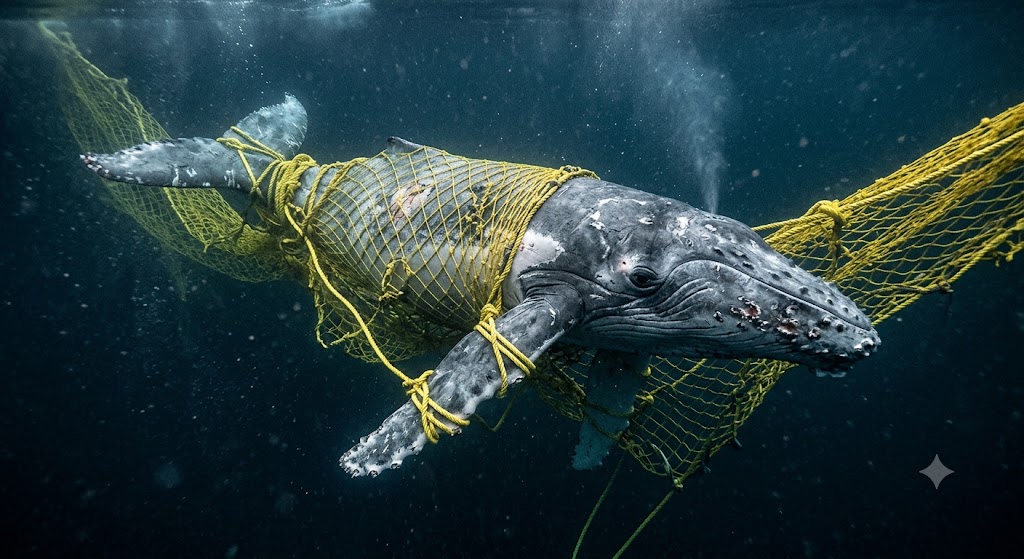
She moves slowly through the deep blue, a creature the size of a school bus, one of the most powerful animals ever to have lived. But something is wrong. Wrapped tightly around her body is a thick fishing rope, knotted into her flesh, so old that barnacles and green seaweed have grown across it like moss on a fallen branch. Trailing behind her is a faded orange buoy, bumping against her side with every weary stroke of her tail.
She has carried this weight for years. And no matter how hard she tries, she cannot get free.
This is not a rare tragedy. It is one of the most widespread and least visible crises facing whales today — a slow, silent form of suffering that plays out far from human eyes, in the vast emptiness of the open ocean. Once you understand it, you will never look at a discarded fishing rope the same way again.
The Invisible Epidemic
Every year, thousands of whales around the world become tangled in fishing gear — ropes, nets, lines, and traps that drift through their feeding grounds or lie waiting in the water column. Scientists call it entanglement, and it has quietly become one of the leading human-caused killers of large whales on the planet.
The numbers are staggering, and they are hard to believe until you sit with them. Among the humpback whales that feed in the Gulf of Maine — one of the most closely studied whale populations on Earth — more than half carry scars from being entangled at least once in their lives. In some regions, drone studies examining whales up close have found that the overwhelming majority of animals, both fully grown adults and young juveniles, bear the telltale marks of rope wrapped around their bodies.
Let that sink in. Getting caught in our fishing gear is not the exception for these whales. For many populations, it is very nearly a rule of life. Nearly every whale you see gliding through the water may have, at some point, fought against a rope it could not escape.
Why a Giant Cannot Simply Break Free
It is one of the cruelest ironies of entanglement. People assume that an animal as enormous and powerful as a humpback whale — capable of launching its entire forty-ton body clear out of the water — could snap a fishing rope like a piece of thread and swim away.
The reality is the exact opposite, and it is far more heartbreaking.
A large whale is usually strong enough to tear the fishing gear loose from wherever it was anchored on the seafloor. And that is precisely the problem. Instead of remaining trapped in one place — where it might be found and freed — the whale rips the gear free and swims off, carrying it along. The rope stays cinched around its mouth, its flippers, its tail, or wound around its whole body. And so the animal becomes a wanderer dragging an anchor, hauling our lost equipment across entire oceans, sometimes for thousands of miles and many months, occasionally for years.
As the whale swims, the rope does its quiet, relentless damage. Every stroke of the tail, every dive, every surfacing to breathe pulls the line a fraction tighter. It saws into the skin, then the blubber, then deeper still. The constant friction opens wounds that never get the chance to heal. Infection sets in. Some whales lose the use of a flipper or have their tail flukes slowly cut away. Others cannot open their mouths properly to feed, and begin to starve — burning through their fat reserves until their bodies are gaunt and their strength fades. Weakened and exhausted, an entangled whale becomes an easy target for ship strikes, or simply gives out.
What looks, at a glance, like a single rope is in fact a death sentence handed down in the slowest possible installments.
The Rope That Tells the Time
One of the most haunting details that rescuers describe is how they can read the age of a whale’s suffering in the gear itself.
When a whale has only recently become entangled, the rope is still clean. But when it has been trapped for a very long time, the line cutting into its body becomes encrusted with marine life — barnacles clamped onto the fibers, streamers of green and brown seaweed trailing from the knots. These are organisms that take many months, even years, to grow.
That living growth becomes a kind of grim calendar. To a trained responder, a rope thick with barnacles and algae is not just a wound — it is a timestamp. It tells them, with quiet horror, that this animal has been dragging our carelessness through the sea for a very, very long time. The image of that knotted, weed-covered rope pressed into a whale’s living skin is one that stays with people long after they have seen it.
The Brave People Who Race to Cut Them Free
Here, at last, the story turns toward hope. Around the world, small teams of specially trained responders dedicate themselves to freeing entangled whales — and the work is far more dangerous and dramatic than most people imagine.
The first rule is that rescuers almost never get into the water with the animal. A single reflexive flick of a distressed forty-ton whale’s tail could kill a person instantly. So instead, the teams work from small inflatable boats, approaching the exhausted giant with extraordinary care.
Their technique is astonishing. Responders use a grappling hook to catch hold of the trailing gear attached to the whale. And then something remarkable happens: the whale, still frightened, simply keeps swimming — towing the rescue boat behind it like a water-skier. The team hangs on, sometimes for hours, being pulled across the sea, using the drag to slow and tire the animal. It is a strange, tense dance between human and whale, patience against panic.
When they finally work their way close enough, they reach out with specially designed cutting tools mounted on the ends of long poles — curved blades built to slice cleanly through rope without harming the whale’s skin. Pass by careful pass, they cut the gear away, peeling the ocean’s cruelty off the animal’s body piece by piece.
And then comes the moment that has moved even hardened, experienced rescuers to tears. The last strand parts. The weight releases. And the whale, feeling free for the first time in months or years, swims off into the blue.
In Hawaii alone, dedicated rescue networks have removed gear from dozens of humpback whales, recovering thousands of feet of rope and netting from animals that would otherwise have been condemned to a slow decline. Each freed whale is a single life handed back to the ocean — and every rescue is a small act of defiance against a very large problem.
The Whales That Seemed to Say Thank You
Some of these rescues end in a way that is genuinely difficult to explain, and impossible to forget.
There are documented accounts of whales that, once freed, did not simply bolt for the horizon. Instead, they lingered near the rescue boats. They circled slowly. They rolled at the surface. Some have been described gently nudging up against the very people who had just cut them loose, hovering nearby for long minutes before finally turning and heading back out to open water.
We must be careful and honest here: no one can climb inside a whale’s mind, and scientists rightly caution against reading human emotions into animal behavior. We cannot know for certain what those whales were feeling. But to the people who were there — who had just spent hours risking their own safety to save a suffering giant — those quiet moments felt unmistakably like gratitude. And who is to say, with certainty, that they were wrong?
What Her Suffering Asks of Us
The whale dragging our rope across the ocean is more than a victim. She is a messenger, carrying — quite literally — the weight of our carelessness on her back.
Every net lost overboard, every length of line cut loose and forgotten, every trap abandoned on the seafloor becomes a piece of “ghost gear” drifting silently through the water. And any one piece of it can turn into a years-long sentence for one of the most intelligent, ancient, and magnificent animals alive. These are creatures that sing to one another across whole ocean basins, that live for decades, that care for their young with tenderness. And too many of them spend their final years in silent pain, entangled in something we simply threw away.
But her story also reveals the better side of us — the divers and volunteers who launch their small boats into big seas, who let themselves be towed for hours by a terrified giant, all for the single reward of watching it swim away unburdened at last.
She carried our weight for thousands of miles, across years of quiet suffering. The very least we can do is remember why — and make sure that fewer whales, in the years to come, ever have to carry it at all.
