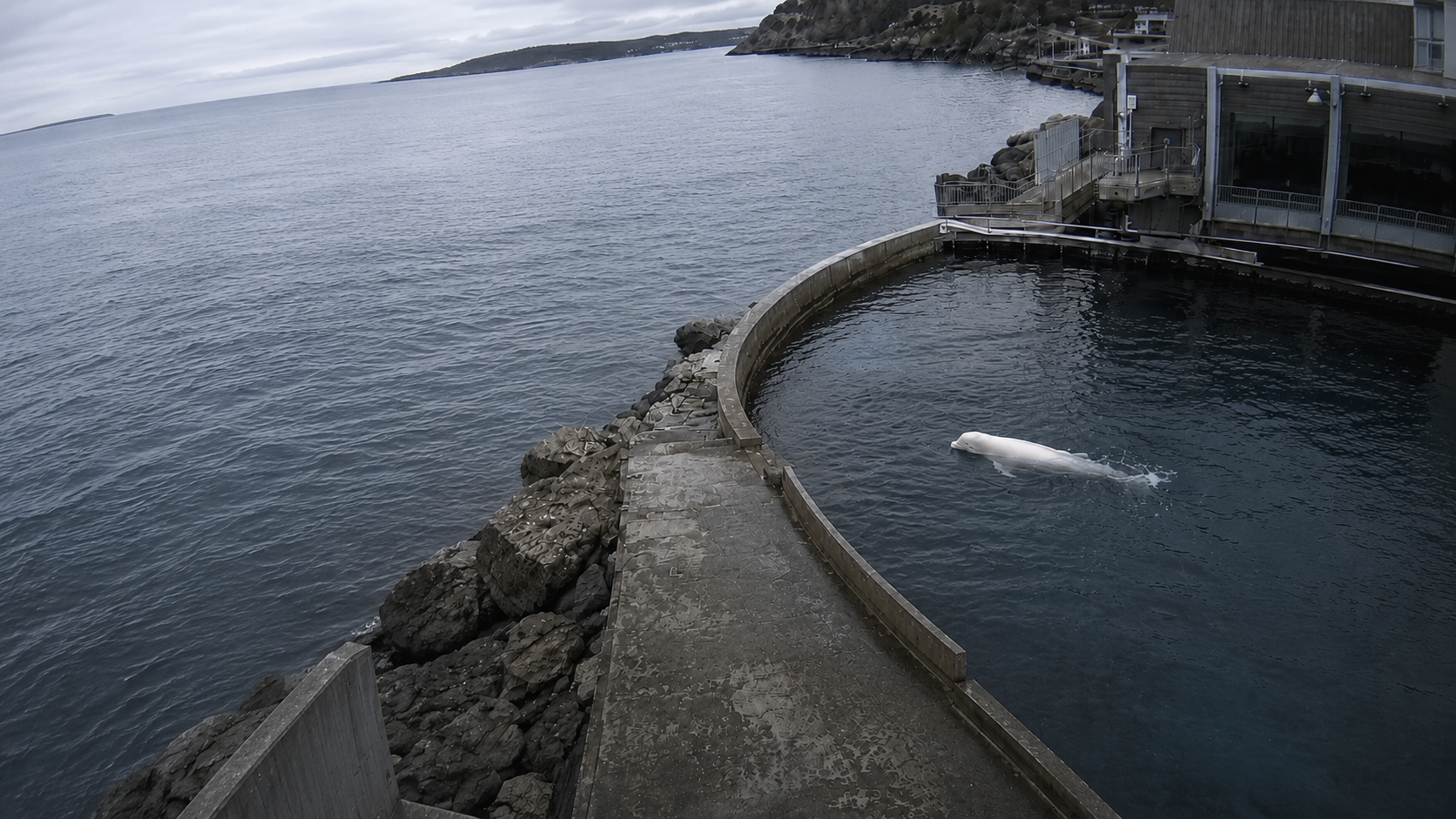
She had lived behind those walls for years. Then one ordinary grey morning, she did something no one thought a beluga could do — and she didn’t stop swimming until she reached the one place that still mattered to her.
For years, she circled the same enclosure.
A smooth white beluga whale, living in a research facility on the edge of a cold northern sea. Every day looked like the last: the same grey concrete, the same railings, the same patch of water. To the people who cared for her, she seemed calm. Gentle. Used to it.
But belugas don’t forget. And somewhere out beyond that fence — past the rocks, past the horizon, across hundreds of miles of open ocean — was something she had never stopped thinking about.
Her baby.
The day everything changed
No one saw it coming.
On an ordinary overcast morning, the security cameras caught something they had never recorded before. The beluga wasn’t circling calmly anymore. She was restless — swimming again and again to the seaward side of the pool, lifting her head toward the open water, as if she could sense something out there calling to her.
And then, in a single powerful movement, she did the impossible. She surged toward the low wall at the edge of her enclosure, threw her whole body over it, and crashed down into the open sea beyond.
She didn’t hesitate. She didn’t look back. She turned toward the deep water and started to swim — fast, focused, and completely certain of where she was going.
This wasn’t a panicked escape. This was a whale on a mission.
[EMBED YOUR VIDEO HERE]
A mother’s memory
To understand why she did it, you have to understand what belugas are.
Belugas are among the most social and emotionally intelligent animals in the entire ocean. They live in close-knit family groups, some numbering in the hundreds, and they almost never spend time alone by choice. They are endlessly curious, playful, and expressive — known to blow bubble rings for fun, mimic sounds they hear, and investigate anything new with the enthusiasm of a child.
But it’s their voices that truly set them apart. Belugas “talk” constantly, using an astonishing range of clicks, whistles, chirps, and calls — so varied and musical that sailors of old nicknamed them “the canaries of the sea.” Scientists believe this rich vocal language helps them stay connected to one another across long distances in dark, murky water, calling out and answering back, always keeping track of who is near.
And at the heart of that social world is the bond between a mother and her calf. A beluga mother and her baby stay side by side for years, the calf swimming so close it’s often touching her body. She feeds it, guides it, teaches it the calls of their family, and protects it with everything she has. Few bonds in the animal kingdom are stronger.
Belugas also remember. They remember voices. They remember places. They remember the individuals they’ve loved. Their world is built on memory and connection — and neither fades easily.
So when this mother felt the pull of the open ocean, it wasn’t random or confused. Somewhere in that vast, cold sea was a bond that no wall, no pool, and no passing year had ever managed to break.
She was going back.
Hundreds of miles of open water
What she was attempting should have been impossible.
Hundreds of miles of cold, open ocean stood between her and where she was headed. Storms. Powerful currents. Exhaustion. The constant risk of predators in unfamiliar waters. And every reason in the world to simply turn around and swim back to the safe, familiar pool — where food appeared without effort, where the water was calm, and where nothing ever threatened her.
But she never turned around.
Mile after mile, she swam — a single white shape moving with unshakable purpose through the grey water. She wasn’t driven by hunger; she had been well fed for years. She wasn’t driven by simple fear; she was swimming toward the danger, not away from it. She was driven by something older and deeper than either.
The pull of family. The refusal to give up on someone she loved.
There is a strength in that kind of determination that’s almost impossible to describe. It’s the same force that makes a mother of any species do things that defy logic, exhaustion, and self-preservation — the quiet, unstoppable certainty that says: I have to get back to them.
What science tells us about animal love
For a long time, people were taught to believe that animals act purely on instinct — that words like “love,” “grief,” and “devotion” belonged to humans alone. But the more closely scientists study creatures like belugas, the harder that idea becomes to defend.
We now know that many animals experience rich emotional lives. Whales and dolphins have been documented grieving their dead, carrying lifeless calves for days, refusing to leave the bodies of loved ones. Elephants return to the bones of their relatives years later. Countless species form bonds that last a lifetime, and show every sign of distress when those bonds are broken.
Belugas, with their complex brains and their deeply social nature, are right at the heart of this understanding. To assume that a beluga mother wouldn’t feel the absence of her calf — wouldn’t remember it, wouldn’t long for it, wouldn’t try to return to it — flies in the face of everything we’ve learned about these remarkable animals.
Her journey, then, isn’t just a good story. It’s a window into an emotional world that is far closer to our own than we ever used to admit.
Why her story stays with us
We like to think of that kind of love as something uniquely human. The willingness to cross any distance, to risk everything, to keep going long after it stops making sense — we tell ourselves those are our qualities, the things that set us apart from the rest of the living world.
And then a beluga whale throws herself over a wall and swims hundreds of miles into the open ocean, and we’re reminded of a humbling truth: the bond between a mother and her child isn’t a human invention. It runs through every corner of the living world, in creatures we’ve barely begun to understand.
She wasn’t just an animal in a pool. She was a mother who never stopped looking toward the horizon — who carried the memory of her baby through every identical, circling day, and who, when the moment finally came, let nothing on Earth stand between them.
She swam into the unknown, alone, across an ocean that could have swallowed her whole.
And she never once looked back.
If her story moved you, share it. The more people understand how deeply these animals feel — how they love, remember, and refuse to give up — the harder we’ll fight to protect them, and the families they would cross an entire ocean to reach.
