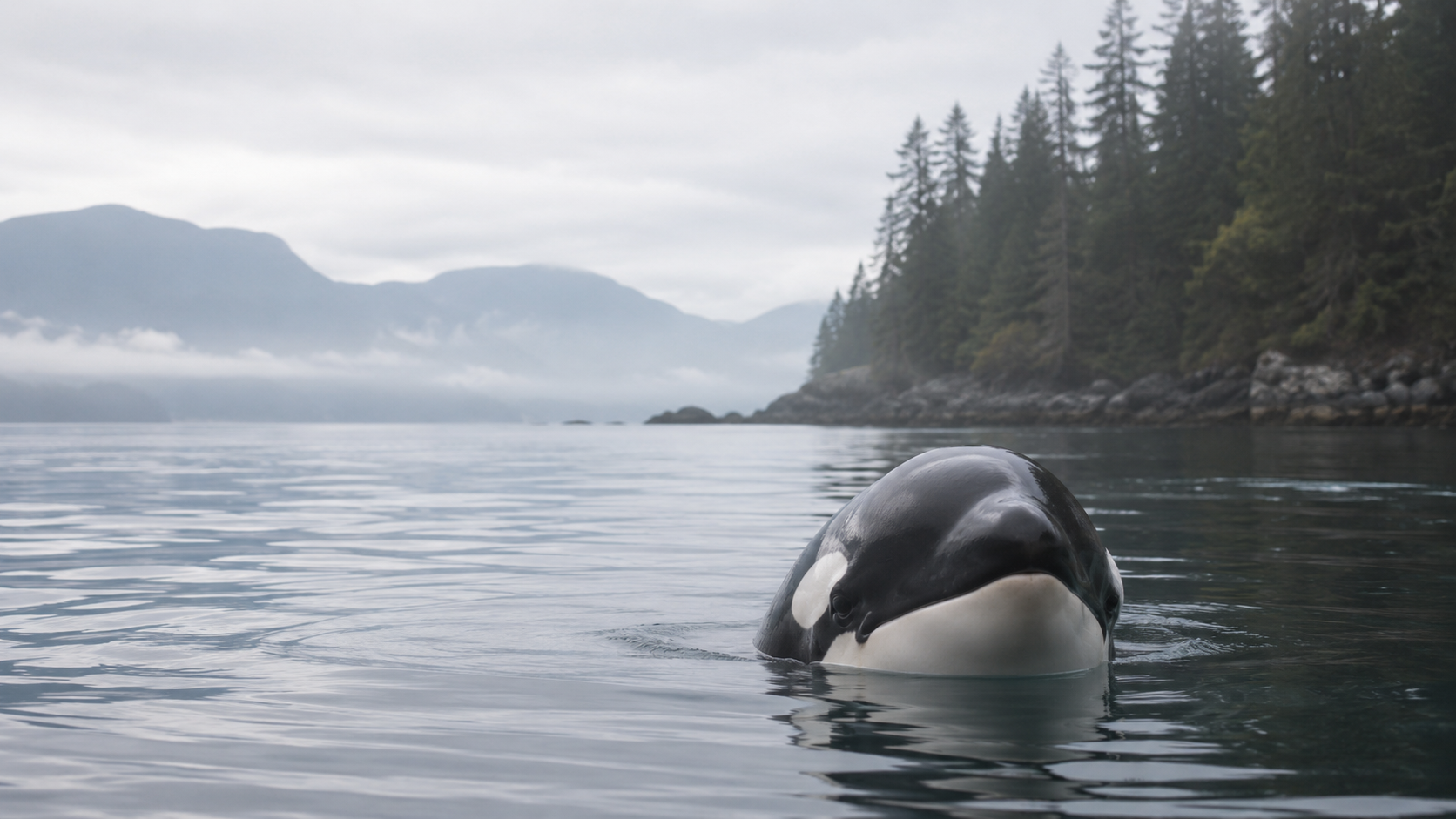
He was just a young whale, completely alone, far from his family. And in his loneliness, he did something no wild orca had ever been seen to do: he came to people, looked them in the eye, and tried to speak.
In a quiet, forested inlet on the Pacific coast, a young killer whale swam alone.
There was no pod around him. No mother, no siblings, none of the family that orcas are almost never without. Just one small whale in a vast grey-blue fjord, surrounded by mountains and silence.
His name was Luna. And his story would go on to move people all over the world — because of what loneliness drove him to do.
A creature built for family
To understand why Luna’s story is so heartbreaking, you have to understand what orcas are.
Killer whales are among the most social animals on the entire planet. They live their whole lives inside tight family groups, and in some populations, a calf will stay beside its mother for its entire life — never leaving, never living alone. They hunt together, travel together, and rest together. They have their own dialects: specific calls and sounds unique to each family, passed down like a spoken language. A young orca learns who he is from the voices of his family.
For an orca, being alone isn’t just sad. It goes against millions of years of evolution. These are animals whose entire being is wired for connection, for the constant presence of others who speak their language and know their name.
And Luna had none of that. Somehow, while still very young, he had become separated from his pod and ended up alone in that fjord, far from any other orca. He was a deeply social animal living in total isolation — and he could not understand why no one was answering.
[EMBED YOUR VIDEO HERE]
So he turned to us
What happened next is the part that stays with people forever.
Most wild animals avoid humans. It’s instinct, and a healthy one. But Luna was so starved for company, so desperate for any kind of social contact, that he began doing something almost unheard of for a wild orca: he started seeking out people.
He would approach small boats. He’d surface beside them, lift his head out of the water, and look directly at the people aboard. He would roll, turn his head, and make sounds — all kinds of sounds — as if he were trying to start a conversation. Some who encountered him described it exactly that way: it felt like the whale was trying to talk to them.
And in a sense, he was. An orca’s calls are how it connects, how it says I’m here, are you there? Luna had no other orca to call to. So he called to us instead — the only company he could find. He was reaching across an enormous gap between species, using the only language he had, hoping someone on the other side would answer.
It’s hard to watch that and not feel something crack open in your chest. Here was one of the ocean’s top predators — an animal people are taught to fear — behaving not like a monster at all, but like a child looking for a friend.
Why he acted so human
People often describe Luna’s behavior as “almost human,” and there’s real science behind that feeling.
Orcas have some of the largest and most complex brains of any animal on Earth. The parts of their brains associated with emotion, social bonding, and self-awareness are remarkably well developed — in some ways even more so than our own. Researchers who study them believe orcas experience rich emotional lives: joy, grief, attachment, and very likely loneliness.
So when a socially intelligent animal like Luna found himself completely cut off from his own kind, it makes heartbreaking sense that he would try to fill that void however he could. He wasn’t being tame, or trained, or fed into friendliness. He was an intelligent, emotional being doing what intelligent, emotional beings do when they’re alone for too long: he went looking for connection wherever he could find it.
That’s what made him so unforgettable. People didn’t just see a whale. They saw a feeling they recognized in themselves — the simple, universal ache of not wanting to be alone.
The bond that wasn’t supposed to happen
As word of the friendly young orca spread, more and more people came to the inlet, and Luna greeted them all with the same open curiosity. He followed boats. He gently nudged kayaks. He seemed to genuinely enjoy being near people, lingering by the docks, watching, listening, calling out.
For the people who lived nearby, it was extraordinary — a wild orca who actually seemed to want their company. But it also raised difficult questions that no one had a simple answer for. Was it right for a wild whale to be this attached to humans? Was it safe — for him, or for the boats he loved to follow? Could a relationship like this ever really end well?
Those questions would come to define Luna’s story in the months and years that followed. But in those first remarkable encounters, none of that was on anyone’s mind. There was only a lonely young whale, and the strange, beautiful sight of him trying so hard to be understood.
What Luna reminds us
It’s tempting to think of the ocean’s giants as creatures apart from us — cold, distant, unknowable. Luna shattered that idea. In his loneliness, he revealed something that science has been slowly confirming for decades: that these animals feel, that they bond, and that being separated from those they love causes them real distress.
His story is a window into just how emotionally complex orcas truly are. And it’s a quiet challenge to the way we see them. The same animal we’ve cast as the villain in films and nightmares turned out, when alone and afraid, to be reaching toward us — not with aggression, but with something that looked an awful lot like hope.
A young whale, calling out across the water, asking the only question that ever really mattered to him: Is anyone there?
Luna’s story is far from over — and what happened to him next is something the world is still talking about. If his story moved you, share it, and stay with us. The more people understand how deeply these animals feel, the harder we’ll fight to protect them.
