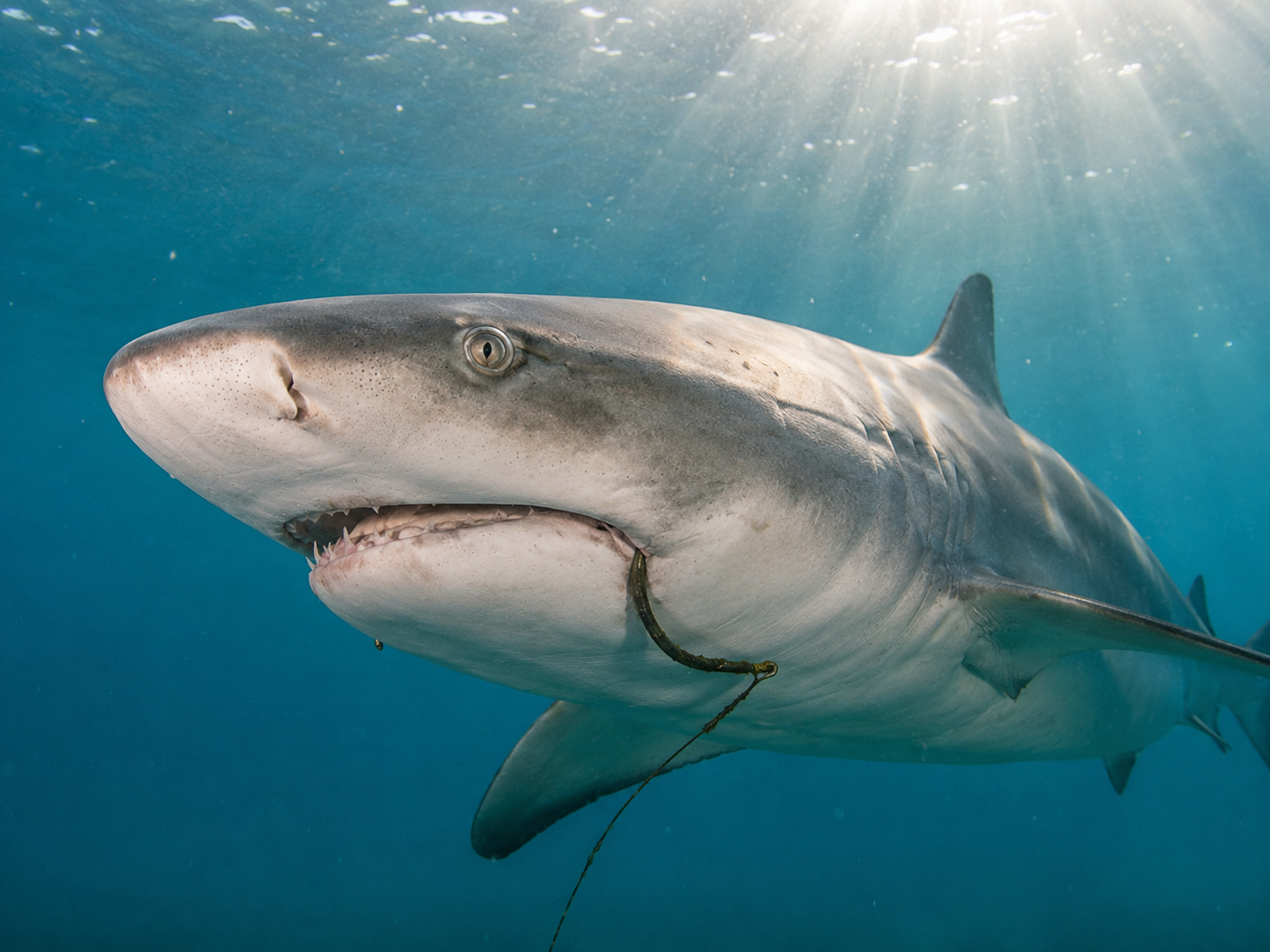
A rusted fishing hook had been buried in her mouth for as long as anyone could remember. To the people who saw her, she was just a shark — something to fear. Almost no one stopped to wonder what she was feeling.
She moved through the water the way sharks always have — silent, ancient, perfectly built for a world we barely understand. To most people, that shape in the blue is a warning. A reason to get out of the water. A monster from a movie.
But if you had looked closely at this particular shark, you would have seen something that didn’t fit the story we tell about her kind. Lodged deep in the corner of her mouth was an old fishing hook, rusted and overgrown with algae and barnacles. It had been there for years.
And it was hurting her.
A wound that never heals
It’s easy to forget that sharks feel anything at all. We’ve been taught to see them as cold, mindless eating machines. But a hook caught in the mouth is exactly as painful as it sounds — a constant, grinding presence that never lets go.
Hooks like this one are tragically common. Every year, countless sharks are caught by fishing lines, and many break free still carrying the hook embedded in their flesh. Sometimes the line snaps. Sometimes the hook is simply cut loose. Either way, the animal swims off with a piece of metal lodged in its body — and no way on earth to remove it.
A shark cannot use its fins like hands. It cannot reach its own mouth. It cannot ask for help. So it simply lives with the pain, day after day, year after year. Every attempt to feed drives the hook deeper. Over time, the algae grows over the rusted metal, a quiet record of just how long the suffering has lasted.
[EMBED YOUR VIDEO HERE]
The animal we love to fear
Here is the part that should stop us.
Sharks kill fewer than ten people in an average year, worldwide. Fewer than ten. You are statistically more likely to be killed by a falling coconut, by a vending machine, or by your own backyard — than by a shark.
And in return? Humans kill an estimated 100 million sharks every single year. Through fishing, through nets, through the finning trade. That’s more than 11,000 sharks every hour, around the clock, all year long.
When you put those two numbers side by side, the story we’ve been told starts to fall apart. We are not the prey in this relationship. We never were. The ocean’s so-called monster is being wiped out by the very species that fears it most — and a single rusted hook in a single shark’s mouth is just one small, visible piece of a much larger wound.
Why this matters more than one shark
It would be easy to look at a hooked shark and feel a flicker of sympathy, then scroll on. But there’s a reason a moment like this stays with people.
Sharks have patrolled our oceans for more than 400 million years. They were here before the dinosaurs. They survived every mass extinction the planet has ever thrown at life. And they are not the villains of the sea — they are its caretakers. As top predators, they keep fish populations balanced and healthy. Remove the sharks, and entire ecosystems begin to collapse from the top down. The reefs suffer. The fish we depend on suffer. The whole ocean tilts out of balance.
In other words, the animal we’ve spent our whole lives being afraid of is one of the animals our oceans need the most.
A moment of trust
There is something almost unbearable about the idea of a wild predator — feared by millions, armed with rows of teeth — quietly enduring pain it cannot escape, while the world looks at it and sees only a threat.
And there is something deeply moving about what it means when one of these animals allows a human to come close. When a shark, of all creatures, stays still long enough to let a pair of hands do what its own body never could. That kind of moment cuts straight through everything we think we know about these animals. It reminds us that the line between “monster” and “creature in need” was never really there at all — we drew it ourselves.
Maybe that’s the real lesson hidden in a single rusted hook. Not that sharks are harmless — they are wild animals, and they deserve our respect. But that fear and understanding are two very different things. And the ocean’s most misunderstood giant has been waiting a very long time for us to tell the difference.
What you can do
The good news is that this story isn’t hopeless. Around the world, divers, marine biologists, and ordinary people are changing the way we see sharks — removing hooks, cutting away nets, and sharing the truth about these animals with anyone who will listen.
You don’t have to dive into the ocean to help. Simply choosing to see sharks differently — and helping others do the same — chips away at decades of fear built on myth. Every person who learns the truth is one more voice for an animal that has no way to speak for itself.
She carried that hook for years, feared by everyone and understood by almost no one. The least we can do is finally see her clearly.
If this changed the way you see sharks, share it. The more people understand these animals, the fewer will fear them — and the more we’ll fight to protect the ocean’s most misunderstood giants before it’s too late.
