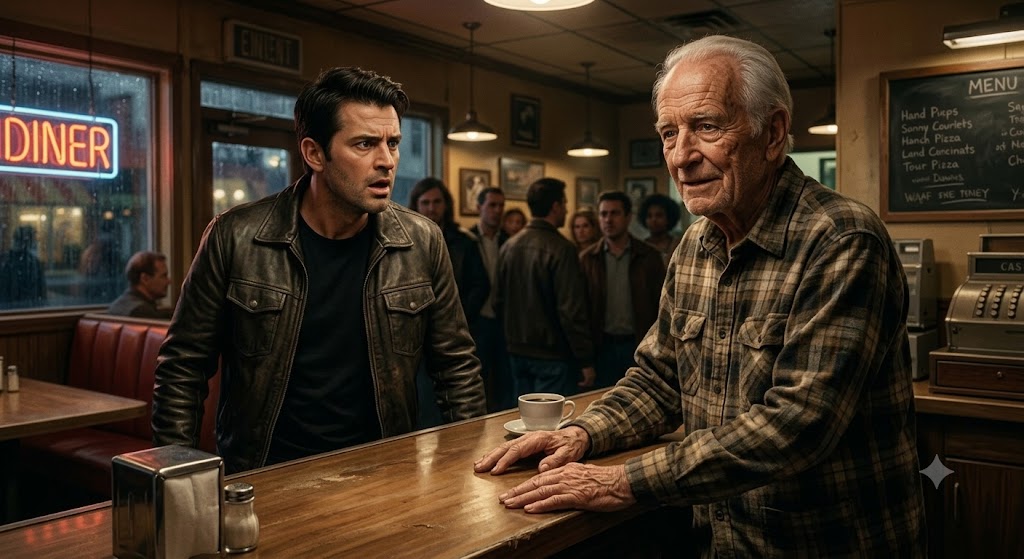
A short story.
The old man had been standing at the counter for almost a minute before anyone bothered to look at him.
He was small, the way people become small when life has worn them down — shoulders rounded, coat a little too thin for the weather, a cap held in both hands. In his fingers he turned a single folded piece of paper, worn soft at the creases from being folded and unfolded too many times. He had clearly practiced what he wanted to say. He never got the chance to say it.
The Humiliation
Behind the counter stood a younger man named Daniel — though the old man did not know his name yet, and Daniel certainly did not know the old man’s. Daniel was everything the old man was not: tall, sharp, dressed in a suit that cost more than the old man’s entire month, with the easy confidence of someone who had never once had to fold a piece of paper soft from worry.
He looked the old man up and down, and something in him decided, instantly and without cruelty’s usual hesitation, that this person did not matter.
“Can I help you?” he said, in the voice people use when they mean the opposite.
The old man began to explain. He spoke softly, apologetically, sliding his worn paper across the counter. He had come about something important — a small matter to anyone else, but clearly the entire reason he had put on his good coat and traveled across the city that morning.
Daniel did not even read it. He pushed it back with two fingers, as if it might be dirty.
“People like you don’t belong here,” he said. And then, because a small audience had gathered and cruelty grows bolder with witnesses, he laughed and pointed toward the door. “Go on. There’s nothing for you here.”
The room went quiet in that particular way a room goes quiet when everyone present knows something wrong is happening and no one is brave enough to stop it. A woman looked at her shoes. A man pretended to check his phone. The old man’s face did something heartbreaking — it did not get angry. It simply absorbed the blow, the way a face absorbs an insult it has heard many times before. He nodded, as if this was no more than he expected from the world. He picked up his soft paper. He turned to leave.
And that should have been the end of it. A small, ordinary cruelty, the kind that happens a thousand times a day and is forgotten by lunch.
It was not the end of it.
The Thing in His Hand
As the old man reached the door, his coat shifted, and the object he had been holding beneath the folded paper caught the light.
It was a medal. Old, tarnished, the ribbon faded to a color that had once been bright. The kind of medal a country gives a man for the worst day of his life — the day he did something most people are never asked to do.
Daniel saw it. And for reasons he could not have explained in the moment, his smug smile began to falter.
He knew that medal. Not medals in general — that medal. The specific shape of it. The specific fade of the ribbon. He had seen it once before, a very long time ago, in a moment he had spent twenty years trying not to remember.
His eyes moved up from the medal to the old man’s face. He looked, really looked, for the first time since the man had walked in. Past the thin coat and the worn cap and the rounded shoulders. At the eyes. At the line of the jaw. At a face that was twenty years older than the one in his memory, but unmistakably, impossibly, the same.
The laughter died in his throat.
Twenty Years Ago
The memory came back the way these things do — all at once, complete, as if it had been waiting just behind a door he kept locked.
He had been nineteen. Reckless, the way nineteen-year-olds are when they believe nothing can touch them. There had been an accident — the details didn’t matter anymore, only the result: metal and water and cold, and Daniel trapped, certain with a calm that terrified him later that he was going to die.
And then there had been a stranger. An ordinary man who had no reason to do what he did, who by every measure of sense should have stayed safely on the bank and waited for someone official to come. Instead the stranger had gone into the cold after a boy he had never met, and had pulled him out, and had stayed with him, holding his hand and telling him to breathe, until help arrived.
Daniel never learned his name. In the chaos that followed he was taken one way and the stranger another, and by the time Daniel thought to ask, the man was gone, melted back into the ordinary world he had come from. For weeks afterward Daniel had told the story. For years he had meant to find the man and thank him. And then, the way these intentions go, life had filled in around the gap. The suit. The counter. The easy contempt for small people in thin coats.
He had spent twenty years becoming exactly the kind of man who would sneer at his own rescuer and tell him he did not belong.
“Wait… Are You…?”
The old man had paused in the doorway. Not because he had heard anything — Daniel had not yet made a sound — but because something in the air of the room had changed, and old men who have lived hard lives learn to feel those changes.
He turned, slowly, back toward the counter.
Daniel’s mouth opened. He took a single step forward, and then another, his expensive shoes loud in the silent room, all the confidence drained out of him, leaving behind only the nineteen-year-old boy who had once been certain he was going to die.
His voice, when it finally came, was barely a whisper. Two words, and then a third he could hardly force out.
“Wait… are you…?”
And the old man looked at him — at the suit, at the counter, at the face he had just been thrown out of a building by — and his unreadable expression shifted, very slightly, into something that was not quite a smile and not quite sorrow.
What he said next — and what Daniel did in the moments that followed — is the part of this story that changes everything. Because recognition is one thing. What you do with it is another. And what happened at that counter in the next sixty seconds is the reason this story is still worth telling at all.
What This Story Asks of Us
It is easy to read this and feel the satisfying jolt of the twist — the cruel man humbled, the universe briefly balancing its books. But the story has a quieter knife in it, and it is pointed at all of us.
Every person we are ever rude to, dismiss, or look past is a stranger carrying a history we cannot see. The man in the thin coat folded his paper soft from worry. The woman who serves you coffee, the elderly person moving slowly in front of you, the quiet figure no one bothers to look at — each one has, somewhere in their past, done something braver or kinder or harder than we will ever know. We just don’t get the dramatic flashback. We don’t get the medal catching the light to warn us.
Daniel got a second chance most cruelty never offers — the rare gift of being shown, in real time, exactly who he had wronged. Most of us are never shown. We simply walk away from the counter, never knowing whose hand we just refused to read the paper from.
The old man had every right, in that doorway, to let the cruel man choke on his shame and walk out. Whether he did — whether twenty years of being the kind of man who runs into cold water survives one more test on one more ordinary morning — is the question the whole story turns on.
This is a work of short fiction, written to move you. What do you think the old man said when he turned around? Tell us in the comments — and share this with someone who needs the reminder to be kind to the people everyone else overlooks. 🙏
