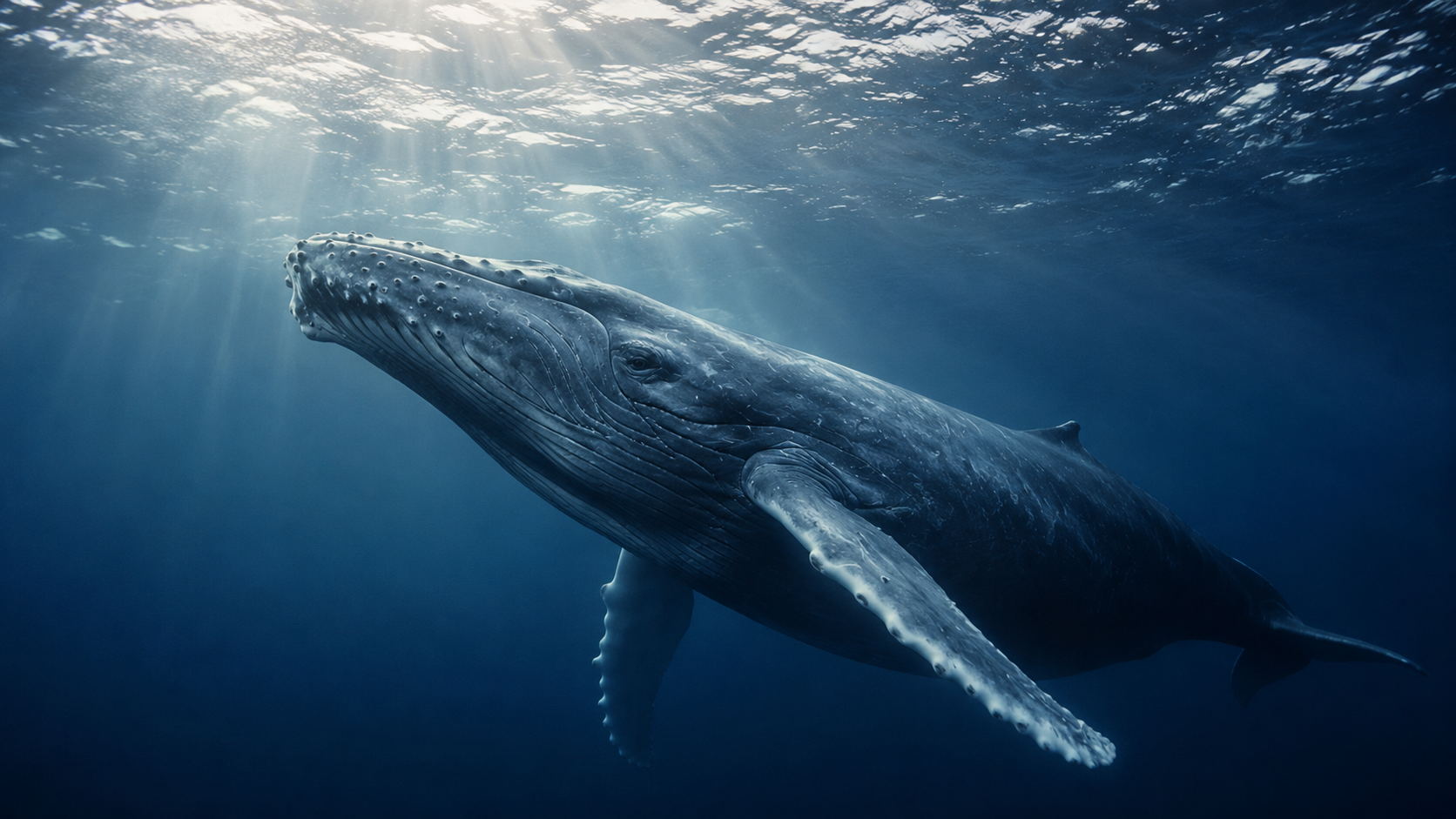
In the dark of the open ocean, a humpback whale sings into the emptiness — and when no one answers, he changes the song and tries again. Why whales do this is one of the most beautiful mysteries in all of nature.
There is a sound in the deep ocean that can travel for hundreds of miles.
It is the song of the humpback whale — long, haunting, rising and falling in patterns so complex that scientists describe them as having verses, phrases, and themes, almost like human music. And on a quiet night, far from any shore, a lone whale will hang motionless in the dark water, point his head down, and sing it into the blackness.
Then he waits.
And if no answer comes, something remarkable happens. He doesn’t simply sing the same song again. Over time, the song changes.
A song that never stays the same
For a long time, people assumed animal calls were fixed — that each species had its sound, passed down unchanged, like instinct. But humpback whales shattered that idea.
Their songs are constantly evolving. A phrase will shift. A new pattern will appear. An old section will fade away. Slowly, week by week and month by month, the song a whale sings at the start of a season is not quite the song he sings at the end of it.
Only the males sing, and they sing most during the breeding season — which is the first clue to one of the great questions: why?
[EMBED YOUR VIDEO HERE]
So why do they change it?
Scientists are still working to fully understand it, but several beautiful pieces of the puzzle have emerged.
To be heard — and chosen. The leading idea is that song is partly about attraction. Females may be drawn to certain songs, and so males are under quiet pressure to keep their song current, fresh, and appealing. A whale singing last season’s song may simply be ignored. So he adapts. He changes. He tries a new way to be heard.
Because they copy each other. Humpbacks are listeners. When one whale introduces a new twist to the song, others nearby pick it up — and then pass it on. The change ripples outward through the population, whale to whale, until everyone is singing the new version. It is, quite literally, a song being learned and shared across a community.
Because their culture travels. This is perhaps the most astonishing part. Researchers have tracked the same song spreading across entire oceans — moving from one population of whales to another, thousands of miles apart, over a year or two, like a hit song crossing the world. Scientists have called this a kind of “cultural revolution,” and it is one of the only examples on Earth of culture spreading on such a vast scale outside of human beings.
The loneliness beneath the science
But there is another, quieter way to hear all of this.
Imagine a single whale, alone in the dark, sending his song out into the silence. No answer comes. So he changes it — just slightly — and sends it out again. Still nothing. He changes it once more. Night after night, he keeps adjusting, keeps reaching, keeps trying to find the version of himself that will finally be answered.
We don’t know what a whale feels. Science is careful here, and rightly so. But anyone who has ever tried again and again to be understood — to be heard, to be chosen, to be answered — feels something familiar in that image. The endless, hopeful reshaping of a song nobody has answered yet.
There is even a famous case that captured the world’s heart: a single whale whose calls were recorded at an unusual frequency, different from all the others around him — leading many to wonder whether he was singing a song his own kind could not recognize. Whether or not that whale was truly “alone,” the idea struck a deep nerve in millions of people. Because we understood it instantly.
The most human thing in the ocean
In the end, the changing song of the humpback is a reminder of something we don’t often associate with the wild ocean: that these giants are not just instinct and muscle. They learn. They listen. They share. They adapt. They have something that looks remarkably like culture — songs invented, spread, abandoned, and reinvented, generation after generation.
And somewhere out there tonight, in water far too deep for the sun to reach, a whale is hanging in the dark, singing a brand new song — and listening, with infinite patience, for someone to answer.
If this gave you a new way of hearing the ocean, share it. The more people understand how intelligent and emotional these giants truly are, the more we’ll fight to protect them — and the songs they carry across the sea.
