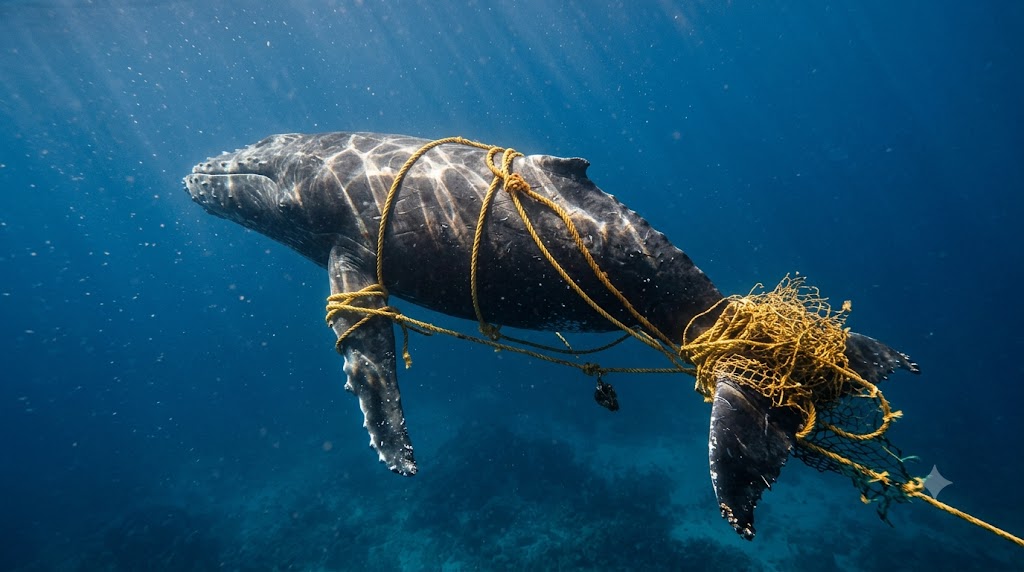
Imagine carrying a weight you cannot put down. A rope wrapped so tightly around your body that it cuts a little deeper with every movement — for months, sometimes years, across thousands of miles of open ocean. You cannot remove it. You cannot rest. And almost no one even knows you are suffering.
This is the silent reality for thousands of whales around the world. And once you understand it, you will never look at a fishing rope the same way again.
A Hidden Epidemic in Our Oceans
Every year, whales become tangled in fishing gear — ropes, nets, lines, and traps left or lost in the sea. Scientists call it entanglement, and it is now considered one of the leading human-caused killers of large whales on Earth.
The scale is staggering. Among the humpback whales that feed in the Gulf of Maine, more than half carry scars from being entangled at least once in their lives. Research using drones has found that the vast majority of humpbacks studied in some regions — both adults and juveniles — show entanglement scars. In other words, getting caught in our gear is not rare. For many whales, it is almost a certainty.
Why They Can’t Just Break Free
People often assume an animal as enormous and powerful as a humpback could simply snap a rope and swim away. The reality is far crueler.
A large whale is usually strong enough to tear the fishing gear loose from the seafloor — and that is exactly the problem. Instead of being trapped in one place, the whale swims off carrying the gear with it. The rope stays wrapped around its mouth, its fins, or its tail, and the whale drags it for months at a time, across thousands of miles.
As the animal swims, the rope saws into its skin and blubber. The wounds can grow deep and become infected. Some whales lose the use of a fin or tail. Many slowly starve, because the gear makes it harder to feed or to swim. Others, exhausted, become easy targets for ship strikes. Over time, what looks like a single rope can become a death sentence that takes years to fall.
And because it happens far out at sea, almost no one ever witnesses it.
The Rope That Tells a Story
One of the most haunting details rescuers describe is how old some of the gear is. When a whale has been entangled for a long time, the rope cutting into its body becomes covered in barnacles and seaweed — tiny living things that grow only over many months or years.
That marine growth is a kind of grim calendar. It tells responders that this animal has been suffering, and dragging our gear, for a very, very long time.
The Brave People Who Set Them Free
Here is where the story turns toward hope. Around the world, specially trained rescue teams risk their own safety to free these whales — and it is far more dangerous than it sounds.
Rescuers never get in the water with an entangled whale; a single flick of a 40-ton animal’s tail could be fatal. Instead, they work from small inflatable boats. They use a grappling hook to catch hold of the trailing gear — and then, often, the whale simply keeps swimming, towing the rescue boat behind it like a water-ski. The team hangs on, waiting for the exhausted animal to tire, slowly working their way closer.
When they are finally near enough, they use special cutting tools mounted on long poles — blades designed to slice through rope without harming the whale. Pass by careful pass, they cut the gear away. And then, in a moment that has moved hardened rescuers to tears, the whale feels the weight release, and swims free.
In Hawaii alone, rescue networks have removed gear from more than 30 humpback whales, recovering thousands of feet of rope and netting. Each freed whale is a life given back to the ocean.
The Whales That Seemed to Say Thank You
Some of these rescues end in a way that is hard to explain. There are documented accounts of freed whales that did not simply swim away — they lingered near the boats, circling slowly, rolling, even nudging gently against the very people who had just cut them loose, before finally heading back out to sea.
We cannot know for certain what passes through a whale’s mind in those moments. But to the people who were there, it felt unmistakably like gratitude.
What We Can Learn From Her
The whale dragging our rope across the ocean is not just a victim. She is a messenger. She carries, quite literally, the weight of our carelessness — and her suffering asks something simple of us: to pay attention.
Every discarded net, every length of lost line, every piece of “ghost gear” drifting in the sea can become a years-long sentence for one of the most magnificent animals alive. But her story also shows the other side of us — the divers and volunteers who race out in small boats to give these giants their freedom back.
She carried our weight for thousands of miles. The least we can do is remember why, and make sure fewer whales ever have to.
