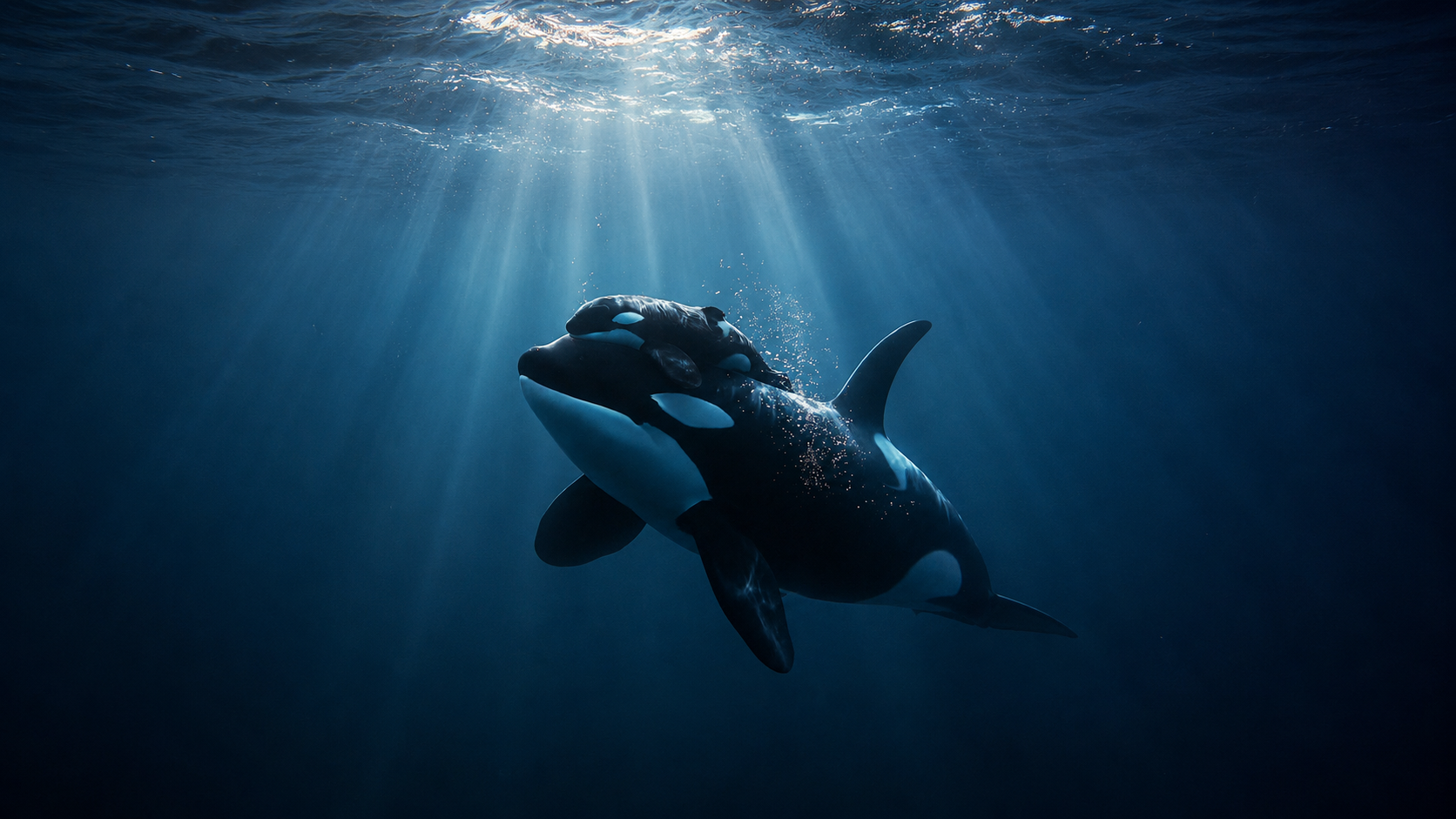
She would not let her baby sink. For seventeen days and a thousand miles, a mother orca carried the body of her newborn — and the whole world stopped to watch.
In the summer of 2018, off the coast of the Pacific Northwest, a mother orca gave birth to a calf. For half an hour, the little one swam beside her. And then it died.
What happened next would be witnessed by scientists, photographed by researchers, and reported around the world. Because the mother — a killer whale known to researchers as Tahlequah, or J35 — did something almost unbearable to watch.
She refused to let her baby go.
Seventeen days. A thousand miles.
Tahlequah balanced her dead calf on her head and pushed it gently toward the surface, again and again. Each time the small body slipped off and began to sink, she dove beneath it, lifted it once more, and carried on.
She did this for seventeen days.
In that time, she traveled more than 1,000 miles, carrying her calf through the cold Pacific water, never abandoning it. When she grew too tired, members of her family pod were seen taking turns helping to support the body. The entire family seemed to share in what looked, to every human who saw it, like grief.
Marine biologists who had studied these whales for decades had never recorded anything quite like it for so long. The world watched, and the world wept. People who had never thought twice about an orca found themselves crying for one.
[EMBED YOUR VIDEO HERE]
So — do animals actually grieve?
For a long time, scientists were extremely careful about words like “grief” and “mourning.” These were considered human emotions, and to apply them to animals risked sentimentality.
But the evidence has become very hard to ignore.
Orcas are among the most intelligent and socially complex animals on Earth. They live in tight family groups, sometimes staying with their mothers for their entire lives. They have distinct dialects, cultural traditions passed down through generations, and parts of their brains linked to emotion and social bonding that are even more developed than our own.
And Tahlequah is not alone. Grief-like behavior has now been documented across many intelligent species:
- Elephants return to the bones of dead relatives years later, touching them gently with their trunks, lingering in silence.
- Dolphins have been seen supporting and refusing to leave the bodies of dead companions and calves.
- Chimpanzees fall quiet around a dead member of their group, and mothers have carried dead infants for days or weeks.
- Giraffes, gorillas, and even some birds have shown behavior that looks like mourning.
The pattern is striking: the more socially intelligent the animal, the more its response to death resembles our own.
A grief we recognize
We may never be able to climb inside an orca’s mind and know exactly what she felt. Science is right to be cautious. But anyone who watched Tahlequah carry her calf for seventeen days saw something they recognized instantly — because they had felt it themselves.
A mother who could not accept that her child was gone. A refusal to say goodbye. A love that kept going long after hope had run out.
Perhaps that is the most humbling lesson of all. For centuries we told ourselves that grief, loyalty, and love were ours alone — the things that made us human, set apart from the rest of the animal world.
Tahlequah, carrying her baby through the cold Pacific for seventeen days, gently suggests otherwise.
A footnote of hope
There is one more chapter to this story. Two years after the world watched her grief, Tahlequah gave birth again — to a healthy calf that survived. Researchers spotted the new baby swimming strong at her side.
She had carried unimaginable loss. And she had carried on.
If this story moved you, share it. The more people understand how deeply these animals feel, the more we’ll fight to protect the oceans they call home. Tahlequah’s family — the southern resident orcas — remains critically endangered, with only a small number left in the wild. Their story is still being written.
