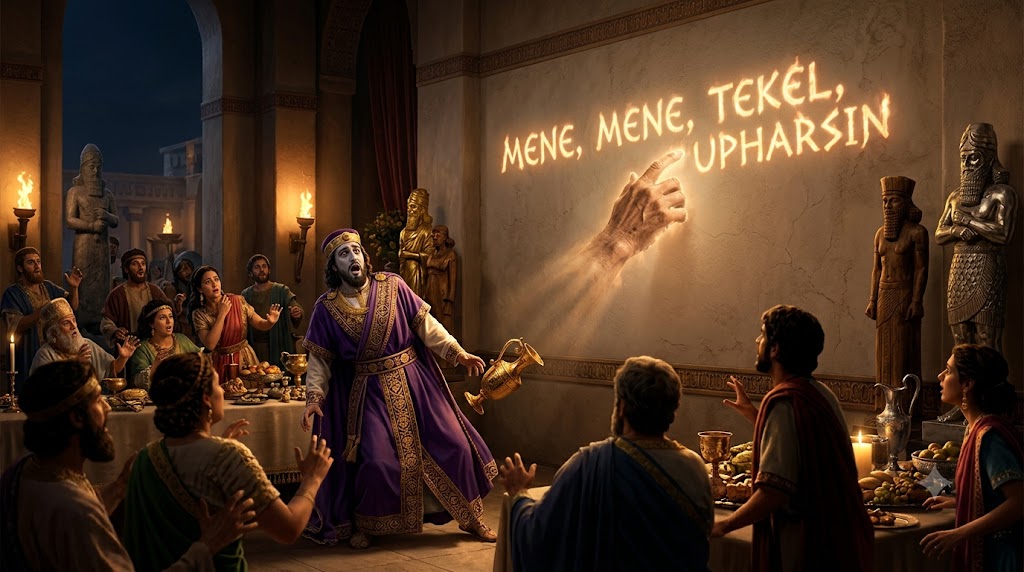
It is one of the strangest and most chilling scenes in the entire Bible — and it gave the world a phrase we still use today: “the writing on the wall.”
It happened at a party. Not a small one. According to the book of Daniel, a king threw a lavish feast for a thousand of his nobles, with wine flowing freely and gold gleaming on every table. At the height of the celebration, drunk on power and pride, the king did something no one before him had dared.
The Act of Mockery
Years earlier, the sacred gold and silver cups had been carried off from the temple in Jerusalem — vessels set apart for the worship of God. They had been locked away, untouched, by kings who knew better than to mock what was holy.
This king did not care. He ordered the sacred cups brought out, filled them with wine, and drank from them with his nobles, his wives, and his guests — toasting his idols of gold and silver, stone and wood, as the whole hall roared its approval.
It was a deliberate, public insult to the living God. And the answer came immediately.
The Hand Appears
In that very hour, as the laughter still echoed, the fingers of a human hand appeared out of thin air near the great plastered wall of the palace — no arm, no body, just a hand — and began to write.
The Bible describes the king’s reaction in unforgettable detail. His face went pale. His thoughts terrified him. His legs gave way beneath him, and his knees knocked together. The most powerful man in the room, moments earlier so sure of himself, could not stop himself from shaking.
He called frantically for his wise men, his astrologers, his advisors — promising riches and power to anyone who could read the words. Not one of them could. The message simply hung there, glowing on the wall, while the feast sat frozen in dread.
What the Words Meant
At last the queen remembered a man known throughout the kingdom for solving the unsolvable — a man of God named Daniel, who had served a previous king. He was brought in.
Daniel refused the king’s rewards. Then he spoke plainly, first reminding the king of something he had chosen to forget: that his greatness had been given to him by God, and that he had hardened his heart in pride anyway, lifting himself up against Heaven and mocking what was holy.
Then he read the words. There were four of them, and together they carried a verdict:
Numbered — the days of the kingdom had been counted, and they were finished. Weighed — the king had been weighed on the scales and found wanting. Divided — the kingdom would be taken from him and given to others.
It was not a riddle about the distant future. It was a sentence, and it was for that night.
What Happened Before Sunrise
The Bible’s next line is one of the most sobering in all of Scripture. That very same night, the words came true. The proud king who had mocked God over breakfast cups of wine did not live to see the morning. By dawn, his kingdom had fallen into other hands.
One evening of arrogance. One refusal to honor God. And a story that has warned every generation since.
What It Still Says to Us
It would be easy to read this as a tale about an ancient king and leave it there. But the reason it has lasted three thousand years is that the warning isn’t really about him. It’s about pride — and pride is something none of us are immune to.
The king’s mistake wasn’t a lack of intelligence or power. He had both. His mistake was believing that because no one could stop him, no one would. He forgot that everything he had — his throne, his breath, his very next heartbeat — had been given, and could be measured, and could be required of him.
There’s a gentler truth hidden inside this frightening story, and it’s worth holding onto: the same God who humbles the proud is the God who lifts up the humble. The wall only spoke judgment because the king refused every chance to bow. Humility was always the door that was open.
So perhaps the most honest question this old story leaves us with is a quiet one: in the places where things are going well, where we feel strong and secure and untouchable — are we still grateful? Are we still humble? Are we still giving the credit to the One who gave it all in the first place?
That’s a question worth answering tonight — long before any hand appears on any wall.
If this gave you chills, share it with someone who needs the reminder — and tell us in the comments: what do you think is the hardest pride to let go of? 🙏
