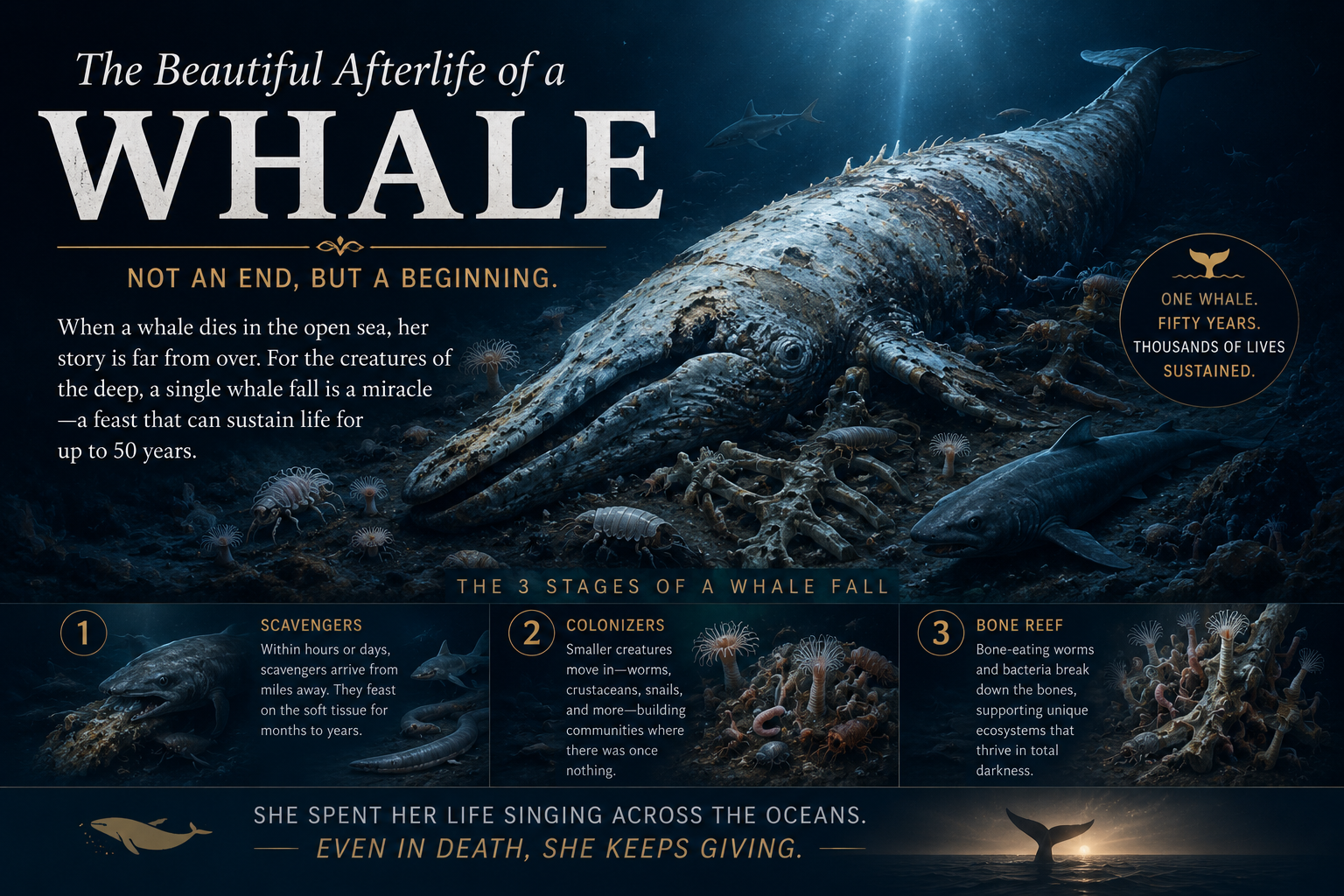
When a whale dies in the open sea, her story is far from over. In fact, it’s just beginning — and what happens next is one of the most beautiful, least-known wonders of the natural world.
The Long Fall Into Darkness
A great whale can weigh as much as 30 to 40 tons. When she dies, her enormous body slowly begins to sink, drifting down through the ocean for hours — sometimes through more than two kilometers of water — until she finally comes to rest on the cold, pitch-black seafloor.
Down here, there is no sunlight. There never has been. The pressure is crushing, the temperature barely above freezing, and food is so scarce that most creatures living here survive on whatever crumbs drift down from far above. It is one of the loneliest, harshest places on Earth.
And then, into this barren darkness, arrives something extraordinary: an entire whale.
A Feast in the Deep
Scientists have a name for this event. They call it a “whale fall.”
To the creatures of the deep sea, a single whale carcass is not a tragedy — it is a miracle. It’s the equivalent of thousands of years’ worth of food arriving all at once in a place where almost nothing ever grows. And life responds quickly.
The process unfolds in stages, each one lasting years:
First, the scavengers come. Sleeper sharks, hagfish, rattail fish, and giant amphipods arrive within hours or days, drawn from miles away by the scent. They strip the soft tissue from the body — a feast that can last anywhere from a few months to several years for a large whale.
Then come the colonizers. Once the big scavengers have had their fill, smaller animals move in. Worms, crustaceans, snails, and other tiny creatures settle onto the bones and the enriched sediment around the body, building thriving little communities where moments earlier there had been only empty seafloor.
Finally, the bones themselves come alive. This is the most astonishing stage of all. A whale’s skeleton is rich in fats and oils. Special bacteria break these down and release chemicals — and a remarkable creature called the “bone-eating worm” (Osedax) moves in, literally drilling into the bones to feed. These bacteria support entire ecosystems that survive with no sunlight at all, the same kind found around deep-sea volcanic vents.
Fifty Years of Life From a Single Death
Put together, all these stages mean that one whale can sustain life on the ocean floor for an astonishing length of time. Scientists estimate that a single large whale fall can feed and shelter deep-sea communities for up to 50 years.
Think about that. In death, this one animal becomes an oasis — a source of food, shelter, and new life for thousands of creatures across half a century, in a place where life would otherwise barely cling on.
Researchers have even discovered species that appear to exist almost only because of whale falls — animals so specialized that they drift through the dark deep, generation after generation, searching for the next fallen giant.
The Most Beautiful Goodbye in Nature
We often think of death as an ending. But in the deep ocean, a whale’s death is something closer to a gift — a final, quiet act of generosity that echoes for decades after she is gone.
She spent her life singing across the oceans. And even after her song falls silent, her body keeps giving, feeding a thousand lives in the dark.
Maybe that’s the most beautiful goodbye in all of nature: not an end, but a beginning.
