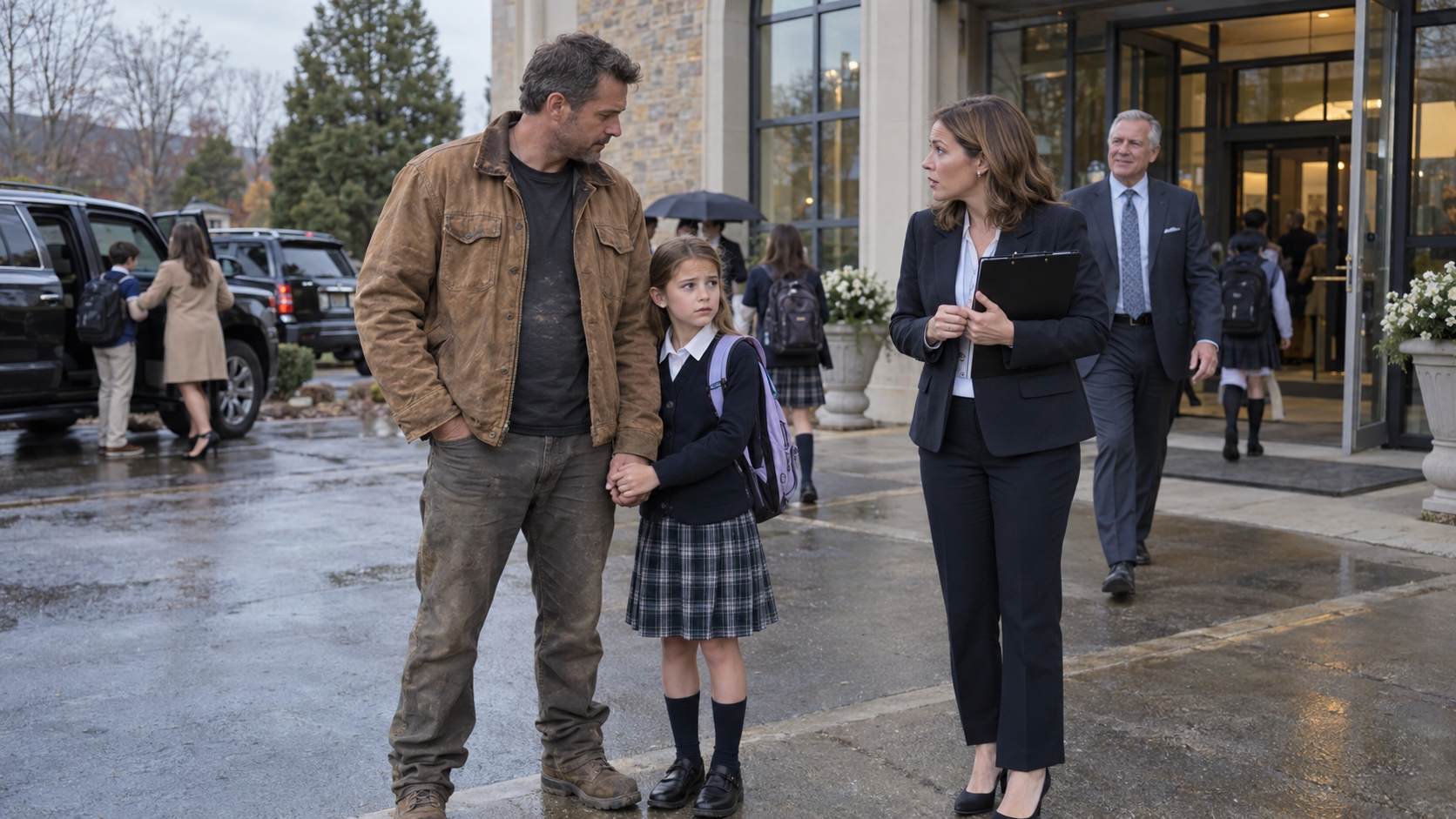
The first thing the administrator noticed was his jacket.
It was worn at the cuffs. His work boots still carried a little dust from the job site.
Beside him stood his ten-year-old daughter, holding his hand outside one of the most expensive private schools in the area.
The administrator barely looked at his face.
“Contractors check in at the service entrance.”
The man remained calm.
“I’m not a contractor.”
Then came another assumption.
When he explained that the girl beside him was his daughter, the administrator glanced at his clothes again.
“If she’s on assistance, scholarship families check in around the side.”
His daughter lowered her eyes.
Her fingers tightened around his hand.
The father still did not argue.
But seconds later, the school’s headmaster came rushing through the glass doors.
“Mr. Bennett. Thank God.”
He shook the man’s hand.
“The trustees have been waiting for you.”
Suddenly, the administrator stopped talking.
And the question was no longer why this man had come to the school.
It was why an entire board refused to begin without him.
He Had Come Straight From a Construction Site
Daniel Bennett did not look like most of the parents arriving that afternoon.
That was partly because he had never planned to attend the school event dressed as he was.
His morning had started before sunrise.
A major construction project outside the city had fallen behind schedule. Daniel had spent most of the day walking the site with engineers and supervisors.
He wore the same brown canvas jacket he often wore there.
His boots were old but comfortable.
There was still a faint line of dust near one knee.
At 3:20 p.m., he looked at his phone and realized he was running late.
His daughter, Sophie, had asked him to attend an important meeting at her school.
He could have gone home first.
Instead, he drove directly there.
Daniel arrived in the same pickup he used when visiting job sites.
Meanwhile, expensive SUVs moved slowly through the school’s circular driveway.
Parents stepped out in polished shoes and tailored coats.
Daniel noticed the contrast.
He simply did not think it mattered.
Sophie was already waiting near the entrance.
When she saw him, she smiled and ran over.
“You came.”
“I said I would.”
She took his hand.
Together, they walked toward the front doors.
Neither of them expected the next two minutes to become the part of the afternoon they would remember most.
The Administrator Never Asked His Name
A woman stood near the entrance checking arrivals.
Her name was Claire Morgan.
She had worked in school administration for several years and was helping direct parents, visitors, and vendors that afternoon.
At first, her interaction with Daniel seemed ordinary.
She looked at him.
Then she looked at his jacket.
Her eyes dropped briefly toward his boots.
Finally, she pointed toward the side of the building.
“Contractors check in at the service entrance.”
Daniel stopped.
“I’m not a contractor.”
Claire looked slightly surprised.
“Then who are you here with?”
Daniel glanced down at Sophie.
“My daughter.”
For the first time, Claire looked directly at the girl.
Sophie wore the same school clothing as many of the children moving through the entrance.
She had a backpack over one shoulder.
Still, Claire seemed confused.
Then she made another assumption.
“If she’s on assistance, scholarship families check in around the side.”
The words were not shouted.
In fact, Claire said them quietly.
That almost made them worse.
A parent standing several feet away heard the comment and briefly looked toward Daniel.
Then she looked away.
Sophie did something even smaller.
She lowered her eyes toward the pavement.
And Daniel felt her hand tighten around his.
His Daughter’s Reaction Changed Everything
Daniel had spent years dealing with people who underestimated him.
Usually, it did not bother him.
He had been mistaken for a driver.
A maintenance worker.
A delivery person.
Once, someone had asked him to move his own truck from a building he partly financed.
Most of the time, he found it amusing.
This time was different.
Sophie had heard it.
Daniel looked down at her.
She was staring at her shoes.
“Hey.”
She looked up.
“You’re fine.”
Sophie nodded.
However, she did not release his hand.
Claire had already turned slightly toward the entrance, as though the conversation was finished.
Daniel could have corrected her immediately.
He could have explained why he was there.
Instead, he asked a question.
“Why would scholarship families use a different entrance?”
Claire looked back at him.
“It’s just how check-in is organized today.”
Daniel nodded slowly.
He did not challenge her.
He did not raise his voice.
But the question remained with him.
Would she have said the same thing if he had arrived in a suit?
Would Sophie have been directed elsewhere if Daniel had stepped out of one of the black SUVs nearby?
He was still thinking about that when the glass doors behind Claire suddenly opened.
Then the Headmaster Came Outside
Dr. Robert Hale moved quickly through the entrance.
He was normally a measured man.
That afternoon, however, he looked like someone searching for a person he could not afford to keep waiting.
He scanned the driveway.
Then he saw Daniel.
“Mr. Bennett.”
Claire turned.
Dr. Hale walked past her and directly toward Daniel.
“Thank God. We thought you were still on the road.”
He extended his hand.
Daniel shook it.
“I came straight from the site.”
“That explains it.”
Dr. Hale smiled briefly.
Then his attention shifted toward Sophie.
“Good afternoon, Sophie.”
“Hi, Dr. Hale.”
Claire said nothing.
Her clipboard had lowered slightly.
Dr. Hale looked back at Daniel.
“The trustees have been waiting for you.”
Daniel glanced at his watch.
“I’m only a few minutes late.”
“They won’t start without your decision.”
That sentence changed the atmosphere immediately.
The parent who had looked away earlier glanced back.
Claire’s posture became noticeably stiffer.
Daniel, however, seemed almost indifferent to the attention.
He was still thinking about the sentence his daughter had just heard.
“They Won’t Start Without Your Decision”
Sophie looked up at her father.
She knew Daniel attended meetings.
She knew his work sometimes involved large projects.
Still, she had never heard anyone at school speak to him like this.
Claire seemed equally confused.
“The board?” she asked.
Dr. Hale looked at her.
“Yes.”
Then he looked back at Daniel.
“We have everyone upstairs.”
Daniel did not move.
“Before we go inside…”
Dr. Hale waited.
Daniel looked toward Sophie.
Then toward Claire.
“I want to know why my daughter was sent to the service entrance.”
Silence followed.
Claire immediately responded.
“I didn’t send her there.”
Daniel stayed calm.
“You told us contractors use that entrance.”
“I thought—”
“I know what you thought.”
Claire stopped.
Daniel continued.
“And after I told you she was my daughter, you said scholarship families should check in around the side.”
Dr. Hale’s expression changed.
Claire looked toward Sophie.
Then back toward Daniel.
“There must have been a misunderstanding.”
Perhaps there had been.
But Daniel was no longer interested only in what had happened to him.
He wanted to know whether it had happened before.
One Question Made the Meeting More Important
Daniel finally entered the building.
Sophie went with a staff member she knew while Daniel followed Dr. Hale upstairs.
Claire remained near the entrance.
The board meeting started several minutes later.
However, Daniel did not immediately discuss the issue everyone had gathered to decide.
Instead, he asked:
“Do scholarship families normally use a different entrance?”
Several trustees looked at one another.
“No,” Dr. Hale said.
“Are they instructed to?”
“No.”
“Do they receive different check-in instructions?”
Again, the answer was no.
Daniel leaned back.
Then the situation changed.
He no longer wanted an explanation about one uncomfortable interaction.
He wanted information.
How many families had complained about being treated differently?
Had anyone reviewed those complaints?
Did parents receiving tuition assistance feel they were treated with the same respect as full-tuition families?
One trustee mentioned an older complaint.
Another remembered a parent who had felt embarrassed during an event the previous year.
Neither incident had seemed serious enough to become a board issue at the time.
Now Daniel wanted both reviewed.
Still, one question remained unanswered.
Why did his questions suddenly carry so much weight?
Daniel Bennett Was Not There as an Ordinary Parent
The answer had nothing to do with the pickup outside.
Daniel Bennett had built one of the region’s largest privately held construction and infrastructure companies.
He had started small.
Years earlier, he had worked on job sites himself.
Even after the company expanded, he continued visiting projects in work clothes because he disliked making decisions from an office.
That explained the jacket.
It did not explain why the trustees were waiting.
Daniel also chaired the Bennett Family Foundation.
Months earlier, the foundation had begun discussions with Sophie’s school about a major long-term commitment.
The proposal included funding for a new academic building.
More importantly, it included a substantial expansion of the school’s financial-aid program.
The trustees had gathered that afternoon because Daniel’s foundation was considering one of the largest gifts in the school’s history.
The final structure still required his approval.
Ironically, much of the money was intended to make the school accessible to families who could not afford full tuition.
The very families Claire had casually referred to as needing to “check in around the side.”
Daniel did not threaten to withdraw the money.
Instead, he said something that made the room quieter.
“If this happened because she thought I had no influence here, then my daughter isn’t the person I’m worried about.”
A trustee asked what he meant.
Daniel answered:
“I want to know how people get treated when nobody important is standing next to them.”
What He Asked the School to Do Next
Daniel could have demanded that Claire lose her job.
He did not.
He could have walked away from the funding discussion.
He did not do that either.
Instead, he asked the school to investigate.
He wanted previous family complaints reviewed.
He wanted financial-aid families interviewed privately.
He also asked the school to examine whether unwritten habits had created two different experiences for parents depending on how staff perceived them.
“If she made one bad assumption today, deal with one bad assumption,” Daniel told the board.
“But if this is a pattern, then fixing one person won’t fix the problem.”
The trustees agreed.
The funding decision was delayed.
Not cancelled.
Delayed.
Daniel wanted to see what the school found first.
Several days later, the review began.
Claire apologized to Sophie and Daniel.
However, Daniel made one thing clear.
The apology mattered.
The larger question mattered more.
The issue was never that Claire had accidentally insulted a wealthy man.
It was that she had treated him differently because she believed he was not wealthy.
That distinction stayed with Sophie too.
Weeks later, she asked her father why he had not simply told Claire who he was at the entrance.
Daniel thought for a moment.
“Because then I would only know how she treats me after she knows.”
Sophie understood.
“And you wanted to know how she treated you before?”
Daniel nodded.
“Exactly.”
The foundation eventually moved forward with its support.
However, the school also changed several procedures.
All families began checking in through the same entrance during major events.
Staff received clearer guidance.
The school also created a direct way for families to report uncomfortable treatment without attaching their names.
For Daniel, those changes mattered more than proving anyone wrong.
And months later, Sophie remembered something else.
Not the expensive cars.
Not the board meeting.
Not even the moment the headmaster rushed outside.
She remembered standing beside her father after someone had made her feel as if she did not belong.
He had looked down at her and said only two words.
“You’re fine.”
Then he made sure the next family would not need those words at all.
