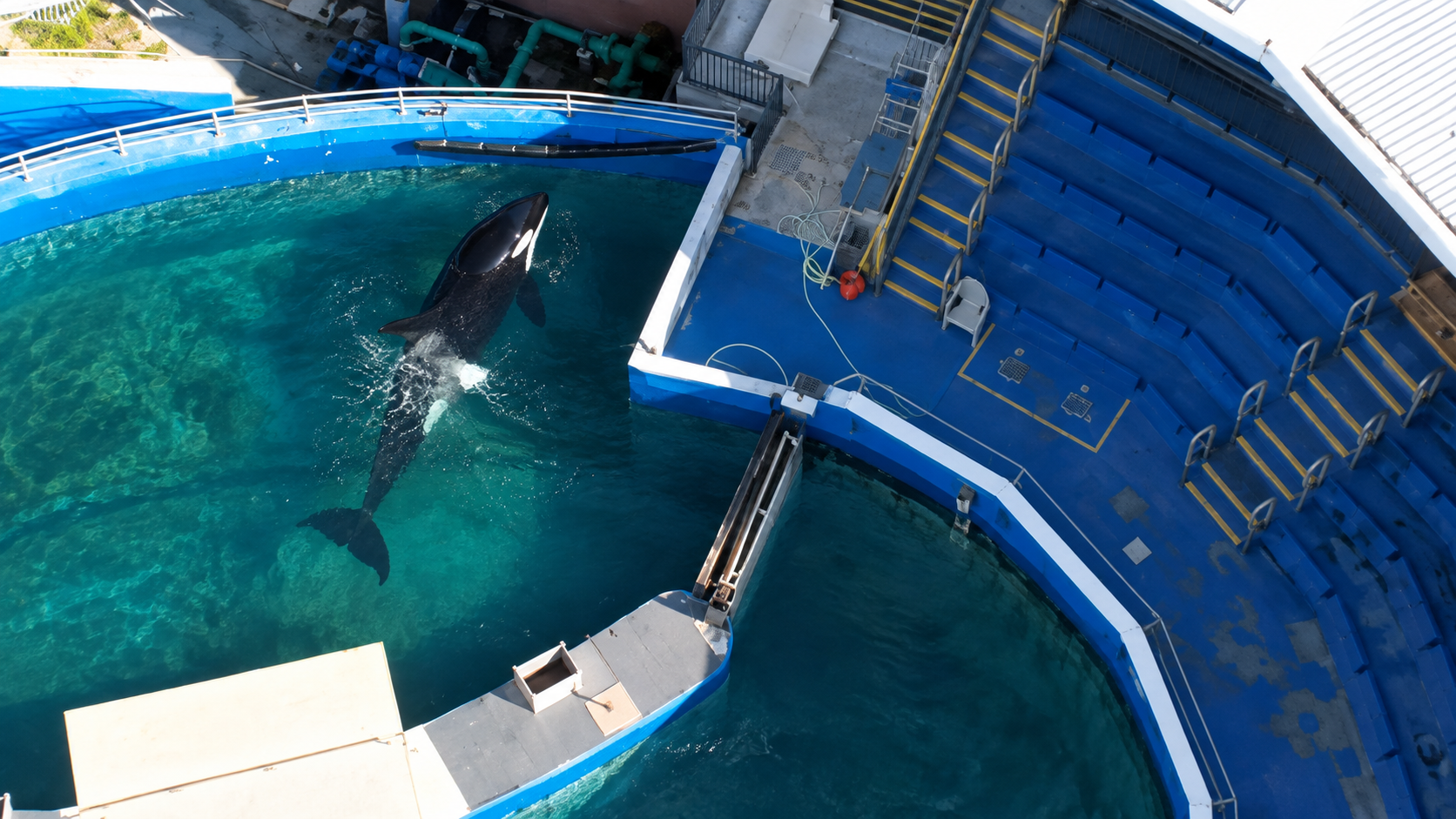
From above, the pool looked even smaller.
A black-and-white killer whale moved through blue-green water.
She crossed the tank.
Turned.
Then crossed it again.
Concrete surrounded her on every side.
For generations of visitors, she was known as Lolita.
To many others, she was Tokitae.
And by 2023, she had lived at the Miami Seaquarium for 53 years.
Then something changed.
After decades of campaigns, discussions and failed hopes, a plan was announced to move her back toward the Pacific Northwest.
Toward colder water.
Toward the region where she had been born.
For the first time in years, supporters could imagine Tokitae leaving the pool that had defined almost her entire life.
But she was old.
Her health needed careful monitoring.
The move had not yet been approved.
And time was becoming part of the problem.
The question was painfully simple.
After 53 years, would Tokitae finally leave the tank?
She Was Taken From Washington in 1970
Tokitae’s life in captivity began during a very different era.
In August 1970, young killer whales were captured at Penn Cove in Washington State.
Tokitae was among them.
She was believed to be only a few years old.
Before the capture, she belonged to the Southern Resident killer whale population.
That meant the Pacific Northwest was not simply a place she had once visited.
It was where her social world had begun.
After the capture, Tokitae traveled across the United States.
Florida became her new home.
The Miami Seaquarium displayed her for decades under the name Lolita.
Meanwhile, scientists learned far more about the population she had left behind.
In 2015, NOAA formally included Tokitae in the endangered Southern Resident killer whale population under the Endangered Species Act.
That recognition mattered.
Her wild relatives still moved through Washington and British Columbia.
Tokitae remained thousands of miles away.
And the distance between those two worlds would define almost everything that came next.
The Whale Bowl Became Her World
Tokitae spent decades in the pool commonly known as the Whale Bowl.
Reports described it as roughly 80 feet long.
About 35 feet wide.
And around 20 feet deep.
Numbers alone can be difficult to picture.
Aerial images made the scale easier to understand.
There was Tokitae.
There was the water.
Then there was concrete.
She could swim forward.
Turn.
Cross the pool.
Then turn again.
The boundary was always close.
That visual contrast became central to debates over her captivity.
Wild killer whales can move through enormous areas of ocean.
Tokitae’s physical world was far smaller.
Still, year after year, visitors came.
Children who saw her in the 1970s eventually returned as adults.
Some brought children of their own.
The decades changed.
The pool did not.
And while Tokitae remained in Miami, the way people understood orcas began changing around her.
Scientists Learned What She Had Left Behind
By the time Tokitae had spent decades in Florida, researchers understood much more about Southern Resident killer whales.
These animals do not simply meet, travel together briefly and separate.
Their family relationships can remain exceptionally strong.
Offspring often remain associated with their mothers throughout life.
That changed the context of Tokitae’s story.
She was not merely a whale living far from “the ocean.”
She came from a specific population.
Scientists could identify that population.
They could follow its families.
They could monitor its survival.
Meanwhile, Southern Residents faced serious conservation problems.
Their recovery has been affected by several threats.
Those include reduced availability of preferred salmon prey.
Vessel disturbance also matters.
So does underwater noise.
Contaminants add another pressure.
Therefore, Tokitae’s story eventually connected two very different conservation questions.
One involved an elderly captive whale in Florida.
The other involved an endangered population in the Pacific Northwest.
And eventually, people began asking whether those two worlds could somehow come closer together again.
Then Her Performances Stopped
By 2022, another major part of Tokitae’s life had changed.
She was no longer performing for the public.
A new federal exhibitor license for the Miami Seaquarium excluded Tokitae while she remained out of public display.
From March 2022 onward, NOAA said it monitored her health and welfare through regular visits.
Those visits involved coordination with the Seaquarium’s attending veterinarian.
The stadium could become quiet.
The crowds could disappear.
Yet Tokitae remained in the same facility.
By then, she was an elderly killer whale.
She also had medical needs that required attention.
That created a difficult contradiction.
The longer she remained in Miami, the stronger calls to move her became.
However, the older she became, the harder a major relocation could be.
Supporters had talked about bringing her back toward the Pacific Northwest for years.
Now the idea carried a new urgency.
Could Tokitae still leave?
Nobody could answer that with a simple yes.
“Going Home” Was More Complicated Than It Sounded
For years, advocates had discussed moving Tokitae out of the Miami Seaquarium.
However, most serious proposals were not about simply opening a gate and releasing her into the wild.
She had spent more than five decades under human care.
That changed everything.
Could she feed independently?
How would she respond to a different environment?
Could new pathogens create problems?
How would wild Southern Resident killer whales react to her?
And could an elderly whale survive the stress of transport itself?
A protected sea pen offered a possible middle ground.
Tokitae could experience natural seawater.
At the same time, humans could continue monitoring and caring for her.
Yet even that option carried uncertainty.
NOAA later emphasized that any move would require careful review.
Health mattered.
Transport mattered.
The destination mattered.
So did long-term care.
For years, therefore, bringing Tokitae “home” remained much easier to imagine than to accomplish.
Then came March 2023.
And suddenly, the idea sounded much more real.
After 53 Years, a Relocation Plan Was Announced
On March 30, 2023, supporters announced an agreement intended to move Tokitae toward the Pacific Northwest.
The Dolphin Company operated the Miami Seaquarium.
Friends of Toki had pushed for Tokitae’s future outside the facility.
Indianapolis Colts owner and philanthropist Jim Irsay also joined the effort.
Irsay committed financial support.
Reports suggested the relocation effort could cost around $20 million.
For supporters, the announcement was enormous.
Tokitae might finally leave Miami.
She might travel across the country.
Then, if health assessments, permits and logistics aligned, she could live inside a protected sea enclosure.
After 53 years, that sounded almost impossible.
Still, it was not fantasy anymore.
There was a public plan.
There was financial backing.
People began discussing transport.
Veterinary preparation followed.
Possible sea-pen locations entered the conversation.
For the first time, supporters could imagine the Whale Bowl without Tokitae inside it.
But an announcement was not the same as an approved move.
And several major obstacles remained.
Every Step Became a Race Against Time
Moving Tokitae would have been an enormous operation.
She weighed thousands of pounds.
She was approximately 57 years old.
She had spent nearly her entire remembered life in human care.
First, a transport system would have been needed.
Specialized lifting equipment would be required.
So would a transport container.
Aircraft logistics also mattered.
Veterinary teams would need to monitor her throughout the journey.
Water and temperature would have to remain controlled.
Then there was the destination.
A sea pen needed suitable depth.
It needed safe currents.
Water quality mattered.
Protection from severe weather mattered too.
Finally, regulators would need enough information to evaluate the proposal.
NOAA later said it had not received a formal relocation proposal on which it could act before Tokitae died.
So despite the headlines, the move was not yet authorized.
Meanwhile, her age remained impossible to ignore.
Leaving her in Miami carried concerns.
Moving her carried different ones.
There was no completely risk-free choice.
Still, preparations continued.
And for several months, the possibility remained alive.
Tokitae Never Got to Make the Journey
Then August arrived.
On August 18, 2023, the Miami Seaquarium announced that Tokitae had begun showing serious signs of discomfort.
Her condition worsened.
Veterinary teams treated her.
But that afternoon, Tokitae died.
She was approximately 57 years old.
She had spent 53 years in captivity.
And the relocation that had inspired so much hope never happened.
The Seaquarium initially identified renal failure as the cause of death.
Later information also described progression of chronic conditions involving her kidneys, lungs and heart.
The exact move that supporters had imagined remained only a plan.
No transport aircraft carried her west.
No Pacific Northwest sea pen received her.
She never reached natural Pacific seawater again.
Only five months had passed since the March relocation announcement.
For decades, supporters had asked whether Tokitae might one day leave Miami.
In 2023, that possibility had finally started to feel tangible.
Then time ran out.
Why Tokitae’s Story Is Still Difficult to Forget
Tokitae’s story can be told through dates.
It can also be told through numbers.
53 years.
Thousands of miles from Washington.
An 80-foot pool.
But the aerial images tell the story differently.
Look down.
There is an orca.
There is blue-green water.
There is concrete.
Then there is the wall again.
Those images cannot tell us exactly what Tokitae thought.
They cannot tell us what she remembered from her early years in Washington.
Nor can anyone know exactly how she would have reacted to Pacific seawater after more than half a century away.
Still, one contrast requires little interpretation.
Tokitae began life among wild Southern Resident killer whales.
Then she spent more than five decades in Miami.
Finally, a plan emerged that might have changed her environment.
She died before it could happen.
That is why the final months of her story carried so much emotional weight.
The question was no longer whether anyone wanted to move her.
People did.
Money was being discussed.
Logistics were being explored.
A destination was being imagined.
For the first time in decades, supporters could picture a different ending.
But Tokitae’s story ended where so much of it had taken place.
Inside the Miami Seaquarium.
The Pacific Northwest remained thousands of miles away.
And the journey everyone had started imagining never began.
