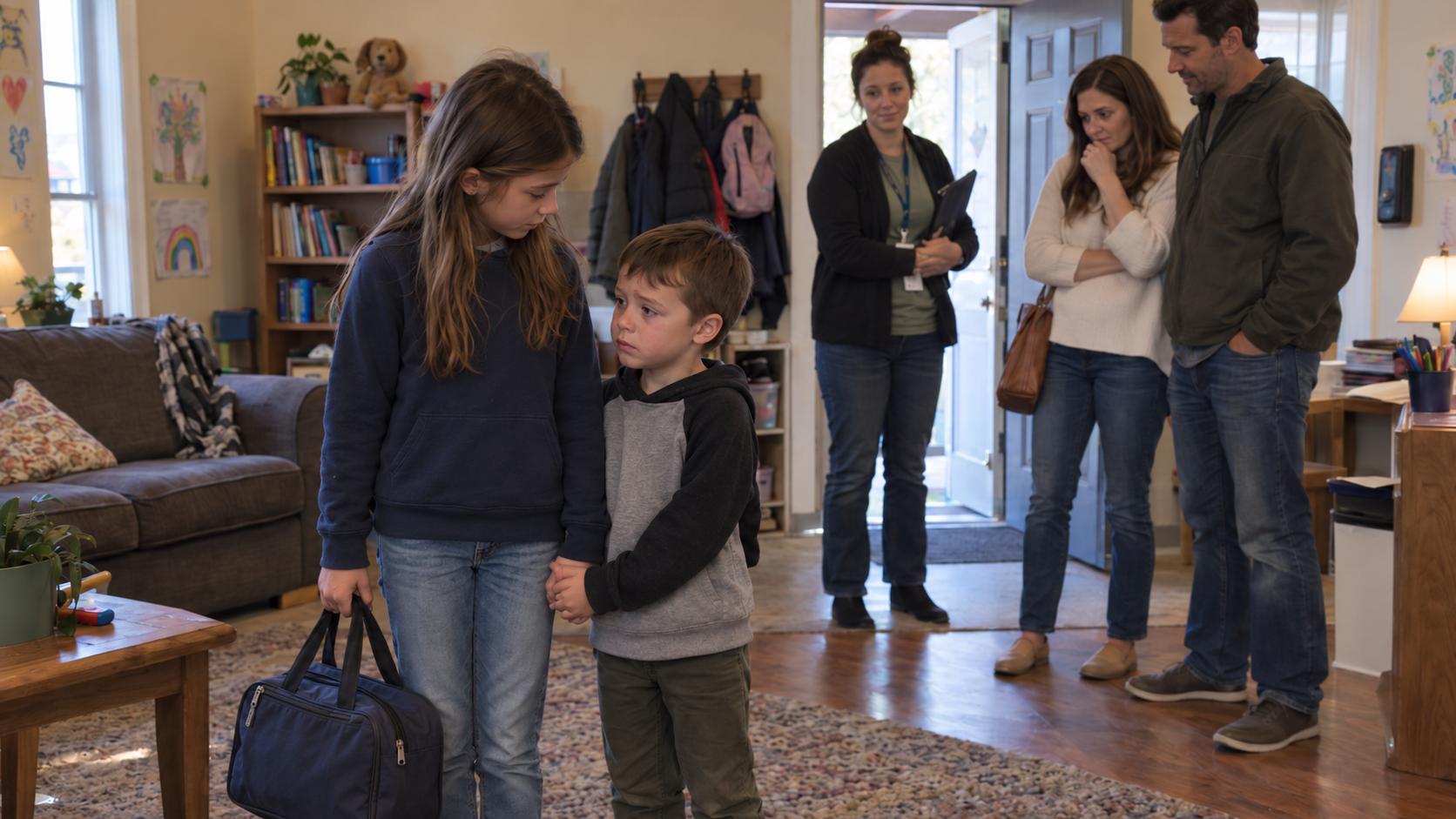
Eli knew his sister was leaving.
What he did not understand was why he had to stay.
A small suitcase stood beside the door.
It belonged to Maya.
There was no bag for him.
The five-year-old wrapped both arms around his sister and held on.
“Why can’t I go with you?”
Maya looked down at him.
She was only nine. Still, she had spent years trying to stay strong whenever Eli became scared.
This time, she had no answer.
“I don’t know.”
Eli stared at her.
“But I’m your brother.”
Maya pulled him closer.
A family waited near the entrance.
They had come to take Maya to a new home.
Her bag was ready.
The caseworker was waiting.
Then Eli asked the question Maya feared most.
“Who’s gonna stay with me?”
Maya’s eyes filled with tears.
“I’ll find you.”
“Promise?”
“Promise.”
Eventually, Maya had to stand.
Eli held her hand as she moved toward the door.
Their fingers slowly slipped apart.
Then the woman waiting near the entrance stopped.
She looked at Eli.
Next, she looked at the caseworker.
“That’s her brother?”
“Yes.”
The woman looked at her husband.
Then she asked one unexpected question.
“Then why isn’t he coming with us?”
Nobody had planned for that question.
However, it changed the rest of the afternoon.
Maya Had Always Been the Person Eli Looked For
Eli could not remember every place he had lived.
Maya could.
She remembered unfamiliar bedrooms.
She remembered packed bags.
She remembered adults discussing plans that neither child fully understood.
Most of all, she remembered Eli being afraid.
So Maya became the person who made new places feel less frightening.
If Eli woke after a nightmare, he called for her.
If he entered an unfamiliar room, he looked for her first.
If an adult asked him something he did not understand, he often looked at Maya before answering.
Sometimes she knew what to say.
Sometimes she did not.
Still, Eli trusted her.
At night, he occasionally asked the same question.
“You’re still here?”
Maya always gave the same answer.
“I’m here.”
For Eli, those two words meant safety.
Then one day, Maya learned she might be leaving.
A New Family Had Made Room for Maya
The couple had met Maya several times.
They seemed patient.
They listened when she spoke.
They also remembered small things about her.
For example, they knew what books she liked.
They knew which foods she avoided.
They even remembered a story she had told during an earlier visit.
Gradually, Maya became comfortable around them.
Meanwhile, the adults began discussing a longer-term placement.
The couple had prepared a bedroom.
They had discussed school.
They had also planned the transition carefully.
In many ways, it looked like good news.
However, one name kept disappearing from those conversations.
Eli.
His case followed a different plan.
The couple had originally prepared for one child.
That child was Maya.
Eli was not part of the move.
Maya understood enough to know what that meant.
Eli did not.
So she kept delaying the conversation.
Eventually, her suitcase made it impossible to hide.
Eli Saw One Suitcase and Understood Enough
Maya packed quietly that afternoon.
She did not have much.
A few shirts.
Pajamas.
A book.
Some personal belongings.
Then Eli noticed the suitcase.
He walked toward it.
“Where’s mine?”
Maya stopped.
“You don’t need one today.”
Eli frowned.
“Why?”
Maya looked away.
That silence gave him the answer before anyone else did.
“You’re leaving?”
Maya crouched in front of him.
“I have to go with them.”
“I’ll come.”
“Eli…”
“I can come.”
His voice became smaller.
Then he wrapped his arms around her.
“Why can’t I go with you?”
Maya wanted to explain.
However, words like placement, approval and case plan meant nothing to him.
So she told him the only truth she had.
“I don’t know.”
Eli looked almost offended by the answer.
“But I’m your brother.”
To him, that should have settled everything.
“But I’m Your Brother”
Eli’s world was simple in one important way.
Maya was his sister.
Therefore, wherever she went, he believed he should go too.
He did not understand why adults treated their plans separately.
He did not understand paperwork.
He did not understand why one home had room for Maya but not automatically for him.
Instead, he understood relationships.
Maya helped him sleep.
She knew when he was scared.
She knew which cereal he hated.
She knew how he liked his sandwich cut.
More importantly, she had stayed when everything else changed.
“But I’m your brother,” he repeated.
“I know,” Maya said.
“Then I go with you.”
Maya’s face changed.
She had been trying not to cry.
Now it became harder.
A caregiver waited nearby.
She did not rush them.
Neither did the caseworker.
The family at the door also stayed quiet.
For a few more seconds, Maya simply held him.
Then Eli changed the question.
“Who’s Gonna Stay With Me?”
At first, Eli wanted to know why he could not go.
Then another fear appeared.
What would happen after Maya left?
“Who’s gonna stay with me?”
Maya froze.
There would still be adults around him.
There would still be other children.
However, that was not what Eli meant.
He wanted to know who would be his person.
Who would sit nearby when he could not sleep?
Who would notice when he became quiet?
Who would tell him where Maya had gone?
Maya wiped a tear from his cheek.
“I’ll find you.”
Eli searched her face.
“Promise?”
“Promise.”
He nodded.
Still, he did not let go.
Eventually, Maya stood.
She picked up her suitcase with one hand.
Eli held the other.
Together, they moved toward the entrance.
Their Hands Were the Last Thing to Let Go
Maya took one step.
Eli followed.
Then another.
He still held her hand.
Nobody pulled him away.
Nobody forced their hands apart.
Instead, the distance slowly did it.
Their fingers stretched.
Then they slipped apart.
Eli stayed where he was.
Maya turned back.
Both children had tears on their faces now.
For a moment, the room became quiet.
The couple waiting near the door watched everything.
They had expected an emotional goodbye.
However, they had not expected this.
The woman looked at Eli.
Then she looked at Maya.
Finally, she turned toward the caseworker.
“That’s her brother?”
“Yes.”
The answer seemed to surprise her.
Not because she had never heard about Eli.
She had.
But hearing his name in a meeting was different from watching him lose his sister.
Then she asked another question.
“Why isn’t he coming too?”
The Original Plan Had Room for Only One Child
The answer was complicated.
The couple had prepared for Maya.
They had completed plans around her needs.
They had arranged one bedroom.
They had discussed one school transition.
Meanwhile, Eli had his own case.
His next placement still required separate decisions.
The caseworker explained this carefully.
The woman listened.
Then her husband looked toward Eli again.
“He’s staying here?”
“For now,” the caseworker said.
The couple became quiet.
Until that moment, the move had looked simple on paper.
Maya would leave.
Eli would stay.
Afterward, adults would continue working on his plan.
However, the goodbye had exposed something paperwork could not show very well.
The children depended on each other.
So the husband asked another question.
“Has anyone tried to keep them together?”
The caseworker explained that people had considered it.
Still, the available options had not worked.
The woman looked toward Maya.
Maya still stood beside her suitcase.
Eli had moved closer to her again.
Then the woman said:
“Can we talk before we leave?”
Maya heard her.
Eli did too.
Neither child knew what it meant.
Then the Family Asked to Stop the Move
The couple did not ask to take Eli home immediately.
They understood that no one could make that decision at the doorway.
Instead, they asked something else.
Could Maya stay for now?
Could the adults first explore whether the couple might qualify to care for both children?
The question changed the discussion.
Immediately, the caseworker began making calls.
She contacted her supervisor.
Meanwhile, the couple asked what additional steps they would need to complete.
They discussed space.
They discussed school.
They discussed support.
Most importantly, they discussed whether a joint placement would work well for both children.
Nobody promised Maya or Eli anything.
The adults did not want to give them hope before they had a real answer.
So the children waited.
Maya’s suitcase stayed beside the door.
An hour passed.
Then another.
Eventually, the caseworker returned to the living room.
Maya and Eli sat together on the sofa.
“You’re not leaving tonight,” she told Maya.
Eli immediately looked at his sister.
Maya looked at the caseworker.
“Why?”
“The adults need more time.”
That was not a final answer.
However, for the first time that day, Maya did not have to walk through the door without her brother.
Two Weeks Later, There Were Two Bags by the Door
The next two weeks moved slowly.
The couple returned several times.
This time, they visited both children.
They saw Maya and Eli when nobody was saying goodbye.
That gave them a very different picture.
Eli was louder.
Maya teased him.
They argued over a game.
Later, they sat beside each other again.
In other words, they were not perfect.
They were simply siblings.
Meanwhile, the adults continued reviewing the new plan.
The couple prepared another sleeping space.
They discussed both children’s needs.
They also completed the additional steps required for the arrangement.
Eventually, the team approved a new plan.
Maya would not move alone.
Two weeks after that painful goodbye, two bags sat near the same entrance.
One belonged to Maya.
The smaller one belonged to Eli.
Eli checked his bag twice.
Then he looked at Maya.
“This one’s mine?”
Maya smiled.
“Yes.”
“And I’m going too?”
“Yes.”
Eli paused.
“Together?”
Maya held out her hand.
“Together.”
He took it.
This time, both children walked toward the door.
Nobody had to promise to find the other later.
Neither child had to stay behind.
And when their hands reached the doorway, they were still holding on.
Eli did not understand why his sister had a suitcase and he did not.
