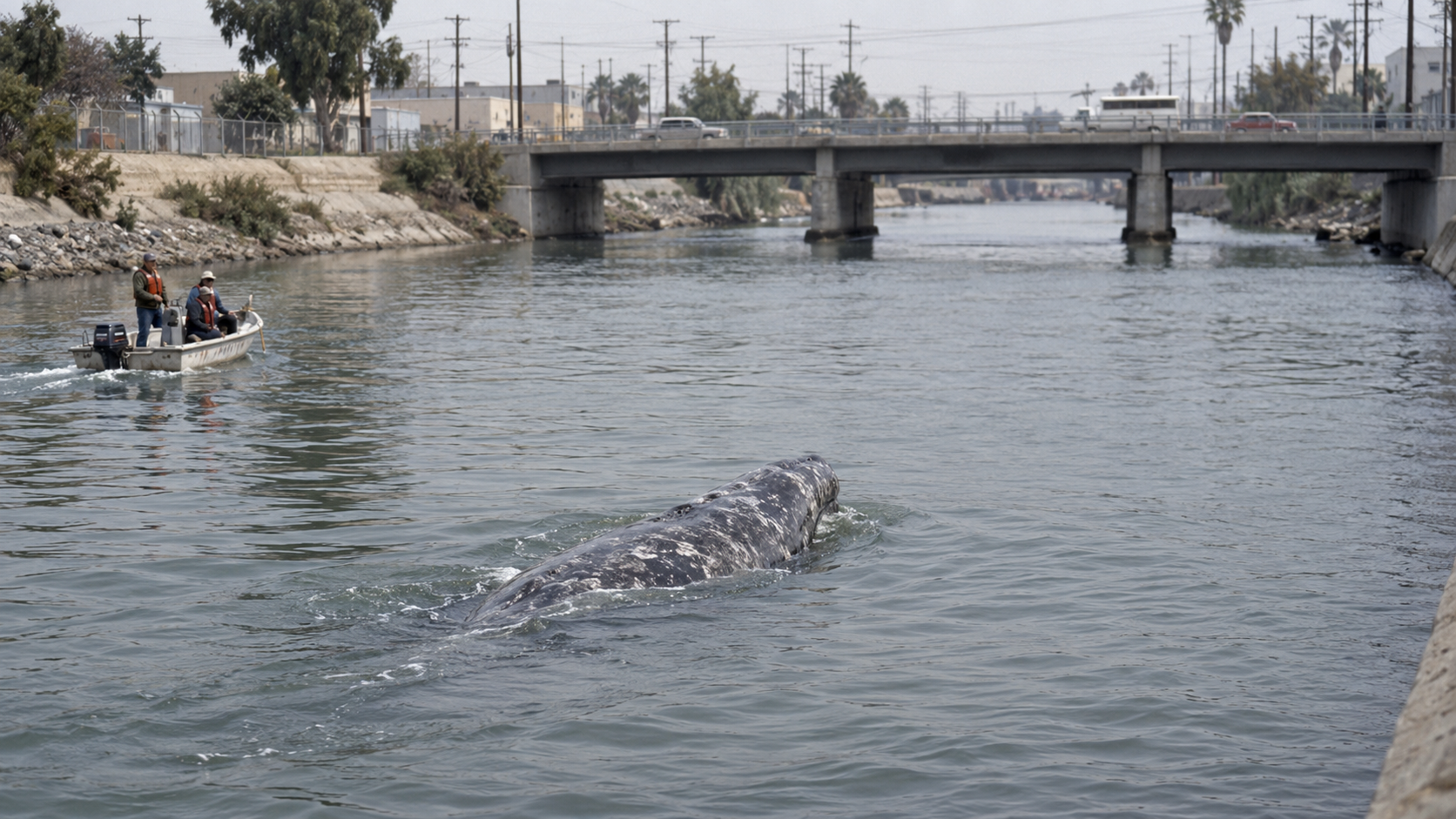
The whale should not have been there.
It was early morning in Southern California.
Cars were moving across nearby roads.
People were heading to work.
Then someone looked into the San Gabriel River.
A gray whale surfaced.
Not an adult.
A calf.
It was roughly 20 feet long.
And somehow, the young whale had traveled nearly three miles into a narrow river channel.
There was no mother beside it.
Within hours, boats arrived.
Whale experts came.
Crowds gathered along the banks.
Again and again, people tried to guide the calf toward the ocean.
Again and again, it refused to go.
More than 12 hours passed.
Then rescuers began running out of options.
By early evening, the official efforts were being abandoned.
The young whale was still inside the river.
But shortly before sunset, it suddenly turned.
And without anyone leading it, the calf headed toward a bridge.
What happened after it disappeared beneath that bridge changed the entire story.
The Whale Was Found Shortly After Sunrise
The unusual sighting began on April 30, 1987.
At around 6 a.m., a young California gray whale was discovered inside the San Gabriel River channel between Long Beach and Seal Beach.
It was immediately clear that this was not a normal migration route.
The calf had traveled far inland.
According to a contemporary Los Angeles Times report, experts had never seen a gray whale that far up that river before.
It was nearly three miles from the ocean.
The whale was approximately 20 feet long.
Experts believed it was probably no more than about two months old.
That made the situation much more serious.
This was not a nearly independent juvenile exploring the coast.
It was still a very young calf.
Today, NOAA says newborn gray whales are generally about 14 to 16 feet long and weigh around 2,000 pounds.
Mothers and newborn calves usually migrate north along the U.S. West Coast between March and May after spending winter in the protected waters of Mexico.
The timing fit.
The location did not.
Somewhere during that northbound journey, this calf had ended up inside a river.
And its mother was nowhere in sight.
The Calf Was Still Dependent on Its Mother
A young gray whale cannot simply be treated like a small adult.
At this age, the calf still depended heavily on its mother.
The whale expert called to the scene, Dennis L. Kelly, warned that the calf still needed its mother’s milk frequently.
According to the Los Angeles Times, he estimated that it needed to nurse roughly every hour or so.
That created a hidden clock behind the rescue.
The calf was swimming.
It was breathing.
It could still move through the channel.
But every hour away from its mother mattered.
Gray whale mothers normally remain extremely close to their young during this stage of life.
NOAA monitoring still observes mother-calf pairs traveling together along the California coast during their spring migration north.
The river calf had lost that protection.
Rescuers therefore faced two problems.
They had to get it back toward the ocean.
Then they had to hope its mother was still somewhere nearby.
First, however, they had to convince the whale to move in the right direction.
That proved far harder than expected.
Everyone Seemed to Have an Idea for Getting It Out
The strange rescue quickly became a public spectacle.
People lined the banks.
Television crews arrived.
Helicopters hovered overhead.
For many children watching from shore, it became their first close look at a whale.
Meanwhile, teams tried different ways to encourage the calf downstream.
Boats entered the channel.
People used surfboards.
Jet skis were also involved.
At one point, a man even entered the water and came dangerously close to touching the whale.
The goal sounded simple.
Position people and boats behind the animal.
Give it space ahead.
Encourage it toward the river mouth.
Then let instinct take over.
But whales do not follow human plans.
The calf moved.
Then hesitated.
It changed direction.
It remained inside the narrow waterway.
Every failed attempt used more daylight.
And every hour meant more time away from its mother.
By afternoon, concern was replacing curiosity.
The River Was Nothing Like the Open Ocean
The San Gabriel River channel was an unnatural place for an animal of that size.
The Los Angeles Times described the channel as only around 50 feet wide in the area.
A 20-foot calf occupied a large portion of that space every time it surfaced.
There were concrete banks.
Bridges.
Human activity.
Boat engines.
Crowds.
Helicopters.
All of that may have made an already confused animal even harder to direct.
Gray whales usually migrate through coastal waters.
NOAA notes that eastern North Pacific gray whales make a massive annual journey between Mexico and Arctic feeding grounds.
They often remain relatively close to the West Coast during migration.
But “close to shore” is very different from “inside an urban river.”
The calf now had to navigate an environment it had never been meant to enter.
Rescuers could show it a direction.
They could not explain where that direction led.
And as the hours passed, another uncomfortable possibility began to emerge.
Perhaps all the attempts to help were making the calf more confused.
By Evening, The Rescue Was Running Out of Time
Morning became afternoon.
The calf remained.
More than 12 hours had passed since its discovery.
By early evening, state and federal marine agencies began abandoning their active rescue strategies.
Experts were increasingly worried about the young whale’s condition.
It appeared thin.
It seemed disoriented.
And there was still no visible mother beside it.
For the people who had spent the day trying to help, stopping must have felt wrong.
The whale was still there.
The ocean was still somewhere beyond the channel.
Yet continuing to crowd or push the calf might not improve anything.
So rescuers began backing away.
The boats stopped trying to force the route.
The calf was given more space.
Dennis Kelly later suggested that this may have mattered.
Perhaps, he said, part of the solution was simply leaving the whale alone.
At the time, nobody knew whether that would work.
There was still a very young whale inside a river.
The daylight was fading.
Then its behavior changed.
Suddenly, The Calf Turned Toward the Bridge
At around 5:45 p.m., something happened that rescuers had been trying to create all day.
The calf changed direction.
This time, no formation of boats was pushing behind it.
No one was steering from a surfboard.
The whale simply began moving.
It headed downstream.
Then it approached a bridge.
Observers watched as the animal moved toward the dark space underneath.
The calf did not turn back.
It went under.
From the bank, the next part of its route was harder to see.
But beyond that bridge were the jetties at Alamitos Bay.
And beyond those jetties was open ocean.
The same animal that had resisted hours of human guidance was now moving on its own.
Why?
Kelly had an idea.
And if he was right, the young whale may not have been navigating alone after all.
Experts Wondered Whether It Had Heard Something
Gray whales communicate underwater.
A mother and calf can exchange low-frequency sounds while traveling together.
In 1987, Kelly told reporters there was a real possibility that the calf had finally heard its mother.
He described mothers and calves as making sounds back and forth to one another.
Perhaps contact had been reestablished.
Perhaps the calf had finally received a signal strong enough to follow.
Nobody watching from the riverbank could hear that underwater exchange.
But the timing was striking.
For more than 12 hours, humans had tried to direct the animal.
Then the rescue efforts eased.
The calf turned.
It went beneath the bridge.
And it continued toward the mouth of the river.
If a mother really was calling from offshore, the calf still had to cover the final distance.
There was no guarantee she had stayed.
There was no guarantee the young whale would find her.
The bridge was only the beginning.
The Whale Kept Going
After passing beneath the bridge, the calf continued downstream.
It moved past the Alamitos Bay jetties.
Then it reached open water.
The river ordeal was finally over.
But rescuers still faced the most important question.
Had the calf simply returned to the ocean alone?
Or had the animal it needed most stayed nearby?
The answer came soon afterward.
State Department of Fish and Game spokesman Curt Taucher told the Los Angeles Times that the calf had reached the sea—
and its mother was waiting.
The two whales were seen leaving together.
After an entire day of boats, surfboards, jet skis and failed rescue attempts, the most important part happened without anyone touching the calf.
It found its way out.
Then it found its mother.
The same young whale that had seemed lost nearly three miles inland was once again swimming beside the animal it depended on.
And that raised another question.
How had the mother known to remain there?
Its Mother May Have Never Stopped Waiting
There is no way to reconstruct every underwater moment from that day.
Nobody could see where the mother had been during all 12 hours.
Nobody recorded a conversation between the two whales.
So we should not turn a possibility into certainty.
But Kelly’s explanation was compelling.
Mother and calf gray whales communicate.
It was possible that the pair had finally heard one another.
That could help explain the calf’s sudden decision to move toward the ocean after resisting human efforts for most of the day.
Modern science continues to show how tightly connected gray whale mothers and calves are during their spring migration.
Mothers with new calves are among the last gray whales to begin the northward journey from Mexico.
They travel along the West Coast while calves continue gaining strength and nursing.
That makes the final scene in 1987 particularly remarkable.
The calf had disappeared into a place where its mother could not safely follow.
It spent more than half a day surrounded by concrete walls, boats and crowds.
People tried repeatedly to guide it out.
Eventually, they stopped.
Then the whale turned toward the ocean on its own.
Perhaps it finally recognized the route.
Perhaps being left alone reduced the confusion.
Or perhaps somewhere beyond the river mouth, a familiar sound had reached it.
We may never know exactly what triggered that turn.
What we do know is what happened at the other end.
The calf emerged into open water.
And its mother was still there.
