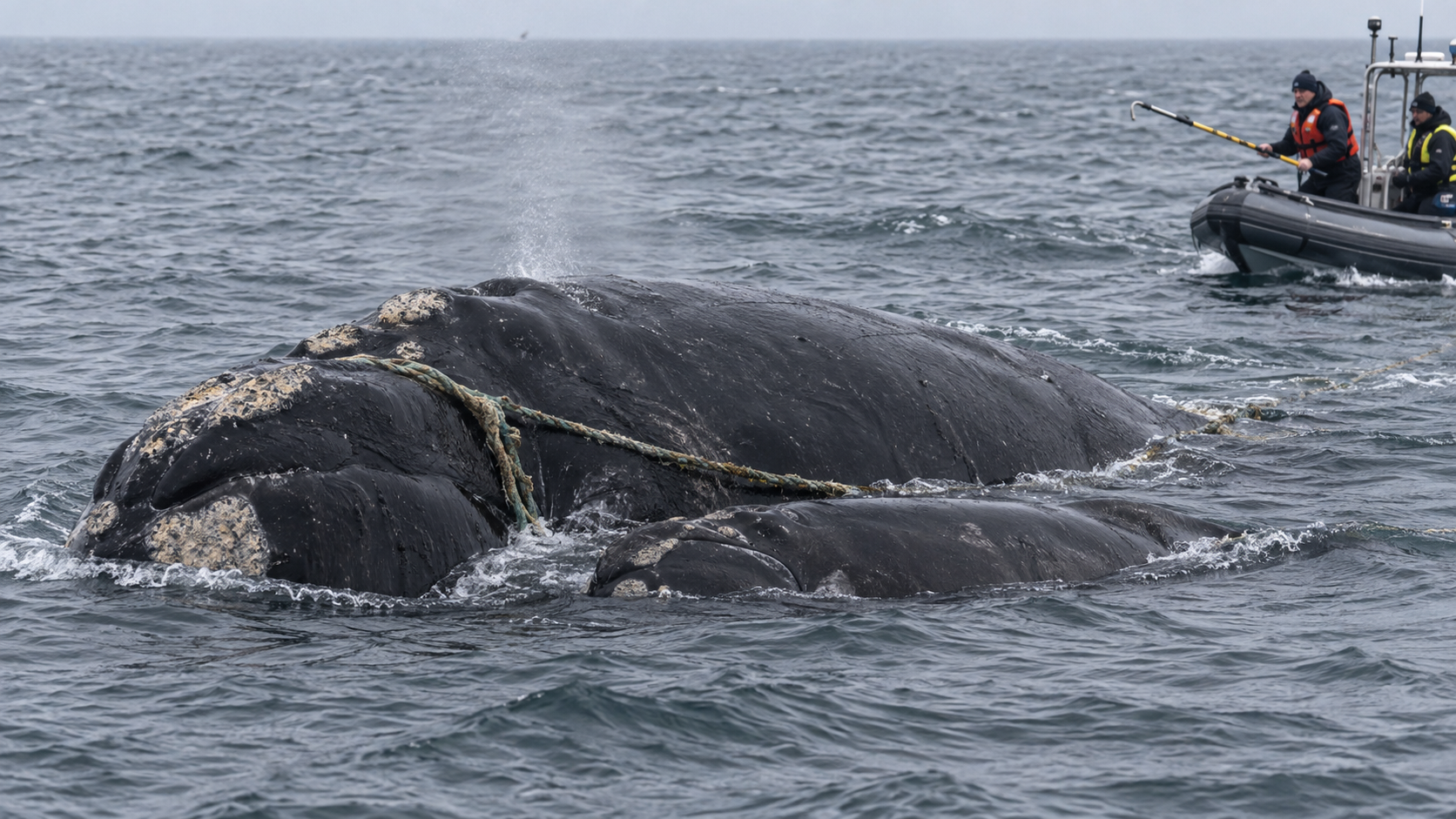
When the rescue boat finally reached the whale, the problem was easy to see.
A thick fishing rope still ran from her mouth.
It had been there for months.
Teams had already tried more than once to remove it.
Now they had another chance.
But something had changed.
Swimming beside the enormous black whale was a newborn calf.
The baby stayed so close that the two animals sometimes appeared almost joined at the surface.
Rescuers watched the rope.
Then they watched the calf.
They had equipment capable of cutting line.
They had trained people on the boat.
And they were finally close to the whale again.
Yet they did not make the cut.
The reason was swimming beside her.
Her name was Snow Cone.
And by the time her newborn appeared off Georgia in December 2021, she had already carried fishing gear across more than 1,300 miles of ocean.
What happened next turned one difficult whale rescue into something even more dangerous.
The Rope Had Been There Since March
Snow Cone was already well known to whale researchers.
She is North Atlantic right whale Catalog #3560.
Researchers named her for the distinctive callosity pattern near her blowholes.
On March 10, 2021, observers found her off Plymouth Harbor, Massachusetts.
Something was terribly wrong.
Heavy fishing rope was caught around her.
Long sections trailed behind as she swam.
A trained team from the Center for Coastal Studies responded.
They made several attempts to help her.
Eventually, responders managed to remove almost 300 feet of heavy rope.
But they could not remove everything.
Snow Cone dove.
Then she disappeared before the team could finish the job.
For a whale, leaving with part of the line still attached does not mean the danger has passed.
A rope can tighten.
It can cut into tissue.
It can create drag every time the whale swims.
It can also interfere with feeding.
And Snow Cone still had an enormous migration ahead of her.
Another Rescue Team Found Her Months Later
Nearly two months passed.
Then, on May 10, a Canadian surveillance aircraft spotted Snow Cone near New Brunswick.
Her condition appeared worse than it had in March.
Another rescue effort began.
The Campobello Whale Rescue Team managed to remove more line.
The following day, crews relocated her again.
They removed additional rope.
Still, they could not get everything.
Some line remained attached to Snow Cone.
That meant the whale had now survived multiple rescue attempts without becoming completely free.
Yet she continued moving.
She traveled north toward summer feeding areas.
Then she eventually turned south again.
Despite carrying the entanglement, Snow Cone completed a journey of more than 1,300 miles.
She moved from northern waters toward the southeastern United States, where North Atlantic right whales gather during calving season.
Researchers already had reason to worry about her.
Then an aerial survey on December 2 revealed something nobody could ignore.
Snow Cone was no longer swimming alone.
There Was a Newborn Beside Her
The sighting happened near Cumberland Island, Georgia.
An aerial survey team saw Snow Cone at the surface.
Beside her was a tiny right whale calf.
Snow Cone had given birth.
NOAA scientists described the discovery as both surprising and concerning.
She had likely become entangled while pregnant.
That meant she had carried the fishing gear through much of the pregnancy.
Then she had migrated south.
And somehow, she had produced a living calf while the rope was still caught around her mouth.
Snow Cone was about 17 years old at the time.
For a critically endangered species, every calf mattered.
However, this birth created an entirely new problem.
A mother nursing a calf already faces an enormous energy demand.
Snow Cone was doing it while dragging fishing gear and dealing with injuries around her mouth.
Even worse, the rope itself had not disappeared.
Now there were two whales swimming around it.
Rescuers Reached Her the Same Day
The sighting triggered another response.
Trained disentanglement specialists from the Georgia Department of Natural Resources reached Snow Cone by boat.
This was exactly what everyone had been waiting for.
The whale had been found.
The weather allowed a response.
The rescuers knew where the remaining gear was.
And after months of failed or incomplete attempts, there seemed to be another opportunity to shorten or remove the rope.
But the team quickly encountered a problem that had not existed during the earlier rescues.
The newborn would not leave Snow Cone’s side.
That is normal.
Right whale calves spend large amounts of time extremely close to their mothers.
They surface together.
They swim alongside one another.
And young calves depend completely on that proximity.
For the rescue team, however, that natural behavior made an already dangerous operation far more complicated.
They could not treat Snow Cone as a single moving target anymore.
Every approach now involved the baby too.
The Calf Began Moving Around the Rope
As teams continued observing the pair, the danger became even clearer.
The calf did not understand that the line was hazardous.
Researchers saw the young whale moving in, through and around the rope attached to its mother.
That created a frightening possibility.
A rescue intended to save Snow Cone could accidentally put her newborn at risk.
The calf itself could become caught.
Or it could suddenly move into the area where responders were trying to work.
NOAA officials were specifically concerned that the baby might become entangled too.
This was not something rescuers could solve by simply moving faster.
Disentangling a whale already requires teams to work beside an enormous wild animal in open water.
Now they had a newborn constantly changing position beside the rope.
The closer the rescuers came, the less margin for error they had.
And that led to the decision viewers of the rescue footage might find hardest to understand.
They Were Close Enough to Help—But It Was Too Dangerous
The rescuers did not simply fail to see the rope.
They did not lack cutting equipment.
They did not decide Snow Cone no longer needed help.
The newborn changed the calculation.
On December 2, responders determined that attempting to remove or further shorten the remaining line was too dangerous while the calf was present.
NOAA explained that right whale calves swim so close to their mothers that a safe approach can become extremely difficult or even impossible.
So the rescue team did something that can look strange from a distance.
They stopped.
The rope remained.
Snow Cone continued swimming.
And the calf remained beside her.
Sometimes the safest rescue attempt is the one responders decide not to make.
One wrong movement could have turned one entangled whale into two.
The team instead continued monitoring the pair and waited for another opportunity.
But Snow Cone still had to survive every day with the line attached.
For a While, Mother and Calf Kept Going
During December and January, survey teams repeatedly found Snow Cone and her calf.
They were documented on multiple days along the southeastern U.S. coast.
At times, the pair traveled surprisingly close to beaches.
On January 19, researchers obtained better photographs of the remaining entanglement.
The images showed rope coming from both sides of Snow Cone’s mouth.
Part of the line had become wrapped around and embedded in her upper jaw.
Yet at that stage, Snow Cone and her baby did not appear dramatically different in body condition from other mothers and calves in the calving grounds.
That offered some hope.
The pair continued north.
By spring, they had traveled back toward New England.
But researchers knew appearances could be misleading.
An entanglement creates a constant energy drain.
A whale must swim against the drag.
If rope damages the mouth or baleen, feeding can also become harder.
Snow Cone now had another huge demand on her body.
She was nursing.
Eventually, researchers began seeing signs that the burden was catching up with her.
Then Researchers Saw Snow Cone Without Her Calf
By spring 2022, Snow Cone’s condition had noticeably declined.
The New England Aquarium reported that her body condition had worsened.
Then another detail became impossible to ignore.
The calf was no longer beside her.
NOAA says the calf had not been seen since April 2022.
By May, observers were seeing Snow Cone alone.
Researchers could not determine exactly what had happened.
The calf may have separated earlier than expected.
It may not have survived.
There was no confirmed answer.
In July, scientists found Snow Cone again in the Gulf of St. Lawrence.
She was still carrying the old entanglement.
She was thinner.
New lesions had appeared around her mouth.
And once again, her calf was nowhere to be seen.
The difficult rescue story had now become something else.
Scientists were no longer only asking whether they could free Snow Cone.
They were asking how much longer her body could withstand what the rope was doing to her.
Then, in September, things became even worse.
A Second Entanglement Appeared
On September 21, 2022, a New England Aquarium aerial survey team spotted Snow Cone south of Nantucket.
The scientists immediately recognized her.
But the photographs showed a devastating change.
Snow Cone still carried the old gear around her head.
Now new fishing gear was wrapped around her tailstock as well.
It was at least the fifth documented entanglement in her life.
Her condition had deteriorated dramatically.
Researchers described her as extremely thin.
Whale lice covered parts of her body.
She moved slowly.
One observer said she could no longer dive normally and instead appeared to sink.
The New England Aquarium concluded that her prognosis had become extraordinarily poor.
A response team was notified.
However, Snow Cone was far offshore and the sighting came too late in the day for an immediate rescue attempt.
Teams remained ready in case she could be located again.
She was not.
NOAA’s latest account says Snow Cone was last sighted in poor condition in October 2022.
Neither she nor the calf has been seen since.
There is no confirmed final moment.
No photograph showing exactly what happened.
Only the last observations of a whale whose body had carried fishing rope through pregnancy, migration, birth and months of nursing.
Snow Cone’s Story Was Bigger Than One Rescue
Snow Cone’s case became famous because the images were extraordinary.
A huge right whale.
Fishing rope coming from her mouth.
And beside her, a newborn calf.
But the story is not really about one moment when rescuers could not cut a line.
It is about how difficult it can be to save a whale after entanglement has already happened.
Teams removed hundreds of feet of rope from Snow Cone.
They found her again.
They tried again.
They monitored her across thousands of miles.
Still, some of the gear remained embedded around her jaw.
Later, she became entangled again.
That is why NOAA says prevention is more effective than relying on rescue after the fact.
The stakes are unusually high for North Atlantic right whales.
NOAA’s December 2025 update estimates roughly 380 animals remain, including only about 70 reproductively active females.
Snow Cone was one of those females capable of adding calves to a population struggling to recover.
Her previous calf had already died after being struck by vessels in 2020.
That young whale was only about six months old.
Then Snow Cone became pregnant again.
She became entangled.
She carried the rope south.
She gave birth.
And when rescuers finally reached her newborn pair, they discovered the cruelest complication of all.
The calf they wanted to protect was also the reason they could not safely move in and cut the remaining line.
For a few months, mother and baby kept swimming together.
Then the calf disappeared from confirmed sightings.
Months later, Snow Cone disappeared too.
The rescue boat had once been only a short distance away.
But with a newborn moving beside the rope, a few metres of ocean could become an impossible distance.
