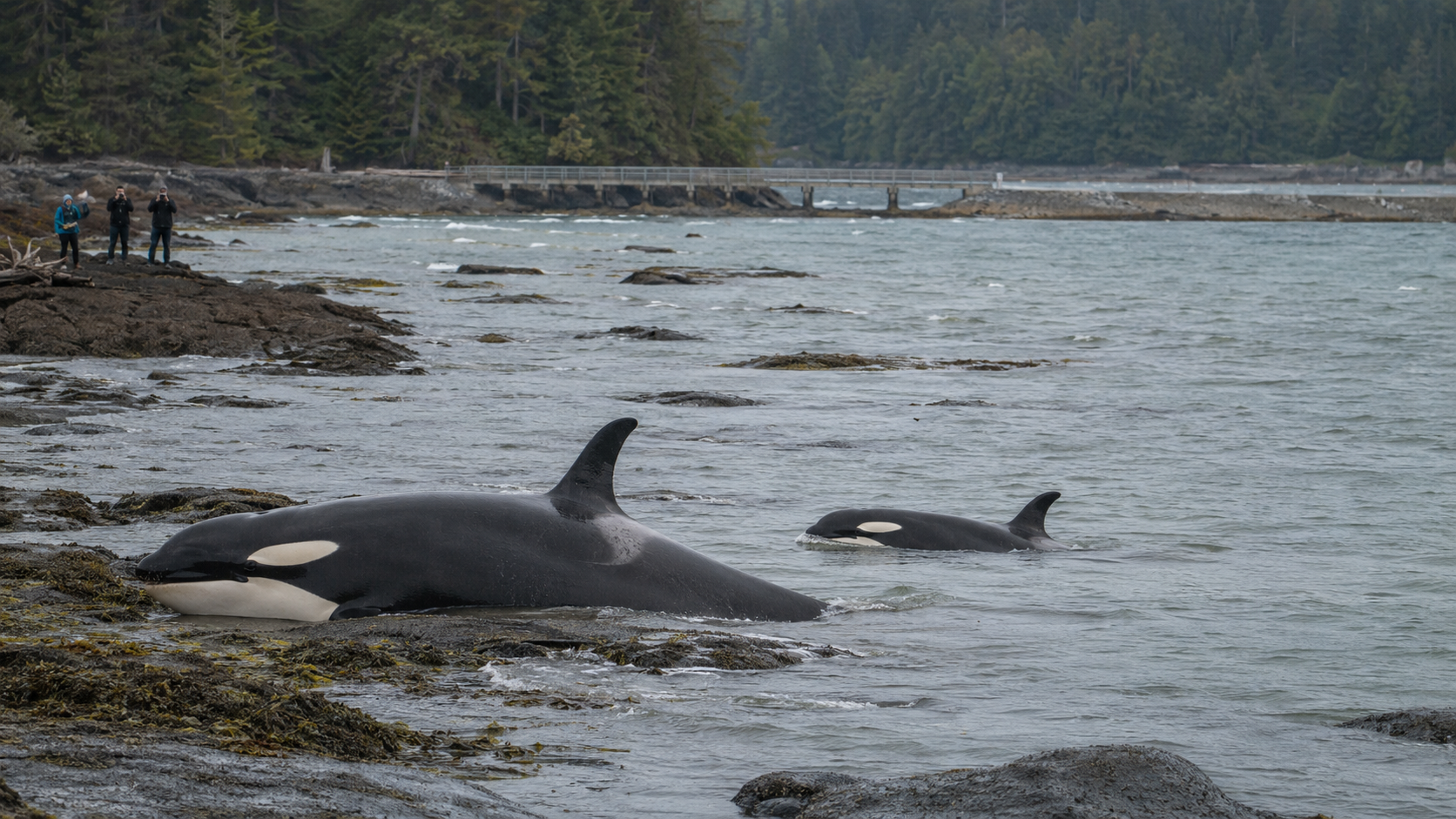
The young orca knew where the water led.
Beyond the shallow passage was a larger inlet.
Beyond that was the Pacific.
But every time she approached the narrow exit, something stopped her.
The current changed.
The water became shallow.
The passage tightened beneath a bridge.
And the little whale turned back into the lagoon.
Her mother was no longer there to lead her.
People watched from shore.
Rescue teams came.
Boats entered the water.
Plans were made to move her.
Days became weeks.
Yet the young killer whale remained inside.
She had survived the event that killed her mother.
Now she faced a second problem.
She had to leave the lagoon alone.
And eventually, the tide would give her another chance.
The Day Her Mother Could Not Leave
On March 23, 2024, two Bigg’s killer whales entered a tidal lagoon near Zeballos on the remote west coast of Vancouver Island.
One was an adult female.
The other was her young daughter, around two years old.
The pair had apparently entered the shallow area while pursuing prey.
Then the tide began to fall.
The adult female became stranded on a rocky sandbar.
People nearby tried desperately to help.
But the mother died after becoming trapped as the water receded.
Her calf remained alive in the lagoon.
The loss was even greater than it first appeared.
A necropsy later found that the mother had been nursing her daughter and was also pregnant with another female calf.
One whale had died.
Another unborn calf had been lost with her.
And a young daughter was now swimming only metres away without the mother she still depended on.
The people watching had saved neither adult nor unborn calf.
But they still had one whale left to help.
A Two-Year-Old Orca Was Left Inside
The calf would soon become known as kʷiisaḥiʔis, a name given by the Ehattesaht First Nation and commonly translated as Brave Little Hunter.
Researchers also knew her as T109A3A.
She was a Bigg’s killer whale.
Bigg’s orcas specialize largely in hunting marine mammals and usually travel in close family groups.
At roughly two years old, kʷiisaḥiʔis was young enough that losing her mother created an immediate concern.
She could swim.
She could breathe.
She could move around the lagoon.
But surviving alone in the open ocean would demand much more.
The first challenge, however, was simpler.
She had to get out.
The lagoon was connected to larger waters.
There was no concrete wall.
No locked gate.
No net trapping her.
Instead, geography and tide created the barrier.
The only practical route out passed through a narrow, shallow, fast-moving channel beneath a causeway bridge.
She had entered the area with her mother.
Now she would have to cross it without her.
And she repeatedly refused to make that final move.
The Ocean Was Close—But the Passage Was Not Simple
From a human perspective, the solution looked almost obvious.
The waterway connected outward.
Why not simply guide the calf through it?
But tidal passages can change dramatically within hours.
At lower water, rocks and shallow areas became more exposed.
The current could move quickly through the narrow opening.
The young orca approached the area more than once.
Yet getting close was not the same as leaving.
That difference became the central frustration of the rescue.
Open water existed on the other side.
Her relatives could potentially be somewhere beyond it.
But the calf had no mother beside her to cross first.
Every failed approach returned her to the same body of water.
So rescuers began trying to persuade her.
At first, the hope was still that she might solve the problem herself.
Then the days kept passing.
And the operation became increasingly complicated.
Rescuers Tried Sound, Boats and Food
The response grew around the calf.
Ehattesaht and Nuchatlaht First Nations worked alongside Fisheries and Oceans Canada, marine mammal specialists, researchers and other rescue personnel.
Different methods were considered and attempted.
Teams used boats to influence the direction of her movement.
They experimented with sound.
Reports described efforts involving banging pipes, drums and recorded killer-whale calls.
At one point, even violin music was tried as another way of encouraging the calf toward the exit.
Nothing produced the result everyone wanted.
The calf remained inside.
Her feeding also became a concern.
Observers had seen her take small prey such as birds and bait fish, but there were worries about whether she was getting enough nutrition.
Eventually, seal meat was offered from a distance to help keep her condition stable while the operation continued.
That created another delicate balance.
Humans needed to keep her alive.
But they did not want a wild killer whale learning that boats and people were a permanent source of food.
The rescue was becoming a race with two competing goals:
help her now,
without making her dependent on humans later.
And eventually, officials decided that waiting for her to leave voluntarily might no longer be enough.
Then a Major Rescue Attempt Failed
A much more ambitious plan was prepared.
The idea was to guide kʷiisaḥiʔis into a shallow part of the lagoon, secure her with a net and place her into a specially designed sling.
From there, rescuers hoped to transport her to deeper water.
This was no small operation.
Roughly 50 people were involved in the effort.
Boats, divers, nets and specialized equipment were brought together.
The operation began early in the morning.
But the young orca would not cooperate with the plan.
She avoided the positioning rescuers needed.
The capture attempt was eventually stopped.
The calf remained in the lagoon.
It was another difficult setback.
The people surrounding her had equipment.
They had expertise.
They had a plan.
Yet the smallest participant in the operation still controlled the final outcome.
If kʷiisaḥiʔis would not enter the required position, they could not simply force the rescue without creating additional risks.
So the waiting resumed.
By then, she had already been separated from the rest of her family for weeks.
The Longer She Stayed, the Harder the Next Step Became
Escaping the lagoon was never the entire problem.
It was only the first half.
Even if the young whale reached deeper water, she would still be alone.
Her maternal relatives were somewhere along a vast coastline.
Researchers and whale watchers tried to track Bigg’s killer whale groups in the region.
Photographs and identifying marks could help determine which animals belonged to her extended family.
But killer whales can travel enormous distances.
The group the calf needed might be nearby one day and far away the next.
And because kʷiisaḥiʔis had been receiving food from people during part of the rescue, teams also wanted her future interactions with humans kept to a minimum.
Once free, she needed to behave like a wild killer whale again.
That meant finding prey.
Avoiding boats.
And ideally finding other orcas.
The longer the situation continued, the more enormous that second challenge looked.
Yet before anyone could worry about reunion, one obstacle remained.
The bridge.
The sandbar.
The shallow water.
And the calf that kept stopping before she crossed.
Then came the night of April 25.
That Night, Her Behavior Started to Change
The evening began with another feeding.
Kʷiisaḥiʔis had accepted seal meat.
Then observers noticed something different.
She became active near the end of the lagoon close to the causeway bridge.
She breached.
She played.
She repeatedly moved around the area near the passage.
The tide was rising.
Most members of the rescue effort eventually left to get some sleep.
A small group remained.
They continued watching.
The night was clear.
The water was calm.
And sometime after midnight, Brave Little Hunter began testing the route again.
This time, the conditions were different.
Higher water covered more of the shallow ground that had made the passage difficult.
The current was changing with the tide.
The young whale moved toward the bridge.
Then she kept going.
At approximately 2:30 a.m. on April 26, the people still watching realized something extraordinary was happening.
The calf had reached the place where she had turned back so many times.
Only now, she did not turn.
Brave Little Hunter Finally Made Her Move
Kʷiisaḥiʔis crossed the shallow area where her mother had died.
Then she swam beneath the bridge.
She continued down Little Espinosa Inlet.
The rescue team later located her farther along the waterway and followed from a distance as she moved toward Esperanza Inlet.
After more than a month inside the lagoon, Brave Little Hunter had finally gotten out on her own.
There was no sling carrying her over the barrier.
No helicopter.
No net.
No human physically moved her to the other side.
The tide rose.
The calf approached.
And this time she crossed.
For the communities and rescuers who had watched her since her mother died, it was the outcome they had spent weeks trying to create.
But even the celebration came with caution.
She was out of the lagoon.
She was not yet safely reunited with another killer whale.
Officials asked people and boaters to stay away.
Human contact now needed to decrease, not increase.
The hope was that she would continue toward open water.
And that somewhere beyond the inlets, another killer whale would hear her calls.
That created one final question.
Perhaps the hardest one of all.
Did Brave Little Hunter ever find her family?
Freedom Did Not Give the Story a Clean Ending
For a while, there were encouraging signs.
Researchers believed kʷiisaḥiʔis was moving through coastal waters after leaving the lagoon.
A young lone killer whale seen near Friendly Cove in Nootka Sound in July 2024 was considered highly likely to be her, based on the location and behavior.
A later update from the Orca Behavior Institute says her last confirmed sighting was in July 2024, with possible sightings extending into November.
But there was a problem.
Her family was being seen.
She was not with them.
By 2025, researchers had documented members of her immediate family without Brave Little Hunter.
The Orca Behavior Institute cautioned that this did not automatically mean she had died.
Bigg’s killer whales use remote stretches of coastline, and individual animals can sometimes go months—or longer—without being photographed.
But uncertainty remained.
In July 2025, the institute explicitly said there were no new updates on her.
Then in September 2025, most of the extended T109 family was documented together in the Strait of Juan de Fuca.
Brave Little Hunter was not among them.
That is where the story becomes very different from a simple rescue video.
We know she escaped.
We know she survived the lagoon.
We know she was documented afterward.
What the available public record does not give us is a confirmed reunion with her family.
As of the latest authoritative public updates I could verify, her ultimate status remains uncertain.
And that uncertainty makes the image of her passing beneath the bridge even more powerful.
Why Brave Little Hunter’s Story Is So Difficult to Forget
The rescue lasted for weeks.
It involved First Nations communities.
Federal officials.
Marine mammal experts.
Researchers.
Boats.
Nets.
Specialized equipment.
Food.
Sound.
Long nights of watching.
Yet the moment everyone remembers required almost none of those things.
A tide rose.
A young whale moved toward a narrow passage.
And instead of turning back, she kept swimming.
That was enough to change the entire story.
For more than a month, people had been asking whether humans could get Brave Little Hunter out.
In the end, she answered the question herself.
But freedom created another question that remains much harder to resolve.
A two-year-old killer whale could leave a lagoon alone.
Could she also build a life without the mother who had led her there?
Researchers may still one day photograph her again.
She may be traveling with another Bigg’s group somewhere along the remote Pacific coast.
Or the story may remain unresolved.
For now, what can be said with certainty is simpler.
Her mother died in the lagoon.
Brave Little Hunter survived.
She waited through weeks of rescue attempts.
Then, at 2:30 in the morning, with the tide finally high enough, she swam beneath the bridge and disappeared toward deeper water.
No one had to carry her out.
She found the way herself.
